



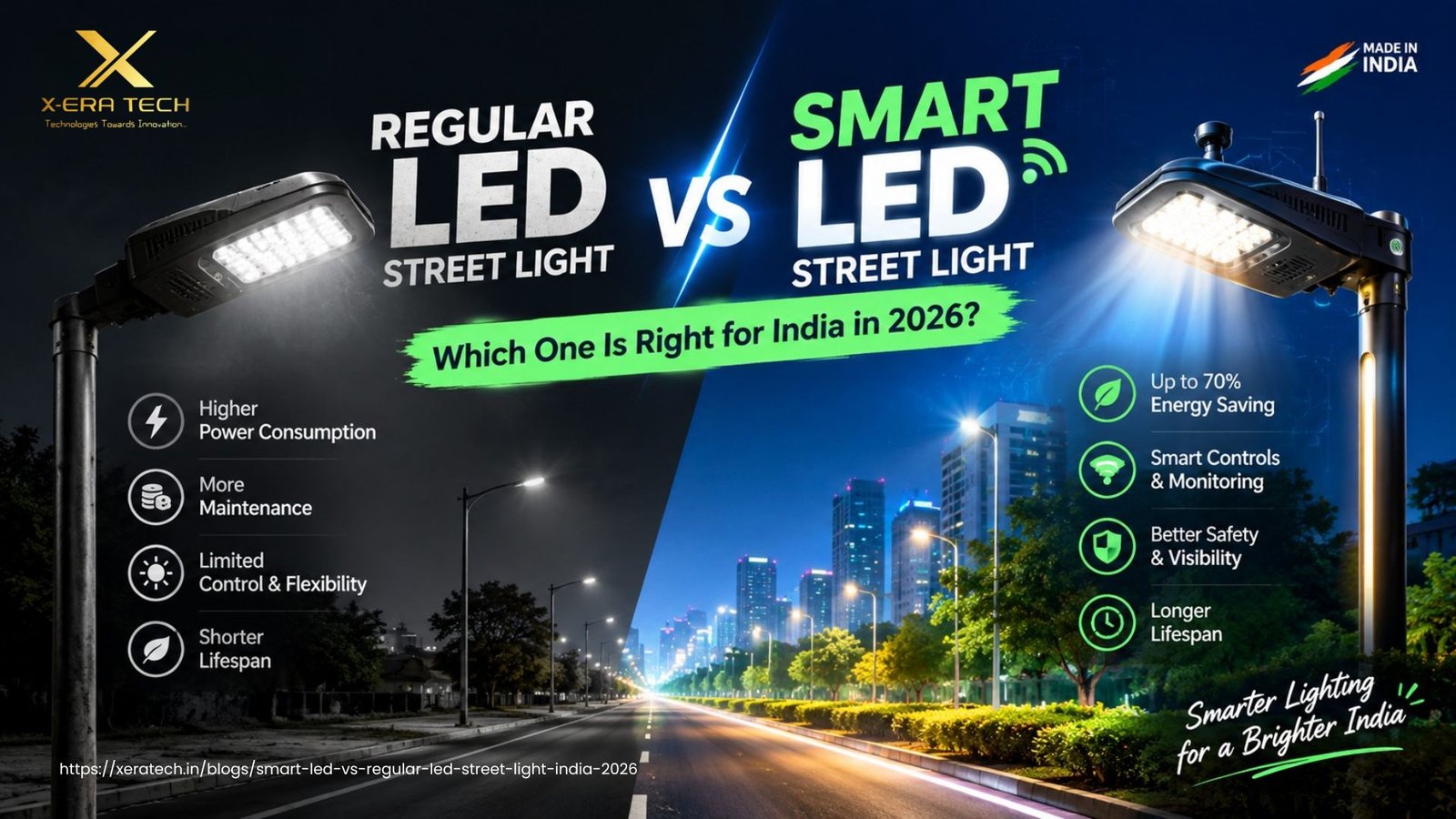
Here is the most important thing to understand about smart LED street lights: the LED itself is exactly the same. The light that comes out, the lumens, the IP rating, the BIS certification, all identical to a regular LED street light. What makes a street light smart is a small controller box, roughly the size of a mobile charger, attached to the LED driver. That controller costs Rs 1,500 to Rs 4,000 per pole. It adds remote monitoring, dimming, and fault alerts. Delhi wants 20,000 of them by Diwali. Andhra Pradesh is installing 10.5 lakh. But for your housing society internal road or your 20-pole village lane, you probably do not need one at all. This guide explains exactly when smart LED is worth the extra cost and when it is not.
What Actually Changes: The LED Is the Same
When you see the term smart LED street light in a tender document or a sales brochure, it can sound like an entirely different product. It is not. The LED array, the aluminium housing, the toughened glass cover, the IP65 weather sealing, the BIS IS 10322 certification, all of these are exactly the same as a regular LED street light of the same wattage. The photons coming out of the fixture look identical.
What changes is the driver and the addition of a controller. In a regular LED street light, the driver converts AC grid power to the correct DC voltage and current for the LED, and that is all it does. In a smart LED street light, the driver is replaced with a PWM-dimming compatible driver, and a small smart controller is wired into the circuit between the driver and the power supply. The controller has a wireless communication module (NB-IoT, LoRa, Zigbee, or GPRS), a microprocessor, and an energy meter. It communicates with a central software dashboard over a wireless or wired network.
What the Smart Controller Does
The smart controller attached to each pole does four things that a regular LED cannot do on its own.
1. Remote monitoring
The controller reports the status of each light to a central software dashboard (called a CLMS or SCADA system) in real time. The municipal operator sitting in an office can see a map of every pole in the network. Each pole shows green (working), yellow (dimmed), or red (fault). When a light fails, the system alerts the maintenance team automatically , before any resident complains. In Kalyan-Dombivali, the Smart City Corporation confirmed: whenever a problem occurs, they get notified via the software immediately. Without smart control, the municipality typically learns of a failed light only when someone calls to complain, which can be days or weeks after the failure.
2. Dimming on a schedule
The controller can dim the LED to any brightness level between 0% and 100% based on a pre-set time schedule. A typical Mumbai or Nashik municipality runs lights at 100% from 7pm to 11pm (peak pedestrian hours), then dims to 50% from 11pm to 4am (low traffic), then returns to 100% from 4am to sunrise. This dimming schedule alone saves 18 to 25% of electricity compared to running the same LED at full brightness all night, without reducing safety during peak hours.
3. Energy metering
The controller measures the exact electricity consumption of each pole in kWh and reports it to the central dashboard daily. The municipality can see exactly which poles are consuming more than expected (driver degradation, voltage fluctuation, tampering), generate electricity consumption reports for billing, and calculate verified energy savings for SEBI BRSR or BEE PAT documentation.
4. Fault detection and alerts
If a pole fails to respond to three consecutive status polls, the system generates an automatic alert with the pole number, GPS location, and fault code. The maintenance team is dispatched before any dark spot forms. For a large municipal network of 1,000 or more poles, this predictive maintenance capability alone justifies the controller cost by reducing truck rolls and emergency night-time response calls.
What It Costs Extra: Rs 1,500 to Rs 4,000 Per Pole
The additional cost of making an LED street light smart has two components: the controller hardware per pole, and the system-level infrastructure (gateways, CLMS software, command centre setup).
Controller cost per pole
The smart controller cost depends on the wireless communication technology. LoRa controllers cost approximately Rs 1,500 to Rs 2,000 per pole and are suitable for projects up to a few kilometres in radius with their own LoRa gateway infrastructure. NB-IoT controllers cost Rs 2,500 to Rs 4,000 per pole and use the national telecom network (Jio, BSNL) as the communication backbone, requiring no separate radio infrastructure. Zigbee and GPRS fall in between. For most Indian municipal smart LED tenders in 2026, NB-IoT is the dominant technology because it requires no additional radio infrastructure investment.
System-level costs
Beyond the per-pole controller, a smart LED project requires gateways (one gateway covers 50 to 500 poles depending on technology), the CLMS software (typically a cloud-based SaaS licence per year), and a command centre workstation and display for the municipal control room. For a 100-pole project, the system-level costs add approximately Rs 2 to Rs 5 lakh. For a 1,000-pole project, the system-level cost per pole drops to Rs 200 to Rs 500 as the infrastructure is shared across more poles.
| Component | Regular LED Street Light | Smart LED Street Light |
|---|---|---|
| LED luminaire (100W BIS certified) | Rs 1,800 to Rs 3,500 | Rs 1,800 to Rs 3,500 (same) |
| PWM-dimming driver upgrade | Not needed | Rs 150 to Rs 300 premium |
| Smart controller (NB-IoT) | Not applicable | Rs 2,500 to Rs 4,000 |
| Gateway (shared, per pole share) | Not applicable | Rs 200 to Rs 500 |
| CLMS software (annual, per pole) | Not applicable | Rs 100 to Rs 300 |
| Total additional cost vs regular LED | Zero | Rs 3,000 to Rs 5,000 per pole (approximate) |
| Annual dimming electricity saving (18% of LED bill) | Zero | Rs 400 to Rs 700 per pole per year |
| Payback on smart premium from dimming savings alone | Not applicable | 4 to 8 years |
When Smart LED Is Worth It
Smart LED street lights genuinely deliver value in specific situations. These are not marketing claims: these are the situations where the remote monitoring, dimming, and energy metering capabilities pay for themselves.
Large municipal networks (100+ poles)
For a municipality managing 500 or more street lights across multiple wards, manual fault detection is a genuine operational problem. Residents call. Complaints are logged. Maintenance teams are dispatched. A dark pole may stay dark for 3 to 7 days before it is repaired. Smart monitoring eliminates this entirely: faults are detected and dispatched within hours. For a Nashik ward with 300 poles, the maintenance efficiency gain alone , fewer complaint calls, faster repair dispatch, lower truck-roll cost , typically justifies the Rs 9 to Rs 15 lakh smart system premium within 2 to 3 years.
Government tenders requiring SCADA or CLMS
Delhi PWD's Rs 473 crore smart LED tender, Andhra Pradesh's 10.5 lakh smart LED project, EESL's next SLNP phase , all of these government tenders explicitly require smart LED with CLMS. If you are an EPC contractor bidding on any of these tenders, smart LED is not optional. The tender disqualifies regular LED regardless of price. For a complete guide to smart LED tender requirements, see the complete guide to smart LED street lights and SCADA in India 2026.
Smart Cities Mission projects
Smart Cities Mission project specifications require CLMS integration for street lighting in ABD (Area-Based Development) zones. Chandigarh, Bhopal, Raipur, and other Mission cities have active smart street light deployments. Contractors working on these projects must specify smart LED with CLMS as a standard component.
Commercial and industrial campuses requiring energy reporting
Corporate campuses, MIDC industrial estates, and large institutional buildings required to report Scope 2 energy consumption under SEBI BRSR or BEE PAT scheme benefit from the smart controller's energy metering capability. Metered per-pole consumption data is auditable evidence for BRSR disclosures. For more on LED lighting and carbon reporting, see the LED lighting carbon reduction and SEBI BRSR guide for India 2026.
When Regular LED Is the Right Choice
For the majority of LED street light projects in India in 2026, regular LED without a smart controller is the correct and more cost-effective specification. The smart premium is real money , Rs 3,000 to Rs 5,000 per pole , and if the use case does not benefit from remote monitoring or dimming, that money is wasted.
Housing society and colony internal roads
A housing society with 20 to 50 poles on its internal roads does not need a CLMS dashboard. The maintenance is done by the society electrician who can walk the perimeter in 10 minutes and visually check every pole. Remote monitoring adds no practical value. The dimming saving of Rs 400 to Rs 700 per pole per year gives a 5 to 7 year payback on the Rs 3,000 to Rs 5,000 smart premium per pole, which is too long to justify. Use a 24W BIS-certified regular LED with a timer on the distribution board. For a housing society lighting guide, see the LED street lights for housing societies India 2026 guide.
Gram panchayat village roads
A gram panchayat with 30 to 100 poles on village lanes has neither the technical staff to operate a CLMS dashboard nor the connectivity infrastructure (reliable 4G or broadband) for NB-IoT controllers to function reliably in most rural Indian locations. Regular LED on a photoelectric cell switch (auto on at dusk, off at dawn) is the correct, reliable, maintenance-free specification. Adding a smart controller to a village installation with unreliable connectivity creates a maintenance burden that the gram panchayat cannot service.
Small EPC projects below 50 poles
For any LED street light project below 50 poles, the system-level cost of smart infrastructure (gateway, CLMS software, command centre) does not scale down proportionally. A 30-pole project with a Rs 2 to Rs 3 lakh system infrastructure investment means Rs 7,000 to Rs 10,000 per pole in additional system cost, on top of the Rs 3,000 to Rs 5,000 controller cost. Total smart premium: Rs 10,000 to Rs 15,000 per pole for a 30-pole project. Regular LED gives the same lux at road level for Rs 3,500 to Rs 5,000 total per pole. The smart premium is 2 to 4 times the base product cost for no operational benefit at that scale.
Replacement of existing HPSV where grid connection is stable
A straightforward HPSV to LED replacement on existing poles with existing cabling, where the municipality has no CLMS infrastructure and no tender requirement for smart, should use regular BIS-certified LED. The energy saving vs HPSV is 60 to 70% from the LED efficiency alone, without any smart premium. For this application, specifying regular LED and saving the smart controller budget for the next project phase is the correct financial decision.
What Is Happening in India Right Now
Three significant smart LED developments in India in 2026 are reshaping what municipal officers and contractors expect from street lighting procurement.
Delhi PWD: 20,000 smart LEDs by Diwali 2026
Delhi's PWD Minister Parvesh Sahib Singh confirmed on September 24, 2026 that Delhi is targeting 20,000 smart LED street lights replaced by Diwali as part of the larger one lakh smart LED project (Source: UNI India, September 24, 2026). The full one lakh target is due by January 2027. The Rs 473 crore project replaces HPSV and old LEDs with smart LED systems connected to a Centralised Command Centre at PWD headquarters. This is the most visible smart LED project in India in 2026 and is setting the benchmark that other state capitals are watching.
Andhra Pradesh: 10.5 lakh smart LEDs across 123 ULBs
Andhra Pradesh is rolling out an Integrated Smart LED Street Lighting Project across all 123 urban local bodies, replacing 10.5 lakh conventional street lights with smart LEDs linked to a statewide Centralised Control and Monitoring System. Each light gets an Individual Light Monitoring (ILM) controller for remote switching, energy measurement, fault detection, and predictive maintenance. Expected saving: 19.57 million units of electricity annually. CDMA officials described it as a next-generation version of the SLNP (Source: Deccan Chronicle, August 9, 2026).
Kalyan-Dombivali, Maharashtra: 50% saving confirmed
The Smart Kalyan-Dombivali Development Corporation deployed 161 Panasonic smart LED street lights in the city's Smart Cities Mission ABD zone. Electricity consumption dropped by 50% compared to the replaced sodium vapour lamps. The SMKDDC General Manager (IT) confirmed: whenever a problem occurs, the system notifies immediately, the individual controller knows whether each light is on or off, and whether voltage has fluctuated (Source: Panasonic Smart LED case study, Maharashtra). This is the closest real-world Maharashtra example of what a smart LED system delivers in daily operation.
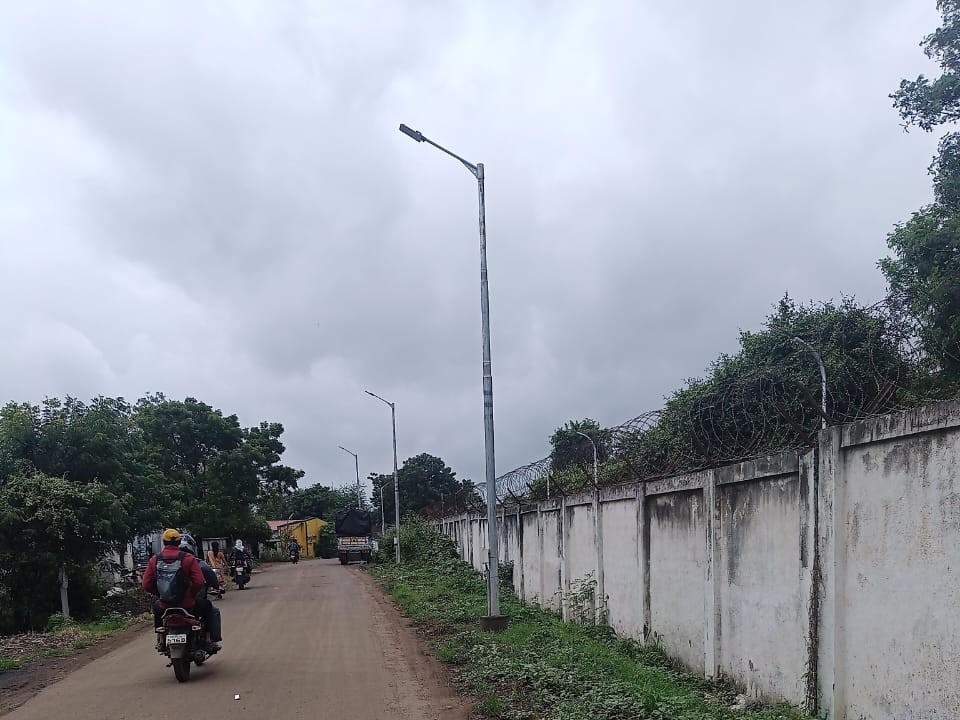
Quick Decision Table: Smart or Regular?
| Your Situation | Smart LED | Regular LED | Why |
|---|---|---|---|
| Municipal ward with 500+ poles | Yes | No | Fault monitoring and dimming savings justify the system cost at scale |
| Government tender requiring SCADA or CLMS | Mandatory | Not eligible | Tender disqualifies non-smart products |
| Smart Cities Mission ABD zone | Required | Not specified | Mission specification requires CLMS integration |
| Housing society, 20 to 50 poles | Not needed | Correct choice | Smart premium pays back in 5+ years; no operational benefit at this scale |
| Gram panchayat village road, 30 to 100 poles | Not suitable | Correct choice | Rural connectivity often insufficient; no staff to operate CLMS |
| MIDC industrial estate common roads | Optional | Standard choice | Smart useful for energy metering and BRSR reporting; not required for functionality |
| School campus, 10 to 30 poles | Not needed | Correct choice | System-level cost is prohibitive for small project; regular LED meets PM SHRI mandate |
| State highway HPSV replacement, 200+ poles | Consider | Default choice | Smart adds value if PWD has CLMS infrastructure; otherwise regular LED with timer is fine |
Xera Tech Products for Both Applications
Xera Tech, LED and solar lighting manufacturer at Satpur MIDC, Nashik, Maharashtra, India, manufactures LED street lights for both regular and smart-compatible applications from the same product range. The LED luminaire is identical. The difference is in the driver option specified at the time of order.
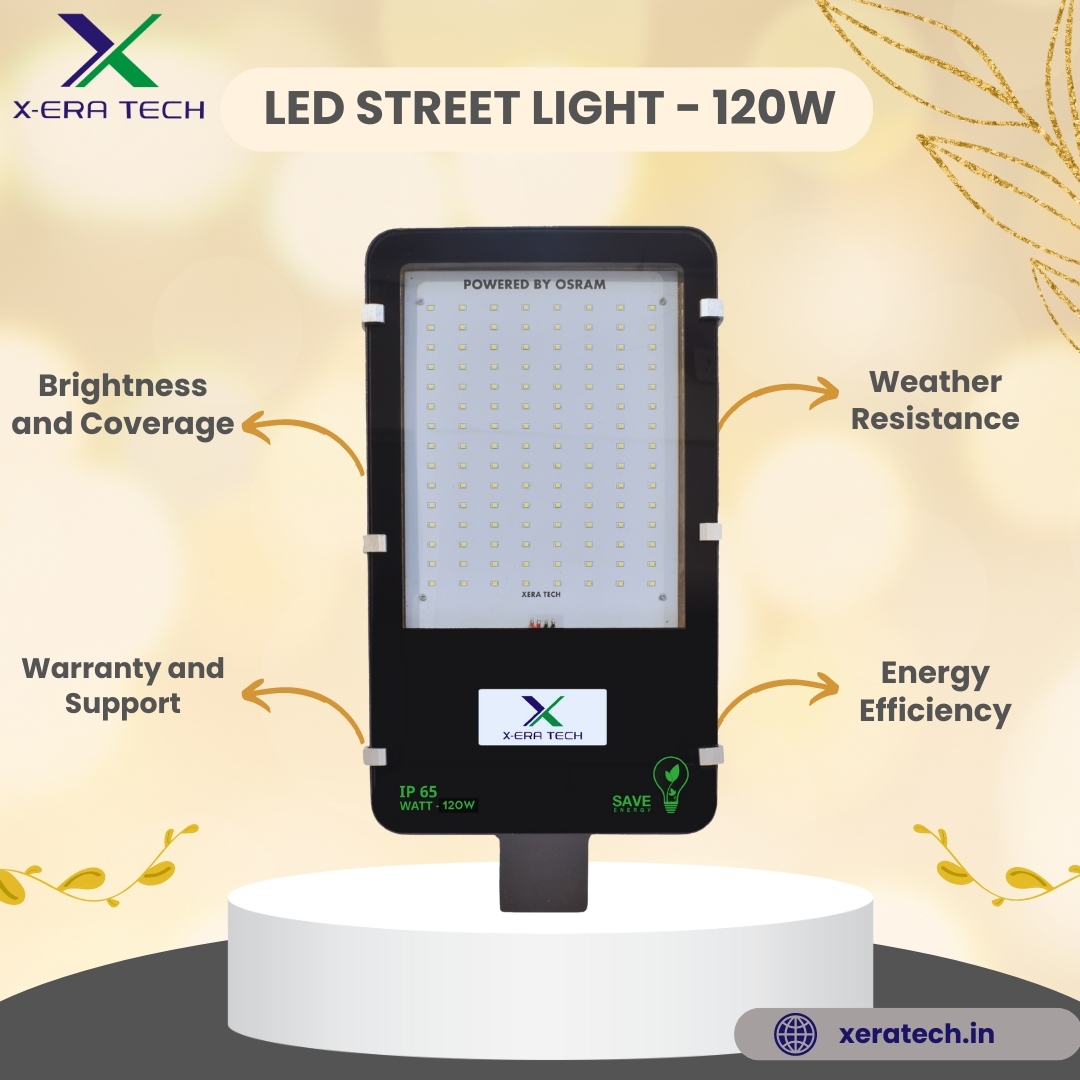
LED Street Light Glass Model (24W to 200W): Regular or Smart-Ready
SL-GM Series · BIS IS 10322 · IP65 · Standard driver (regular) or PWM dimming driver (smart) · 2-year warranty
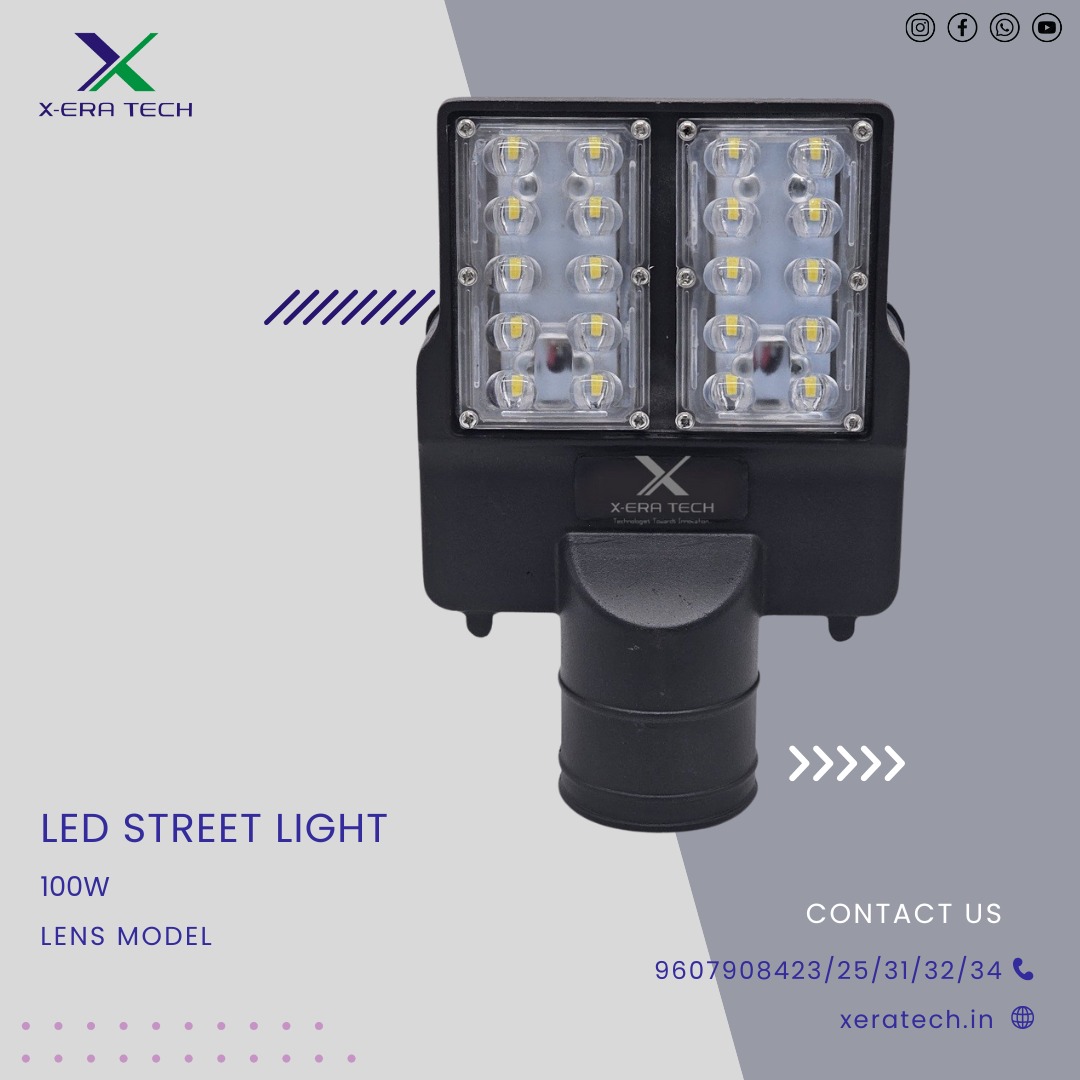
Specify standard driver for regular LED applications (housing society, gram panchayat, school, HPSV replacement). Specify PWM dimming driver option for smart city SCADA-compatible applications (municipal tenders, Smart Cities Mission, EESL SLNP). Same luminaire, same BIS IS 10322 certification, same NABL test reports. PWM driver premium is Rs 150 to Rs 300 per fitting. The smart controller is purchased separately from the system integrator. All Xera Tech Glass Model lights are PWM-compatible by driver option, covering both use cases from a single product family.
| Wattage Range | 24W to 200W |
| Standard Driver | For regular LED applications |
| PWM Dimming Driver | For smart SCADA/CLMS applications (factory option) |
| IP Rating | IP65 |
| Input Voltage | 90V to 300V AC |
| Certifications | BIS IS 10322 · ISO 9001:2015 · PWD · ERDA · NABL · GeM |
| Warranty | 2 years |





Frequently Asked Questions
Not Sure Whether Your Project Needs Smart LED or Regular LED? Ask Xera Tech.
Xera Tech supplies BIS IS 10322 certified LED street lights (24W to 200W) in both standard driver and PWM dimming driver (smart-compatible) configurations. Same luminaire, same certification, same warranty. One call and our technical team tells you exactly which is right for your project size and budget. Pan-India supply from Nashik.
WhatsApp for Free Advice Browse LED Street Lights Submit Project EnquiryLooking for the right LED solution?
Xeratech manufactures BIS-certified LED flood lights, solar street lights, highbay lights and more — shipped across India.
Xera Tech is a BIS-certified LED lighting manufacturer established in 2017, headquartered in Nashik, Maharashtra , India. Product range: LED Street lights, Decorative lights, solar street lights (all-in-one & semi-integrated), LED Flood lights, decorative poles, and high mast lights — all manufactured at Satpur MIDC and compliant with IP65/IP67 and photometric standards. Learn more about Xera Tech →