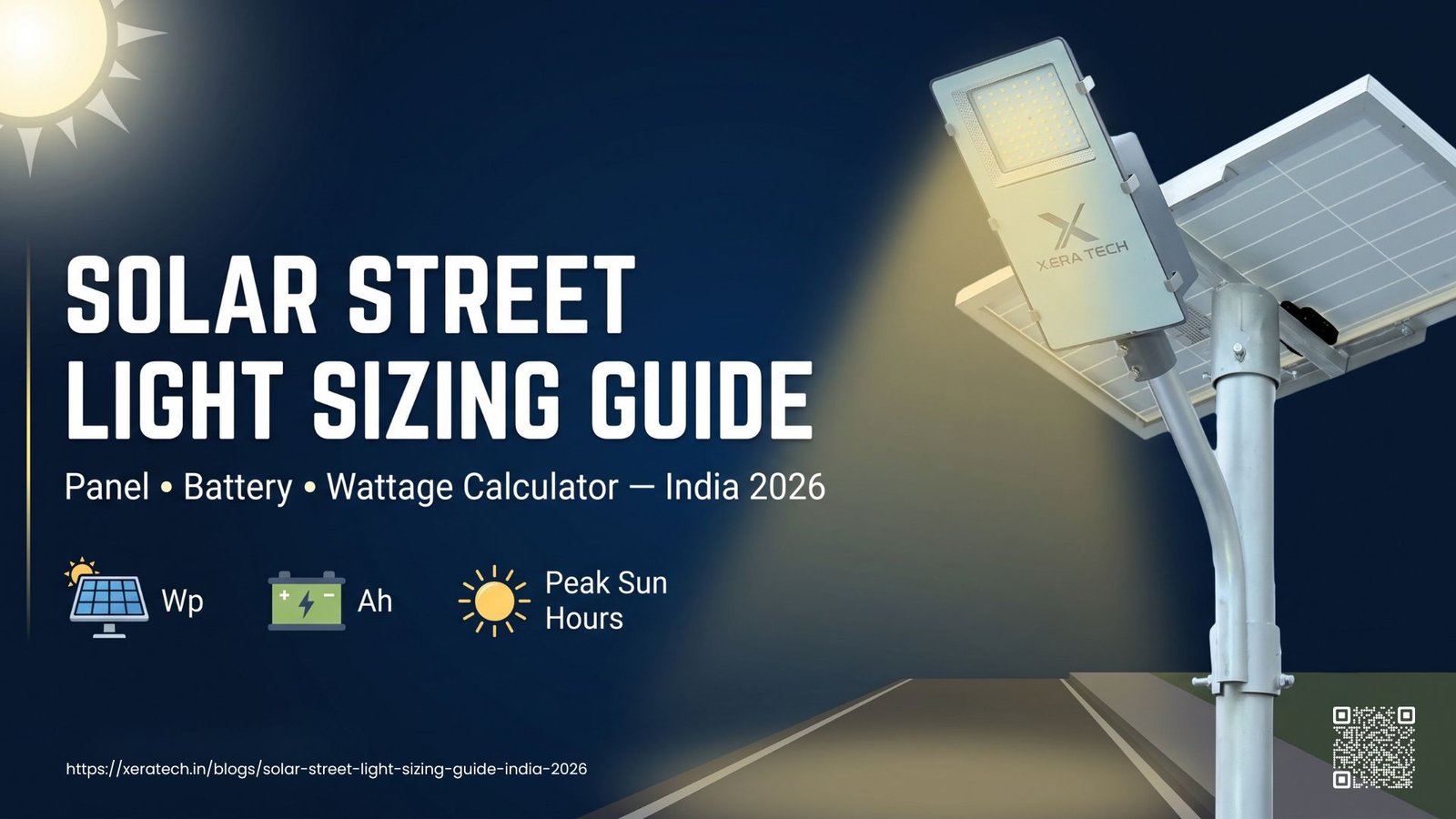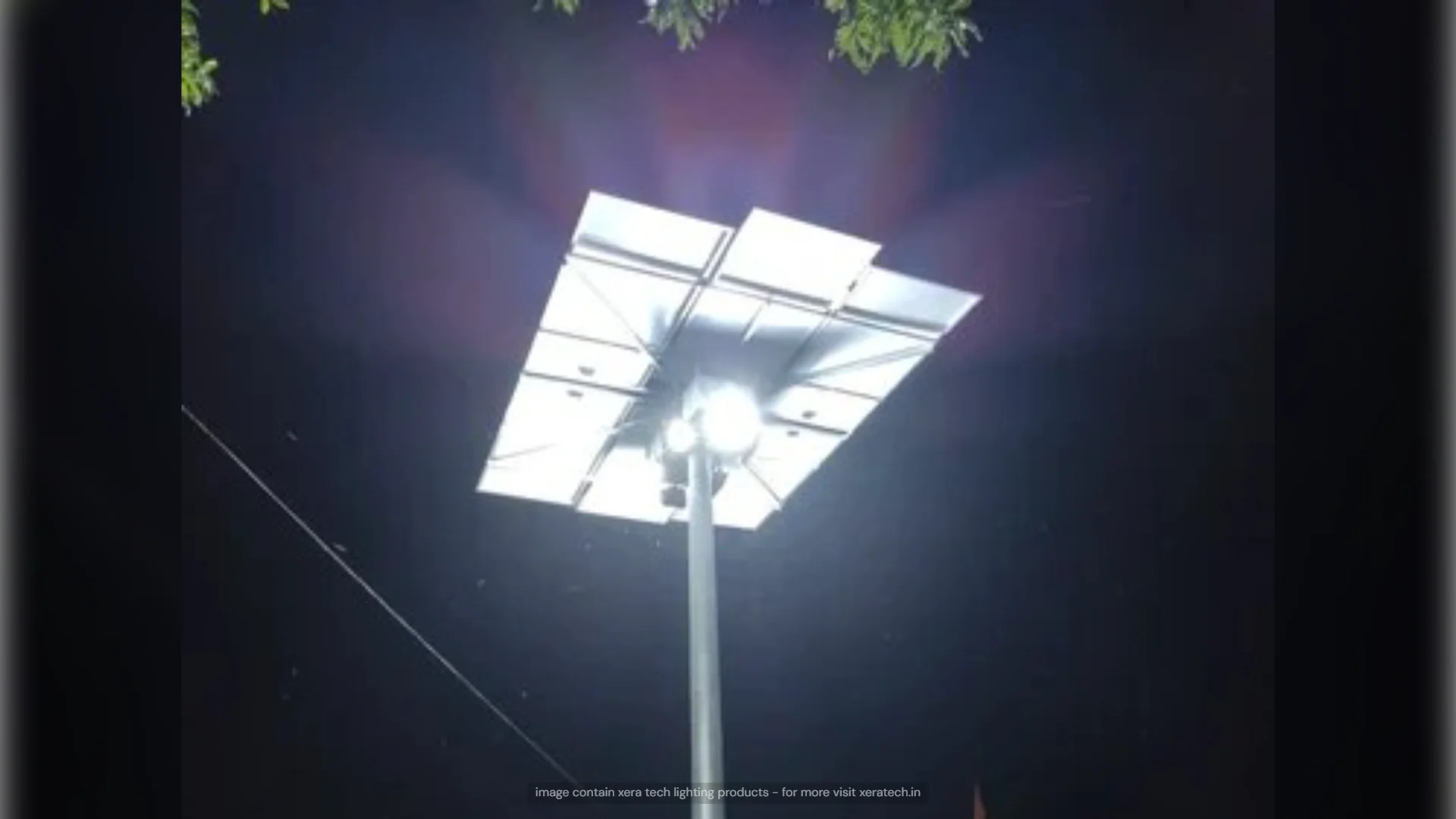




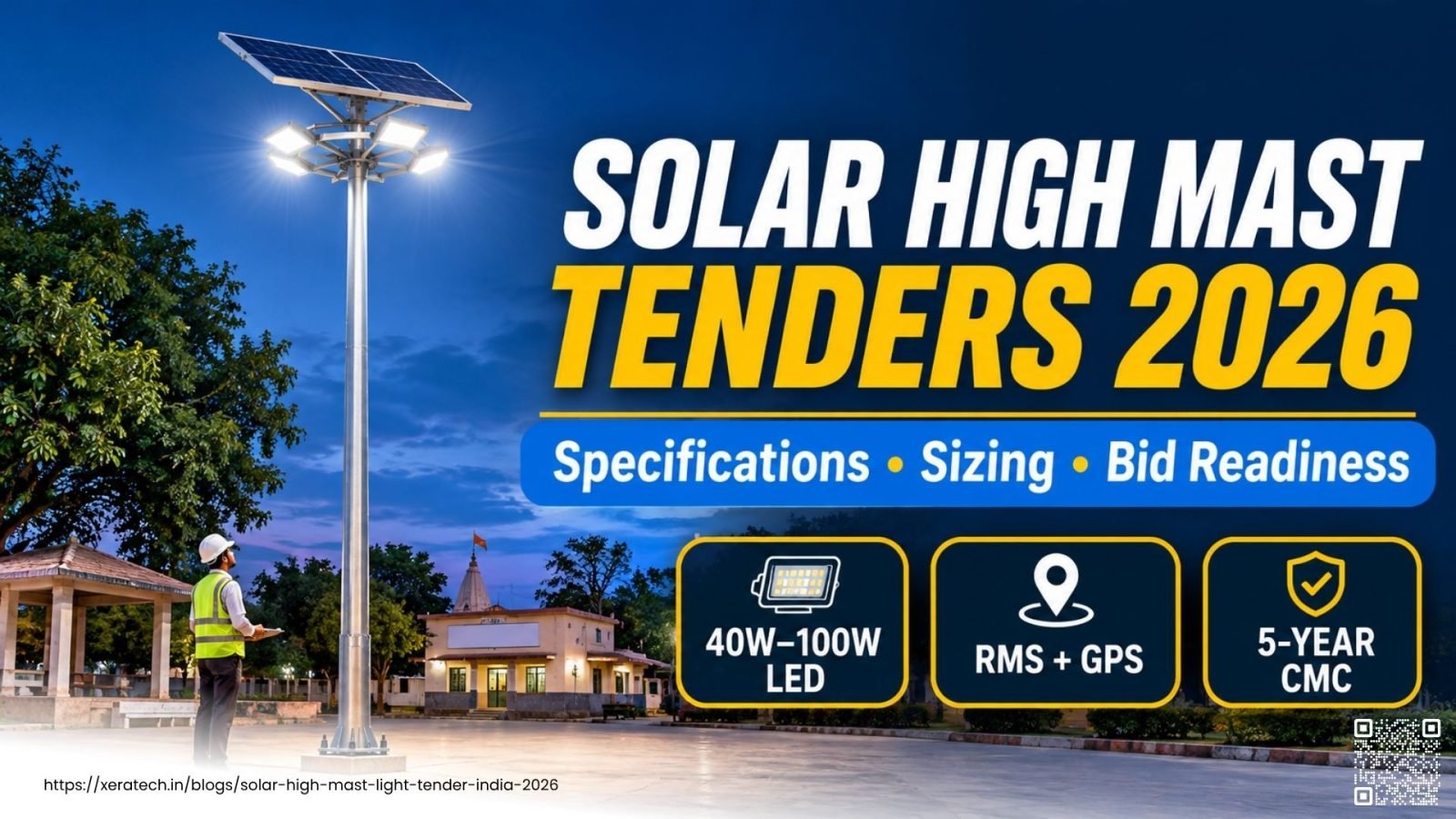
A solar high mast light is a tall pole carrying one or more LED heads, powered by its own solar panel and LiFePO4 battery, with no grid connection at all. In 2026 state agencies such as UPNEDA, JREDA and MEDA, and rural development departments on GeM, are buying them for village squares, chowks and public spaces, usually with remote monitoring, GPS and a 5-year maintenance contract. This guide explains what these tenders actually ask for, how to size the system, and which documents a bid needs.
What Is a Solar High Mast Light and How Is It Different from Grid High Mast?
A grid high mast is a pole of 18 metres or more carrying a ring of high-wattage flood lights, fed by underground cable from the electricity network. It lights highways, ports, railway yards and large open areas. A solar high mast works on the same idea of one tall pole lighting a wide area, but it is a much smaller, self-contained system. The tenders found for 2026 mention poles of 8 m and 9 m, LED heads in the 30W to 100W range, and a solar PV module and battery mounted on the pole itself.
That difference changes the buying logic. A grid high mast is chosen for lux level over a very large area. A solar high mast is chosen where there is no cable, an unreliable supply, or a village chowk, school ground, health centre or market square that needs a bright focal point without a DISCOM connection. For the grid version, see the complete guide to high mast lights for India 2026.
| Factor | Solar high mast | Grid high mast |
|---|---|---|
| Power source | Own PV module and LiFePO4 battery | Grid cable and distribution board |
| Typical pole height in 2026 tenders found | 8 m to 9 m | 18 m and above |
| Typical LED load | 30W to 100W class systems | Several hundred watts per head, multiple heads |
| Best location | Village chowk, school ground, health centre, market square, no-cable areas | Highway junctions, ports, yards, stadium-scale areas |
| Running cost | No electricity bill | Grid tariff applies |
| Monitoring in 2026 tenders | RMS and GPS often mandatory | Not usually specified for the pole itself |
The 2026 Solar High Mast Tender Landscape
Solar high mast tenders in 2026 come through three channels: state energy agencies (UPNEDA, JREDA, MEDA), rural development and panchayat departments buying on GeM, and municipal bodies. The table lists the examples found while researching this guide. Closing dates are shown so you can tell which are historic examples and which to watch for repeat cycles.
| Agency | Scope | Key terms | Status |
|---|---|---|---|
| UPNEDA (Uttar Pradesh) | Solar high mast lighting systems at various sites in UP | Estimated value ₹10.33 crore, EMD ₹21 lakh with exemption allowed, 5 years comprehensive warranty and maintenance | Published 12 June 2026, closed 3 July 2026 |
| JREDA (Jharkhand) | Rate contracts for 40W, 60W, 80W and 100W LED solar high mast systems | Turnkey, RMS and GPS, lithium ferro phosphate battery, 5 years CMC | Published on the JREDA tender page in 2026; check current status |
| MEDA (Maharashtra), Amravati | 8 solar LED high masts of 9 m with RMS in five villages of Dharni taluka | Survey, design, fabrication, supply, installation, testing, commissioning | Published 16 May 2026, closed 29 May 2026 |
| Pune District Panchayats (GeM) | 5 units of High Mast Lighting Octagonal Tower with Solar Based LED Street Light | Two-packet bid, 1-year onsite warranty, Wp, W and Ah set in the BOQ | Published 1 January 2026, closed 12 January 2026 |
| UP Rural Development Department, Azamgarh (GeM) | High Mast Lighting Octagonal Tower with Solar Based LED Street Light (V2) | EMD ₹75,000 | Closed 26 June 2026 |
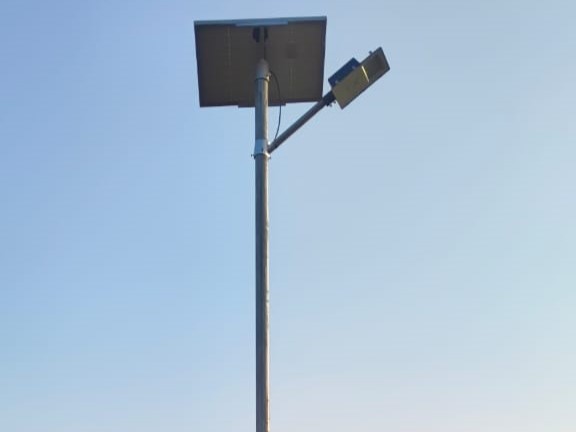
Two other signals are worth tracking. Maharashtra rural development tenders for solar high mast and LED street lights have appeared in Wardha and Parbhani districts, and a solar high mast tender was published for Trimbak Nagar Panchayat. For the wider picture of how state agencies buy solar lights, see the state rural solar street light schemes guide for India 2026.
What Tenders Specify: Wattage, Panel, Battery, Pole
There is no single national specification. Each tender sets its own configuration, and on GeM the BOQ fills in the numbers. What is consistent is the list of parameters you will be asked to state.
| Parameter | What the 2026 documents show |
|---|---|
| Pole | Octagonal or polygonal tower; 8 m in one GeM catalogue variant and 9 m in the MEDA and a Madhya Pradesh tender title |
| PV module (Wp) | Set in the BOQ on GeM; one catalogue variant lists 150 Wp |
| LED rating (W) | Set in the BOQ; one catalogue variant lists 50W; JREDA covers 40W, 60W, 80W and 100W systems; UPNEDA's heritage high mast specification allows up to 4 x 30W |
| Battery (Ah) | Set in the BOQ; one catalogue variant lists 42 Ah; JREDA specifies lithium ferro phosphate |
| Monitoring | RMS and GPS in JREDA documents; RMS in MEDA Amravati |
| Warranty and maintenance | 5 years comprehensive in UPNEDA and JREDA; onsite warranty from 1 to 5 years or more on GeM; 1 year in the Pune District Panchayats bid |
Worked Sizing Example: 4 x 30W Solar High Mast
This example uses the same method as the solar street light sizing guide for India 2026. The inputs are assumptions for illustration, not a tender requirement: always replace them with the figures in your bid document and your site's solar data.
| Step | Calculation | Result |
|---|---|---|
| 1. LED load | 4 heads x 30W | 120W |
| 2. Nightly energy | 120W x 10 hours | 1,200 Wh |
| 3. Panel size | 1,200 Wh / (4.5 peak sun hours x 0.75 system efficiency) | About 356 Wp, round up to 400 Wp |
| 4. Usable battery for 3 nights | 1,200 Wh x 3 | 3,600 Wh |
| 5. Nominal battery capacity | 3,600 Wh / 0.80 depth of discharge (LiFePO4) | 4,500 Wh |
| 6. Battery in Ah at 25.6V | 4,500 Wh / 25.6V | About 176 Ah |
If the tender allows a dimming profile, for example full output for the first hours of the night and reduced output after, the nightly energy drops and so do the panel and battery. Where the bid fixes the Wp, W and Ah in the BOQ, the work is checking that the stated panel and battery can actually carry the stated LED load for the required autonomy. For why LiFePO4 is the right chemistry for these batteries, see the LiFePO4 battery guide for solar lights in India.
RMS, GPS and the 5-Year Maintenance Contract
Three terms recur across the 2026 documents and decide who can bid and who can profitably deliver.
Remote Monitoring System (RMS)
RMS reports each pole's status to a central dashboard so the agency sees faults without waiting for a villager's complaint. MEDA Amravati requires RMS on its solar high masts, and JREDA's rate contracts list RMS and GPS as part of every system. Bidders without an RMS solution or a partner for one cannot respond to these tenders.
GPS
GPS records where each pole actually is. For the agency this limits ghost installations; for the contractor it means recording coordinates at commissioning. The solar street light tender guide covers how geo-tagging and RMS are evaluated in the technical bid.
5-year comprehensive maintenance (CMC)
UPNEDA and JREDA both require 5 years of comprehensive warranty and maintenance. This is a cost the bidder carries after installation: battery health, panel cleaning, fault visits and replacement. Price the CMC honestly. A low bid that ignores five years of site visits across scattered villages will lose money in years two to five.
Site Planning: Pole, Wind Load and Placement
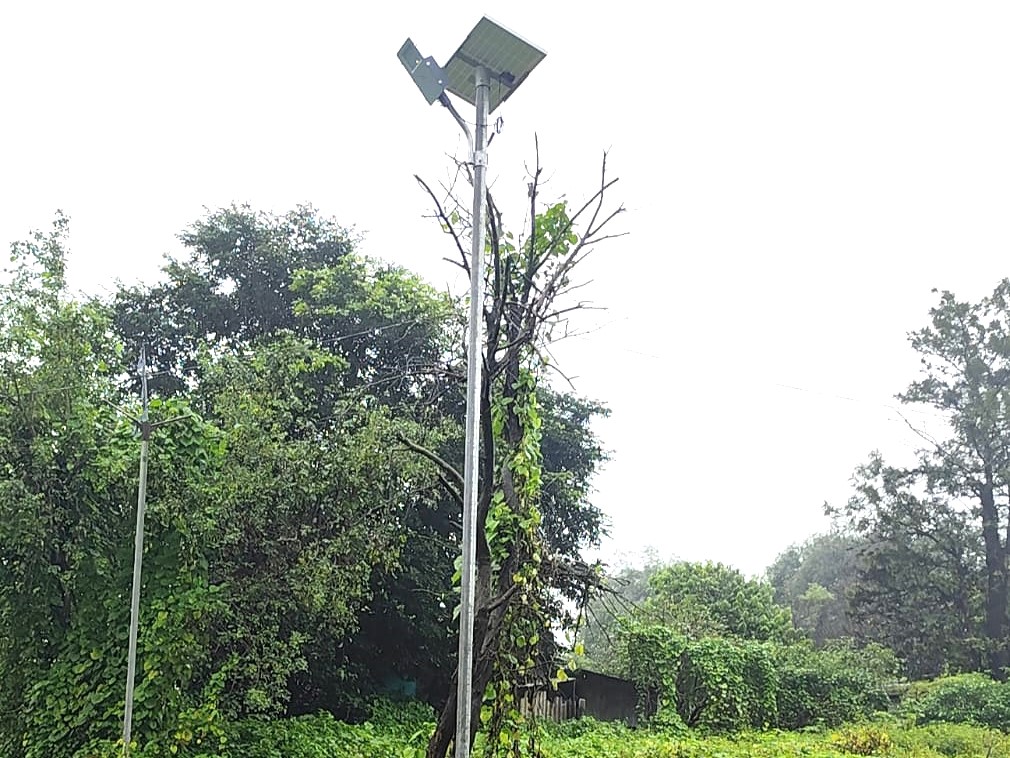
A solar high mast carries a panel and head at height, so wind load matters more than on a plain pole. Foundation and pole design should follow the structural requirement in the bid document and the wind provisions of IS 875 Part 3 for the district. Three practical checks apply on every site.
- Shade: keep the panel clear of trees and buildings from mid-morning to mid-afternoon. A shaded panel undercharges the battery and the light fails at night even when the system is correctly sized.
- Panel orientation: face the panel due south at a tilt suited to the latitude, as covered in the solar flood lights guide for India 2026.
- Placement: centre the mast in the open area it serves. A chowk or school ground is lit evenly from the middle; a mast at the edge wastes half its light.
Bid Eligibility, EMD and Documents
Eligibility follows the usual pattern for government supply tenders. The UPNEDA solar high mast tender carried an EMD of ₹21 lakh with exemption allowed, which is the route available to NSIC-registered MSME bidders. The Azamgarh GeM bid carried an EMD of ₹75,000. Some GeM bids ask for local vendor participation with an authenticated brand certificate, and bids on GeM are usually two-packet, so a technical disqualification means the price bid is never opened.
| Document | Purpose |
|---|---|
| Company registration, GST, PAN | Proves the bidder is a legal entity |
| Audited financials or turnover certificate | Meets the tender's financial criterion |
| Experience certificates | Shows similar solar lighting work completed |
| Product test reports and certificates for LED, PV module and battery | Confirms the components meet the stated standards |
| OEM authorisation or manufacturer letter | Needed when the bidder is an installer, not the manufacturer |
| RMS technical write-up | Shows the monitoring requirement is met |
| Warranty and CMC undertaking | Commits to the stated maintenance period |
| NSIC certificate, if applicable | EMD exemption and MSE preference where the tender allows |
Exact requirements differ by tender, so treat this table as a checklist and verify each item against the bid document. For the full bid-preparation method used in solar street light tenders, which applies here too, read the solar street light tender guide for India 2026.
Xera Tech and Solar High Mast Projects
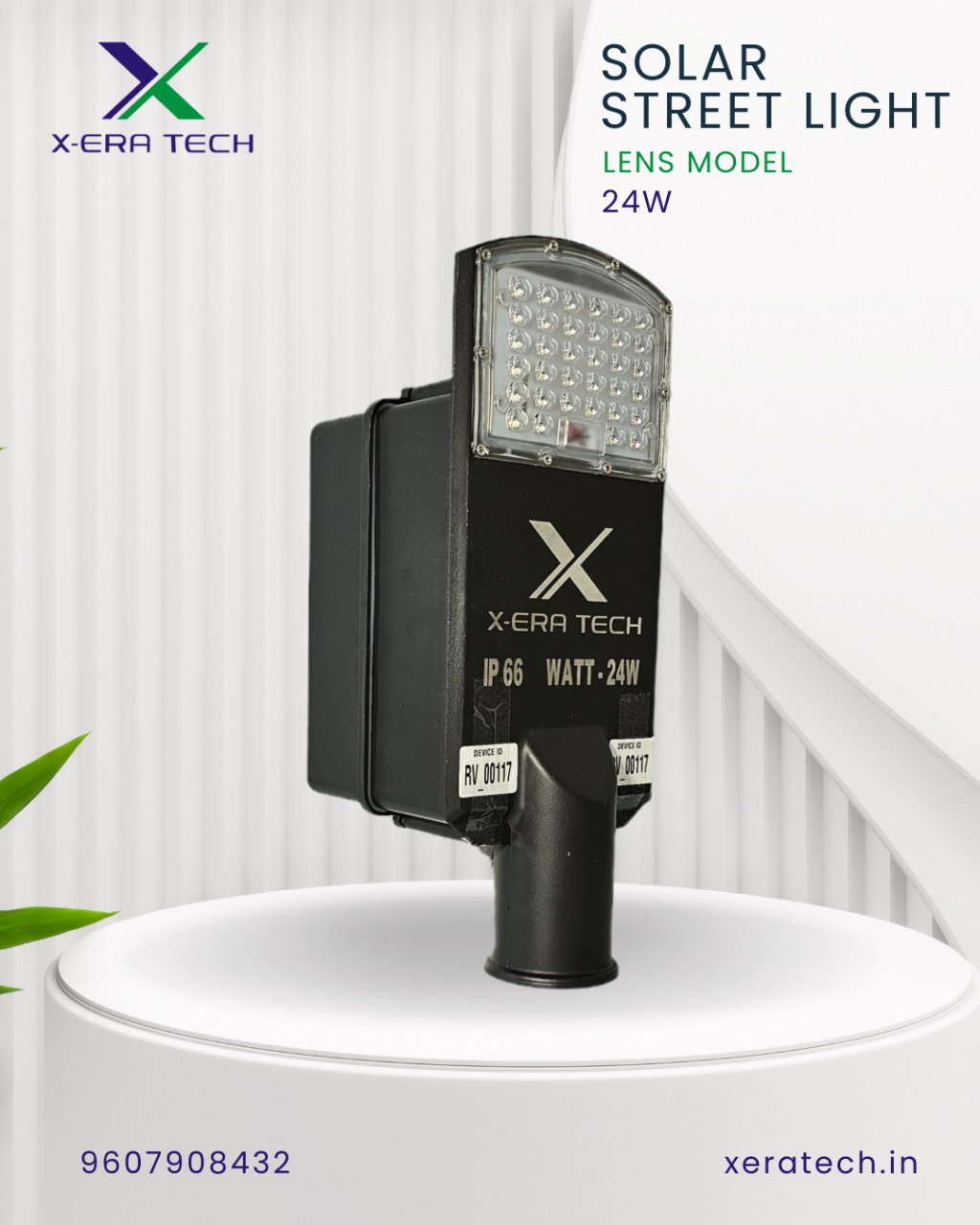
Xera Tech, LED and solar lighting manufacturer, Satpur MIDC, Nashik, Maharashtra, India, makes the solar building blocks these systems depend on: solar street lights, off-grid solar flood lights, and grid high mast lighting. Xera Tech holds BIS (IS 10322 and IS 16102), ISO 9001:2015, PWD, ERDA, NABL, NSIC and ZED certifications and is GeM listed. For a solar high mast tender, the practical route is to send the BOQ: LED wattage, PV module Wp, battery Ah, pole height and warranty period. The Xera Tech team will confirm which configuration it can supply and which documents it can provide for the technical bid.
Solar Lights for Village and Off-Grid Projects
BIS IS 16102 · LiFePO4 · MPPT · IP65 · GeM listed · NSIC · 2-year warranty
Send your tender BOQ and the Xera Tech team will confirm the solar configuration it can supply, along with the BIS certificate, NABL test reports, ISO 9001:2015 certificate and NSIC certificate for your technical bid. Extended maintenance periods such as the 5-year CMC in UPNEDA and JREDA tenders are arranged per project and should be agreed in writing before bidding.
| Battery | LiFePO4 |
| IP Rating | IP65 |
| Certifications | BIS · ISO 9001:2015 · NABL · NSIC · ZED · GeM |
| Standard Warranty | 2 years |
| How to enquire | Send the BOQ on WhatsApp for a configuration quote |



Frequently Asked Questions
Have a Solar High Mast Tender BOQ? Send It to Xera Tech.
Send your LED wattage, PV module Wp, battery Ah, pole height and warranty period. Xera Tech, Satpur MIDC, Nashik, will confirm what it can supply and which certificates and test reports are available for your technical bid. BIS, ISO 9001:2015, NABL, NSIC and ZED certified, GeM listed.
WhatsApp Your BOQ Browse Solar Lights Submit Project EnquiryLooking for the right LED solution?
Xeratech manufactures BIS-certified LED flood lights, solar street lights, highbay lights and more — shipped across India.
Xera Tech is a BIS-certified LED lighting manufacturer established in 2017, headquartered in Nashik, Maharashtra , India. Product range: LED Street lights, Decorative lights, solar street lights (all-in-one & semi-integrated), LED Flood lights, decorative poles, and high mast lights — all manufactured at Satpur MIDC and compliant with IP65/IP67 and photometric standards. Learn more about Xera Tech →