



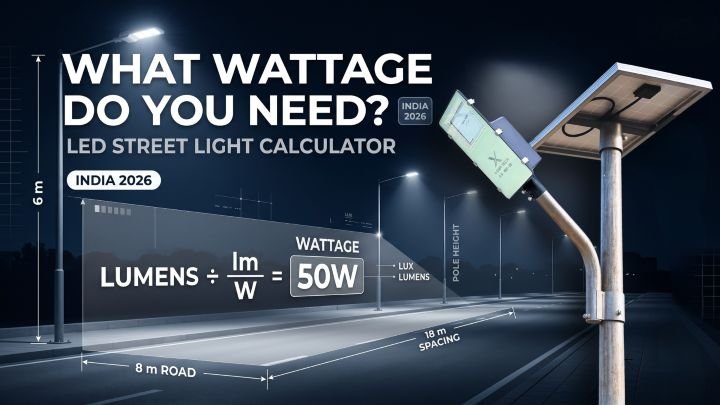
The single most common mistake in Indian street lighting projects is selecting wattage by guessing or by copying what the contractor used on the last project. A 100W LED on a 4-metre pole on a 5-metre wide colony road delivers roughly four times the lux required, wastes electricity, and creates glare for residents. A 50W LED on an 8-metre pole on a 10-metre wide municipal road delivers less than half the required lux, creating dark patches and a safety hazard. Getting wattage right takes five minutes and a simple formula. This guide walks you through it step by step for every common Indian road type, with worked examples you can use directly.
Step 1: Identify Your Road Category (IS 1944 Lux Requirements)
IS 1944 (Code of Practice for Lighting of Public Thoroughfares), published by the Bureau of Indian Standards, is the mandatory standard for road lighting in India. It classifies roads into five categories (labelled P1 through P5 in updated versions, corresponding to the older A1 through C classifications) and specifies the minimum maintained average horizontal illuminance in lux that each category must achieve at the road surface.
The maintained illuminance is not the initial lux: it is the lux level the system must still deliver at the end of its maintenance cycle, after LED lumen depreciation and soiling of the lens cover have reduced output. A maintenance factor of 0.80 is used for clean inland environments; 0.70 for dusty zones (Rajasthan, Vidarbha, coastal areas with salt deposits).
| IS 1944 Category | Old Ref | Road Type | Min Maintained Lux (Em) | Uniformity Ratio |
|---|---|---|---|---|
| P1 | A1 | High-volume arterial, urban expressways, national highways with heavy traffic | 20 to 30 lux | 0.4 minimum |
| P2 | A2 | Main urban roads, collector roads, state highways, important commercial streets | 15 to 20 lux | 0.35 minimum |
| P3 | B1 | Local distributor roads, secondary urban roads, township main roads | 10 to 15 lux | 0.3 minimum |
| P4 | B2 | Residential access roads, housing society internal roads, colony roads | 7 to 10 lux | 0.25 minimum |
| P5 | C | Village lanes, farm tracks, very low traffic rural paths, pedestrian paths | 3 to 7 lux | 0.20 minimum |
Use the middle of each range as your target for planning calculations: 25 lux for P1, 17 lux for P2, 12 lux for P3, 8 lux for P4, 5 lux for P5. This gives you a comfortable margin above the minimum while avoiding over-design. For detailed lux level explanations and measurement methodology, see the Xera Tech guide on what lux level means for road lighting.
Step 2: Determine Pole Height
Pole height is the most important variable in wattage selection. A higher pole spreads light over a larger ground area, which improves uniformity between poles but requires more lumens (and therefore more wattage) to achieve the same lux at road level. The standard rule for Indian road lighting is:
Pole height (H) = 0.6 to 0.8 times road width (W)
For a 6-metre wide road: H = 3.6m to 4.8m, so use a 4m or 5m pole. For an 8-metre road: H = 4.8m to 6.4m, so use a 6m pole. For a 10-metre road: H = 6m to 8m, so use a 7m or 8m pole. For a 14-metre dual carriageway: H = 8.4m to 11.2m, so use a 9m or 10m pole.
| Road Width | Formula Range | Standard Pole Height | Mounting Configuration |
|---|---|---|---|
| 4m to 5m (narrow lane, footpath) | 2.4m to 4m | 4m | Single side, wall mount, or median |
| 5m to 7m (colony road, housing society) | 3m to 5.6m | 5m to 6m | Single side or staggered |
| 7m to 9m (ward road, township main) | 4.2m to 7.2m | 6m to 7m | Single side or opposite |
| 9m to 12m (municipal main road) | 5.4m to 9.6m | 7m to 9m | Opposite or staggered |
| 12m to 15m (state highway, dual lane) | 7.2m to 12m | 9m to 11m | Central median or opposite sides |
For solar street lights, keep pole height below 9 metres. Above 9 metres, wind loads on the combined solar panel and LED fixture assembly become significant and the structural design of the pole requires an engineer's calculation (IS 875 Part 3 wind load). For pole height selection guidance including the detailed H/W ratio analysis, see the Xera Tech LED street light pole height guide.
Step 3: Calculate Pole Spacing
Pole spacing determines how much road area each luminaire must cover. Too wide a spacing creates dark patches between poles (uniformity failure). Too tight a spacing wastes capital cost on unnecessary poles. The standard spacing formula is:
Pole spacing = pole height (H) multiplied by 2.5 to 3
For a 6m pole: spacing = 15m to 18m. For an 8m pole: spacing = 20m to 24m. For a 10m pole: spacing = 25m to 30m. Use the lower end of the range (H x 2.5) in dusty areas where soiling reduces output faster, and for P1 and P2 roads where uniformity requirements are stricter. Use H x 3 for P4 and P5 roads where uniformity requirements are relaxed.
For single-side mounting on a road narrower than 6m, you can extend to H x 3.5 without uniformity problems because the light does not need to travel as far across the road. For staggered (alternating-side) mounting, use H x 2.5 as a safe maximum. For opposite-side (facing pairs) mounting, use H x 3 to H x 3.5.
Step 4: Calculate Required Lumens
With road width (W), pole spacing (S), target lux (Em), and utilisation factor (UF) established, the required lumen output per luminaire is:
Required lumens = (pole spacing x road width x target lux) ÷ utilisation factor
The utilisation factor (UF) accounts for the percentage of emitted lumens that actually reach the road surface. Not all lumens from the fixture land on the road: some go upward (wasted unless reflected), some fall on verges, footpaths, or building facades. For Indian LED street light installations with Type II or Type III asymmetric optics, UF is typically 0.65 to 0.75. Use 0.70 as the standard planning value for most Indian roads. For single-side mounting on a narrow lane where the fixture is directed mostly over the road, UF can be 0.75. For very wide roads where significant spill occurs, use 0.65.
For dust-affected zones (Rajasthan, Vidarbha, western UP, semi-arid areas), multiply the required lumens by an additional factor of 1.15 to account for the faster lumen loss from soiling. This builds in a maintenance buffer so the system stays above the IS 1944 minimum between cleaning cycles.
Step 5: Convert Lumens to Wattage
The final step converts required lumens to wattage using the luminaire's rated efficacy in lumens per watt (lm/W):
Required wattage = required lumens ÷ luminaire efficacy (lm/W)
The efficacy value to use is the system efficacy from the LM-79 test report: the lumens measured at the luminaire output at rated wattage, divided by the rated wattage. This is not the bare LED chip efficacy (which is higher) or the driver efficiency (which is lower). Always request the LM-79 tested system efficacy from the supplier. Xera Tech Glass Model LED street lights deliver a conservative planning efficacy of 130 lm/W (NABL-tested; actual values 120 to 145 lm/W depending on wattage and colour temperature). LM-79 reports are available on request.
Once you have the required wattage, round up to the nearest standard wattage available in the product range. Never round down: a marginally undersized wattage fails the IS 1944 lux requirement, especially after lumen depreciation over years of operation. The available Xera Tech Glass Model wattages are: 24W, 36W, 50W, 60W, 72W, 100W, 120W, 150W, 180W, 200W.
Worked Examples: 5 Common Indian Road Types
These five examples cover the road types encountered in the vast majority of Indian LED street light projects in 2026. All use Xera Tech Glass Model efficacy of 130 lm/W, utilisation factor of 0.70, maintenance factor of 1.0 (clean inland area).
Example 1: State highway (10m wide, P2 category)
- Road width (W): 10m
- Category: P2, target lux: 17 lux
- Pole height: 8m (H = 0.8 x W)
- Pole spacing: 20m (H x 2.5)
- Required lumens: (20 x 10 x 17) / 0.70 = 4,857 lm
- Required wattage: 4,857 / 130 = 37.4W
- Select: 50W Glass Model (SL-GM-50): provides margin above target
Example 2: Municipal main road (8m wide, P3 category)
- Road width (W): 8m
- Category: P3, target lux: 12 lux
- Pole height: 6m (H = 0.75 x W)
- Pole spacing: 18m (H x 3)
- Required lumens: (18 x 8 x 12) / 0.70 = 2,469 lm
- Required wattage: 2,469 / 130 = 19W
- Select: 24W Glass Model (SL-GM-24): provides comfortable margin
Example 3: Housing society internal road (6m wide, P4 category)
- Road width (W): 6m
- Category: P4, target lux: 8 lux
- Pole height: 5m (H = 0.8 x W = 4.8m, rounded to 5m)
- Pole spacing: 15m (H x 3)
- Required lumens: (15 x 6 x 8) / 0.70 = 1,029 lm
- Required wattage: 1,029 / 130 = 7.9W
- Select: 24W Glass Model (SL-GM-24): next available wattage, gives double the minimum lux for comfort and safety margin
- Alternative: Solar 18W all-in-one if no underground wiring is available
Example 4: Gram panchayat village road (5m wide, P5 category)
- Road width (W): 5m
- Category: P5, target lux: 5 lux
- Pole height: 4m (H = 0.8 x W = 4m)
- Pole spacing: 12m (H x 3)
- Required lumens: (12 x 5 x 5) / 0.70 = 429 lm
- Required wattage: 429 / 130 = 3.3W
- Select: 24W Glass Model (SL-GM-24): the minimum standard product; village roads often exceed the IS minimum target deliberately for safety and comfort
- Note: for this road type, 24W at 4m on 12m spacing will significantly exceed 5 lux. Many gram panchayats prefer 20m to 25m spacing at the same wattage to reduce pole count and civil cost while maintaining compliance
Example 5: Wide municipal arterial road (12m wide, P1 category)
- Road width (W): 12m
- Category: P1, target lux: 25 lux
- Pole height: 9m (H = 0.75 x W)
- Pole spacing: 22.5m (H x 2.5)
- Required lumens: (22.5 x 12 x 25) / 0.70 = 9,643 lm
- Required wattage: 9,643 / 130 = 74.2W
- Select: 100W Glass Model (SL-GM-100): next standard wattage; provides a 35% lumen buffer for lumen depreciation over service life
- Alternative: Lens Model (SL-LM-72 or SL-LM-100) for better uniformity on wide roads

HPSV Replacement: Quick Wattage Equivalents
If you are replacing existing High Pressure Sodium Vapour (HPSV) or metal halide street lights with LED and want a quick equivalence table without doing the full calculation, use the table below. These equivalences assume the original HPSV installation was correctly specified for the road category and the pole positions are unchanged. If the original installation was over-specified (a common situation in India where contractors always chose the next wattage up), the LED equivalent will deliver the same lux as the HPSV at the lower wattage.
| HPSV Wattage | HPSV System Draw (with ballast) | Equivalent LED Wattage | Xera Tech Model | Energy Saving |
|---|---|---|---|---|
| 70W HPSV | 85W | 24W to 36W LED | SL-GM-24 or SL-GM-36 | 57% to 72% power reduction |
| 100W HPSV | 120W | 36W to 50W LED | SL-GM-36 or SL-GM-50 | 58% to 70% power reduction |
| 150W HPSV | 175W | 50W to 60W LED | SL-GM-50 or SL-GM-60 | 66% to 71% power reduction |
| 250W HPSV | 290W | 80W to 100W LED | SL-GM-100 | 65% to 72% power reduction |
| 400W HPSV | 460W | 120W to 150W LED | SL-GM-120 or SL-GM-150 | 67% to 74% power reduction |
| 250W Metal Halide | 290W | 80W to 100W LED | SL-GM-100 | 65% to 72% power reduction |
| 400W Metal Halide | 450W | 120W to 150W LED | SL-GM-120 or SL-GM-150 | 67% to 73% power reduction |
For a full energy saving and cost comparison between LED and HPSV technologies in India, see the LED lighting carbon reduction and energy savings guide for India 2026. For the complete LED vs traditional street light comparison, see the LED vs traditional street lights guide.
Ready-Reference Wattage Selection Table
Use this table as a starting point for any Indian road lighting project. All values use the five-step formula above with UF 0.70 and Xera Tech Glass Model efficacy of 130 lm/W. Final wattage should be confirmed by photometric simulation (DIALux or Relux) for projects above 50 poles or for any road requiring P1 or P2 compliance certification.
| Road Width | Pole Height | Pole Spacing | IS 1944 Category | Target Lux | Required Lumens | Recommended Wattage | Xera Tech Model |
|---|---|---|---|---|---|---|---|
| 4m (footpath, narrow lane) | 4m | 12m | P5 | 5 lux | 343 lm | 24W | SL-GM-24 |
| 5m (village road) | 4m | 12m | P5 | 5 lux | 429 lm | 24W | SL-GM-24 |
| 6m (housing society, colony) | 5m | 15m | P4 | 8 lux | 1,029 lm | 24W | SL-GM-24 |
| 7m (ward road, internal township) | 6m | 18m | P3 | 12 lux | 2,194 lm | 24W | SL-GM-24 |
| 8m (secondary municipal road) | 6m | 18m | P3 | 12 lux | 2,469 lm | 24W to 36W | SL-GM-24 or SL-GM-36 |
| 9m (main ward road) | 7m | 21m | P2 to P3 | 15 lux | 4,071 lm | 36W to 50W | SL-GM-36 or SL-GM-50 |
| 10m (state highway, collector road) | 8m | 20m | P2 | 17 lux | 4,857 lm | 50W | SL-GM-50 |
| 10m (arterial road) | 9m | 22m | P1 | 25 lux | 7,857 lm | 72W to 100W | SL-GM-72 or SL-GM-100 |
| 12m (dual carriageway) | 9m | 22m | P1 | 25 lux | 9,429 lm | 100W | SL-GM-100 |
| 15m (national highway, boulevard) | 11m | 27m | P1 | 25 lux | 14,464 lm | 120W to 150W | SL-GM-120 or SL-GM-150 |
Xera Tech Glass Model: Wattage Range with Lumen Output
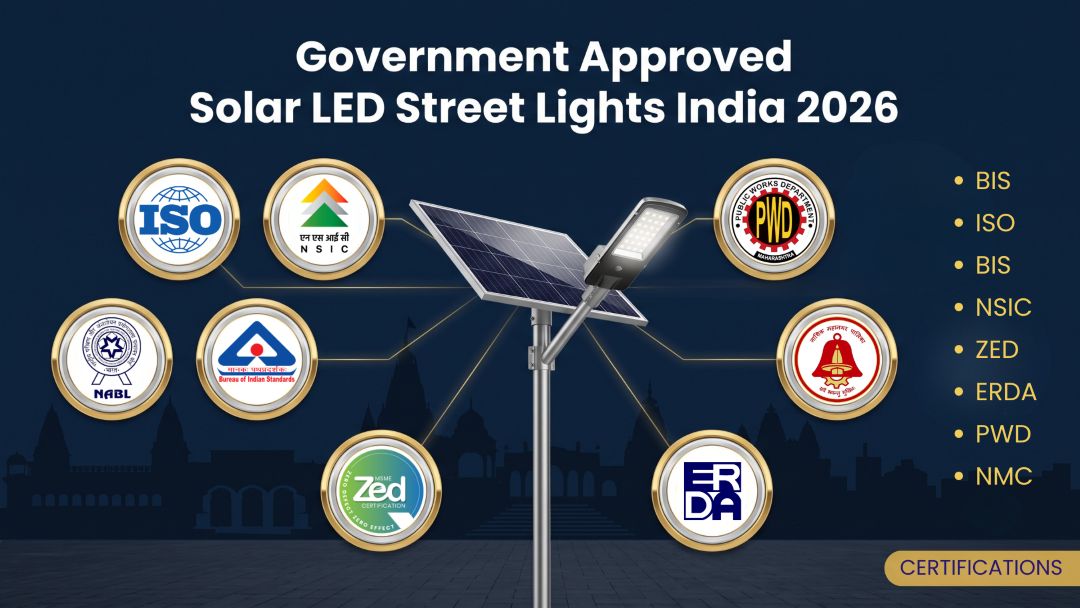
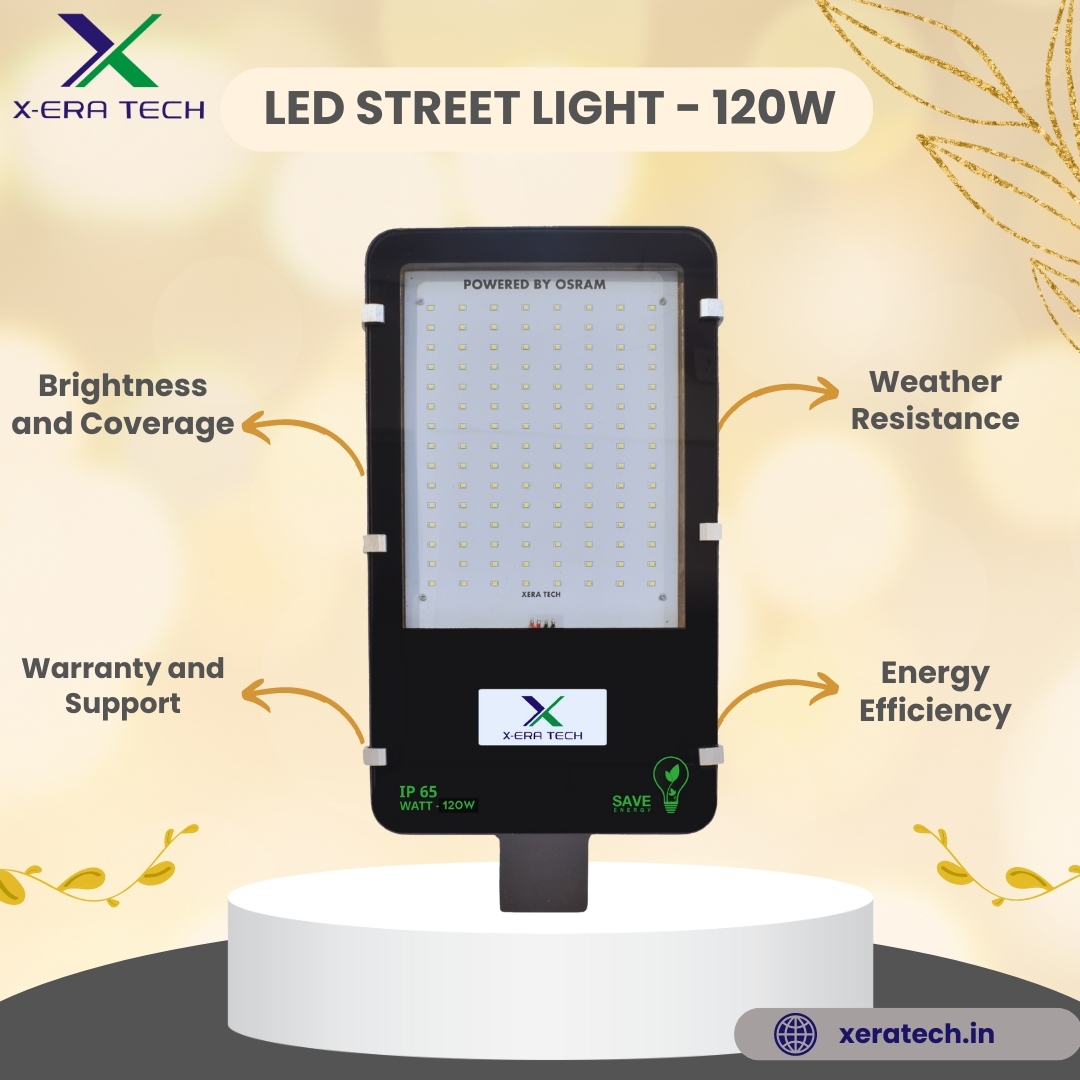
Xera Tech, LED and solar lighting manufacturer at Satpur MIDC, Nashik, Maharashtra, India, manufactures the SL-GM Glass Model LED street light in ten standard wattages from 24W to 200W. All carry BIS IS 10322 certification, ISO 9001:2015 quality management, IP65 rating, 90V to 300V wide-input voltage range, power factor above 0.95, and a 2-year manufacturer warranty. NABL-tested LM-79 photometric reports for each wattage are available on request for tender submission and DIALux simulation input.
| Model | Wattage | Approx Lumen Output (130 lm/W) | Primary Application | IS 1944 Category |
|---|---|---|---|---|
| SL-GM-24 | 24W | 3,120 lm | Village lane, colony road, housing society, footpath | P4 to P5 |
| SL-GM-36 | 36W | 4,680 lm | Housing society main road, secondary ward road | P3 to P4 |
| SL-GM-50 | 50W | 6,500 lm | State highway, collector road, township main entry | P2 to P3 |
| SL-GM-60 | 60W | 7,800 lm | Wide secondary road, industrial estate internal road | P2 to P3 |
| SL-GM-72 | 72W | 9,360 lm | Main urban road, narrow arterial | P2 |
| SL-GM-100 | 100W | 13,000 lm | Arterial road, national highway, wide dual carriageway | P1 to P2 |
| SL-GM-120 | 120W | 15,600 lm | Wide arterial, expressway, large roundabout | P1 |
| SL-GM-150 | 150W | 19,500 lm | National highway, expressway, 15m+ road | P1 |
| SL-GM-180 | 180W | 23,400 lm | Wide national highway, high mast supplement | P1 |
| SL-GM-200 | 200W | 26,000 lm | Widest roads, high pole height applications | P1 |
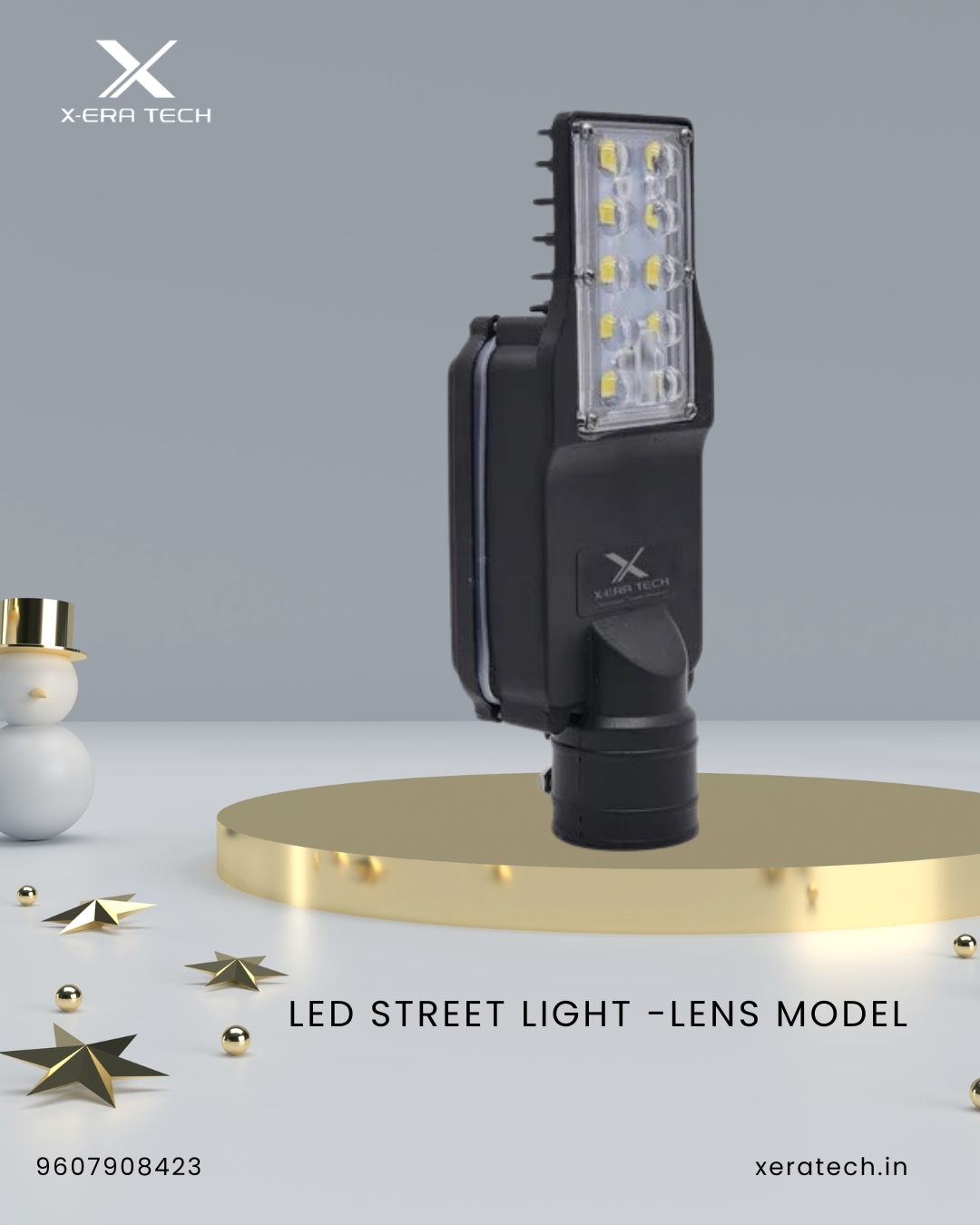
LED Street Light Glass Model and Lens Model (24W to 200W)
SL-GM / SL-LM Series · BIS IS 10322 · IP65 · 90V-300V · PWM Dimming Option · 2-year warranty
Available in 10 wattages from 24W to 200W. Glass Model for general road illumination with a wide 120° beam. Lens Model for precision beam control on highways and arterials where beam distribution and uniformity ratio are critical tender requirements. Both available with PWM dimming driver for SCADA and smart city integration. NABL-tested LM-79 photometric reports available for every wattage for DIALux simulation and tender documentation.
| Wattage Range | 24W to 200W |
| Efficacy | 120 to 145 lm/W (NABL tested) |
| IP Rating | IP65 |
| Input Voltage | 90V to 300V AC |
| Power Factor | >0.95 |
| Certifications | BIS IS 10322 · ISO 9001:2015 · PWD · ERDA · NABL · GeM |
| Smart Dimming | PWM 0 to 100% (factory option) |
| Warranty | 2 years |






Frequently Asked Questions
Need a Free Wattage Calculation for Your Street Light Project?
Xera Tech's technical team calculates the right wattage, pole count, and spacing for any Indian road project within one working day. BIS IS 10322 certified LED street lights in 24W to 200W with NABL-tested LM-79 reports, IES photometric files, and free DIALux simulation for bulk orders. Made in Nashik, delivered pan-India.
WhatsApp for Free Calculation Browse LED Street Lights Submit Project DetailsLooking for the right LED solution?
Xeratech manufactures BIS-certified LED flood lights, solar street lights, highbay lights and more — shipped across India.
Xera Tech is a BIS-certified LED lighting manufacturer established in 2017, headquartered in Nashik, Maharashtra , India. Product range: LED Street lights, Decorative lights, solar street lights (all-in-one & semi-integrated), LED Flood lights, decorative poles, and high mast lights — all manufactured at Satpur MIDC and compliant with IP65/IP67 and photometric standards. Learn more about Xera Tech →