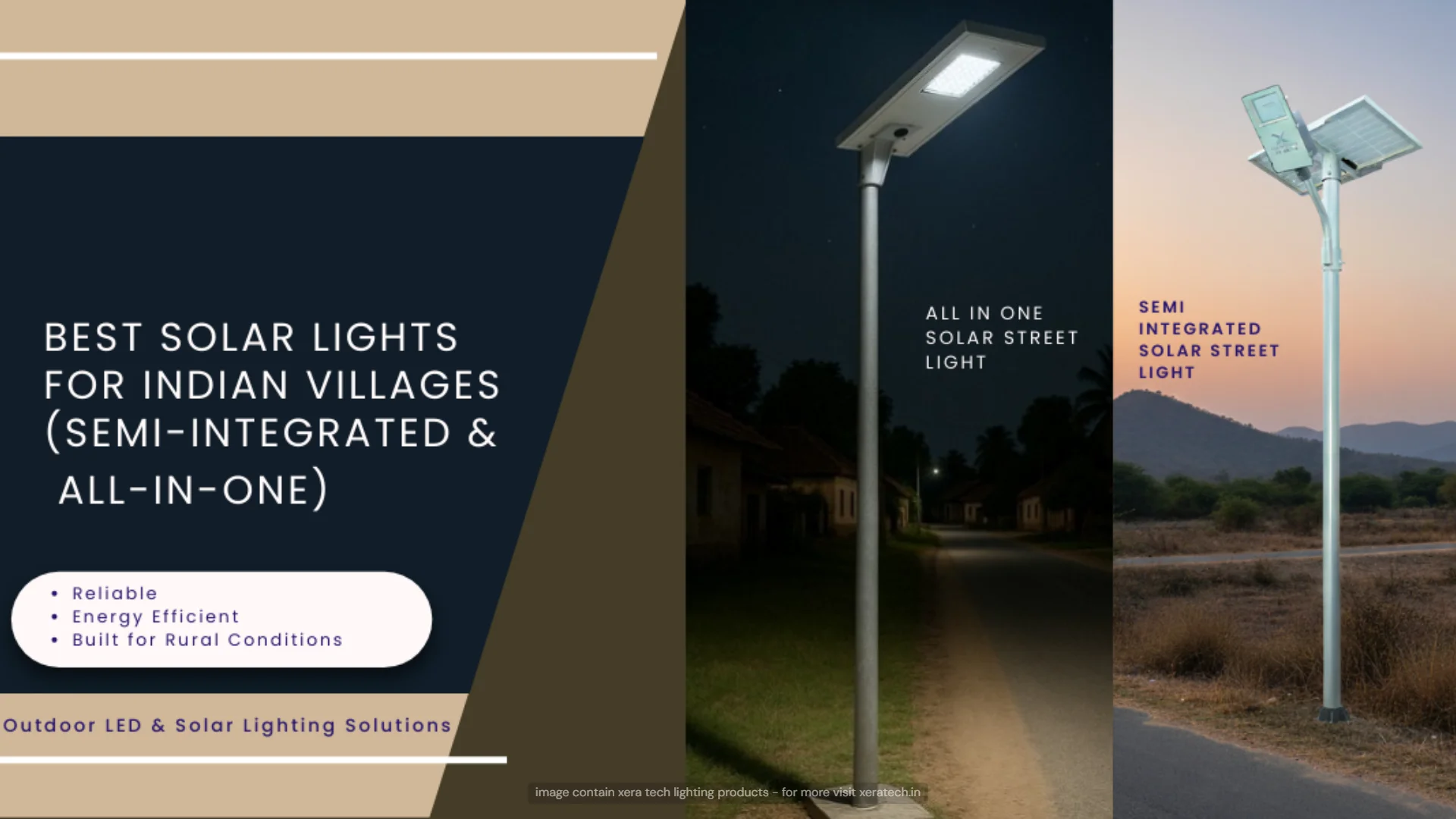




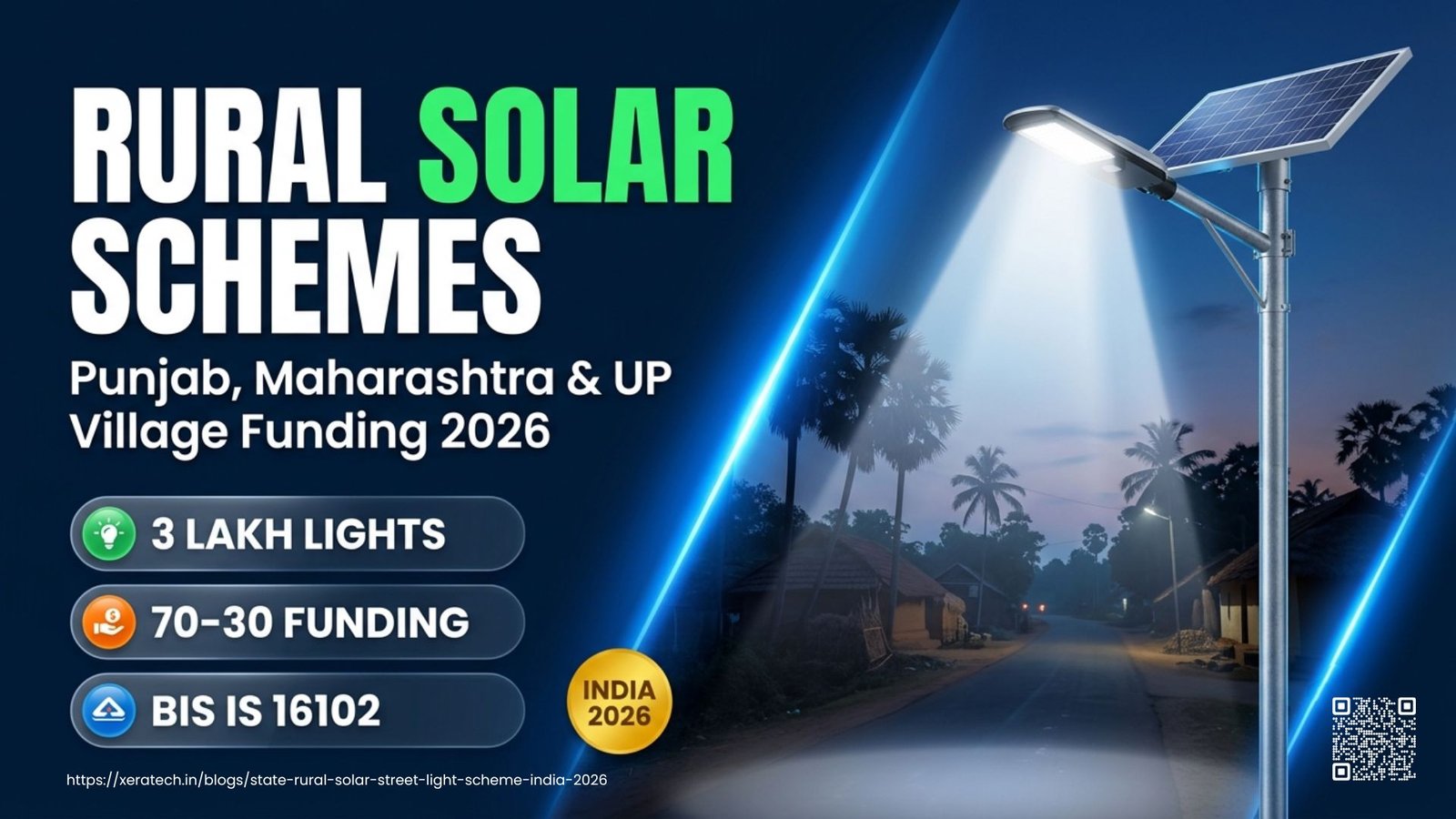
Punjab approved Rs 550 crore to install 3 lakh solar LED street lights across 13,500 villages in April 2026. Maharashtra's MEDA is running village solar street light tenders every month across all six divisions. Uttar Pradesh floated a Rs 85.99 crore tender for 40,000 lights. Every state in India now has a government programme that can fund solar street lights for gram panchayats at subsidised rates. Most sarpanches do not know it exists, and most local contractors do not know how to qualify for it. This guide covers every active scheme, how gram panchayats apply, what the funding split is, and what products are eligible.
Why Solar Is the Correct Choice for Village Street Lighting
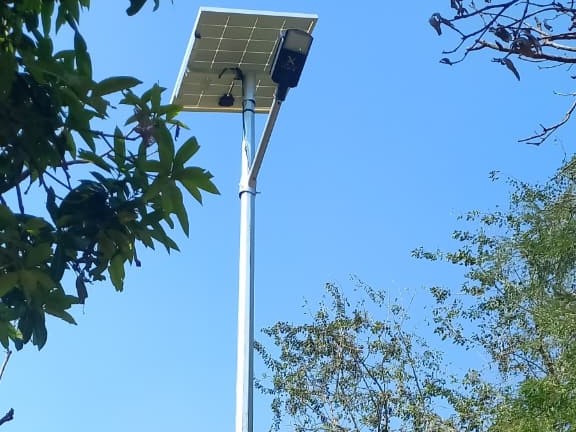
Village streets in India have three lighting problems that make solar the structurally correct solution rather than simply a green preference. First, grid reliability: rural feeders in UP, Bihar, Maharashtra's Vidarbha, and parts of Punjab experience 4 to 8 hours of daily power cuts. A grid-connected street light goes dark whenever the grid fails, which in many villages means several hours every night. A solar street light with a 3-day LiFePO4 battery continues operating regardless of the DISCOM supply.
Second, grid connection cost: most village lanes do not have existing street light infrastructure. Installing a new grid-connected light requires digging a cable trench (Rs 800 to Rs 2,500 per running metre), laying armoured cable, a distribution board connection, and a new DISCOM connection. For a 500-metre village phirni with 15 to 20 lights, the civil and wiring cost can easily exceed the cost of the solar street lights themselves. Solar eliminates this entirely.
Third, ongoing cost: a 250W HPSV street light running 12 hours per night costs approximately Rs 9,855 per year in electricity at Rs 9 per unit. A 18W solar LED replacement has zero ongoing electricity cost. For a gram panchayat managing 30 to 100 street lights from a limited panchayat fund, eliminating the electricity bill redirects significant money to other village development priorities.
Punjab: Mukhya Mantri Roshan Punjab Yojana (Rs 550 Crore)
Punjab's Cabinet, led by Chief Minister Bhagwant Mann, approved the Mukhya Mantri Roshan Punjab Yojana on April 12, 2026, with New and Renewable Energy Minister Aman Arora announcing the scheme publicly (Source: IANS, April 12, 2026). The scheme is described by the Minister as one of the biggest rural lighting initiatives in the country.
Key scheme parameters
| Parameter | Detail | Source |
|---|---|---|
| Total lights | 3 lakh solar LED street lights | IANS, April 12, 2026 |
| Villages covered | 13,500 villages across all 23 districts of Punjab | Drishti IAS citing Punjab government |
| Budget | Rs 470 crore to Rs 550 crore (different figures from different government releases) | Drishti IAS (Rs 470 crore); IANS/Minister Arora (Rs 550 crore) |
| Phase 1 | 2,617 villages, 50,870 solar street lights | Drishti IAS citing Punjab government |
| Implementation agency | Punjab Energy Development Agency (PEDA) | IANS, April 2026 |
| Funding pattern | 70% state government + 30% gram panchayat | IANS, sarkariyojana.com |
| Installation period | June to October 2026 (phased) | IANS, April 12, 2026 |
| AMC period | 7 years with 3-day replacement guarantee for malfunction | IANS, April 12, 2026 |
| Monitoring | Geo-tagging of each light, centralised command centre, IVR helpline | IANS, April 12, 2026 |
| LED specification | 12W LED based solar street light | PEDA rate contract tender, April 18, 2026 |
| Participation basis | Opt-in: gram panchayats that want to participate apply through PEDA | sarkariyojana.com |
PEDA has a long history with solar street lights in Punjab, having previously installed over 52,000 solar street lights across 2,191 villages in the state (Source: sarkariyojana.com, citing PEDA records). The Roshan Punjab Yojana is a significant scale-up from this existing base.
The rate contract tender for the full 3,00,000-light procurement was published by PEDA on April 18, 2026 on eproc.punjab.gov.in, with bids closing May 11, 2026. EMD: Rs 6.6 crore. Tender fee: Rs 11,800. Period of work: 119 days from award. Bid validity: 180 days. The procurement specifies 12W LED based solar street lighting systems with 7-year comprehensive warranty and AMC (Source: publicservicesmap.in, tender ID 2026_PEDA_166439_1).
How a Punjab gram panchayat participates
The scheme operates on an opt-in basis. Sarpanches and panchayat members can visit peda.gov.in for application guidelines and details. The gram panchayat contributes 30% of the per-unit cost; PEDA coordinates procurement at the state level, which means gram panchayats get BIS IS 16102-certified lights with 7-year AMC without having to run their own tender. The centralised procurement model eliminates the procurement burden from individual panchayats entirely.
Maharashtra: MEDA Village Solar Street Light Tenders
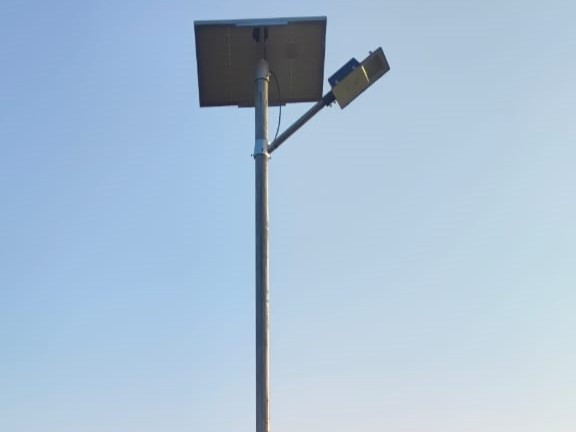
In Maharashtra, the Maharashtra Energy Development Agency (MEDA) is the state nodal agency for solar energy under the Energy Department, Government of Maharashtra. MEDA runs a continuous pipeline of village-level solar street light tenders across all six divisions of the state, with new tenders published every month throughout the year. Unlike Punjab's centralised rate contract model, MEDA issues district-level and village-specific tenders, which means local Maharashtra contractors and installers can participate in tenders close to their operating area.
Active MEDA solar street light tenders in 2026
| Tender Reference | Location | Scope | Value | Date |
|---|---|---|---|---|
| REN/S-NG/ITDP/SSL/2025-26/338 | Nagpur (5 talukas: Ramtek, Parshivani, Umred, Katol, Narkhed) | 251 solar LED street lights, 18W | Undisclosed | June 2026 |
| REN/S-GD/REKHEGAON/25-26/350 (2026_MEDA_1303607) | Rekhegaon and Anantpur, Taluka Chamorshi, District Gadchiroli | 70 solar LED street lights (18W) + 5 solar high mast with RMS | Rs 44.63 lakh | June 2026 |
| DGM/MEDA-NSK/JALGAON-PAROLA/SSL/2026-27/09 (2026_MEDA_1297682) | Savkhede Turk and Dhulpimpri villages, Jalgaon (MEDA Nashik Division) | 47 + 48 = 95 solar LED street lights, 5-year CMC | Rs 46.55 lakh | April 2026 |
| MEDA-AMT/SHM./CR 89/58/2026-27 (2026_MEDA_1303587) | Amravati | Solar LED high mast 9m, 8 units with RMS | Undisclosed | May 2026 |
The MEDA Nashik division office is responsible for tenders covering Nashik, Ahmednagar, Dhule, Nandurbar, and Jalgaon districts. The April 2026 Jalgaon tender (pre-bid meeting at MEDA Nashik office) is directly in Xera Tech's home territory. MEDA has historically installed solar home lighting in 18,603 gram panchayats across Maharashtra and has replaced 1,38,456 street lights with CFL and LED across Maharashtra villages (Source: MEDA Wikipedia page). The 2026-27 tender pipeline continues this work with 18W LED solar street lights now the standard specification across all MEDA village tenders.
How Maharashtra local contractors participate in MEDA tenders
MEDA village tenders are published on mahatenders.gov.in (MAHA eTender portal) and NIC GePNIC. Each tender covers a specific set of villages in one taluka or district. Eligibility requirements for these smaller tenders (Rs 40 lakh to Rs 1 crore range) are proportionally lower than the large UPNEDA or REIL tenders: turnover threshold of approximately Rs 12 to Rs 30 lakh average annual, BIS IS 16102 certified product documentation, and prior experience in solar street light installation. For Maharashtra-based contractors, MEDA's continuous village tender pipeline is the most accessible government solar street light procurement channel in the state.
For a complete guide to preparing a technically compliant bid for solar street light government tenders, see the solar street light tender guide India 2026.
Uttar Pradesh: UPNEDA and the Atal Jyoti Yojana Legacy
Uttar Pradesh has historically been the largest market for rural solar street lights in India, driven by the state's 75 districts, tens of thousands of villages, and unreliable rural grid supply. Two distinct procurement streams operate in UP for rural solar street lights.
UPNEDA 2026 tender: 40,000 lights, Rs 85.99 crore
UPNEDA issued tender 01/UPNEDA/18 watt Solar Street Lighting System/2026-27 for 40,000 solar street lighting systems with Remote Monitoring System (RMS) at Rs 85.99 crore, with bids closing July 3, 2026. This is a state agency tender, not a gram panchayat-level scheme: EPC contractors and manufacturers bid for the full package, and UPNEDA coordinates installation across multiple districts. For detailed specifications and bid requirements, see the complete solar street light tender guide India 2026.
Atal Jyoti Yojana (AJAY): the national programme that proved the model
The Atal Jyoti Yojana, launched by MNRE with EESL as implementing agency, installed 1.35 lakh solar street lights across rural areas of UP, Assam, Bihar, Jharkhand, and Odisha between 2016 and 2022, targeting areas with less than 50% grid connectivity (Source: International Energy Agency, July 2024). AJAY Phase I (September 2016 to March 2018) covered UP, Assam, Bihar, Jharkhand, and Odisha. Phase II (December 2018 to June 2022) expanded to NE states, island territories of Lakshadweep and Andaman Nicobar, and 48 additional specified districts. AJAY's 7W and 12W specifications established the baseline that most subsequent state rural solar street light schemes have built upon.
Other States: HAREDA, RRECL, GEDA and REIL
Every major Indian state has a renewable energy agency that runs a solar street light programme. The table below covers the key state agencies for contractors and suppliers looking to expand beyond Punjab and Maharashtra.
| State | Agency | Programme Type | Tender Portal | Notes |
|---|---|---|---|---|
| Punjab | PEDA (Punjab Energy Development Agency) | Rate contract, centralised, gram panchayat 30% share | eproc.punjab.gov.in | 3 lakh lights, Roshan Punjab Yojana, April 2026 |
| Maharashtra | MEDA (Maharashtra Energy Development Agency) | Continuous district-level tenders, village-specific | mahatenders.gov.in | 18W LED standard, Nashik/Nagpur/Gadchiroli tenders active 2026 |
| Uttar Pradesh | UPNEDA (UP New and Renewable Energy Development Agency) | Large-scale state tenders + gram panchayat sub-allocation | etender.up.nic.in | 40,000 lights Rs 85.99 crore tender, July 2026 |
| Haryana | HAREDA (Haryana Renewable Energy Development Agency) | Annual rate contract for solar street lights | haryanaeprocurement.gov.in | Annual rate contract; village panchayats order against it |
| Rajasthan | REIL (Rajasthan Electronics and Instruments Limited) | National tender (MNRE funded) | GePNIC / CPPP | 20,000 lights national tender, 2026 |
| Gujarat | GEDA (Gujarat Energy Development Agency) | District-level solar village tenders | nprocure.gujarat.gov.in | 18W LED standard; tribal district focus |
| Karnataka | KREDL (Karnataka Renewable Energy Development Limited) | Village solar lighting systems | eproc.karnataka.gov.in | Active tender pipeline for rural Karnataka |
How a Gram Panchayat Accesses a State Solar Scheme
The process varies by state scheme model. Two distinct models are in use across India in 2026.
Model 1: Centralised rate contract with gram panchayat contribution (Punjab PEDA model)
The state agency (PEDA) runs the full tender, selects the empanelled contractor, and manages procurement centrally. The gram panchayat's role is: opt in to the scheme by submitting an expression of interest through the PEDA website (peda.gov.in), confirm the number of lights required for the village, and deposit the 30% gram panchayat share with PEDA. PEDA then arranges installation by the empanelled contractor within the district timeline. The gram panchayat does not run its own tender, does not select its own supplier, and does not need to verify BIS certifications independently. This is the lowest-complexity model for a sarpanch to navigate.
Model 2: District or village-level tender with gram panchayat or CEO Zila Parishad as issuing authority
In Maharashtra, many solar street light projects are procured through the CEO Zila Parishad (Chief Executive Officer, District Panchayat) or through MEDA directly at district level. The gram panchayat identifies the requirement and submits it to the CEO Zila Parishad or to the MEDA district office, which then issues the tender on NIC GePNIC or MAHA eTender. Local contractors bid against the tender. This model gives gram panchayats slightly more visibility into which contractor wins and what product is supplied, but requires the panchayat or the district office to verify BIS IS 16102 documentation in the technical bid evaluation.
Common steps for any gram panchayat in any model
- Contact the district office of the state energy agency (MEDA district office, PEDA district office, HAREDA district office) to register interest and understand the current year's budget availability.
- Pass a gram sabha resolution approving the solar street light project and the gram panchayat's contribution (typically 30%).
- Submit the approved resolution and the village map with proposed pole locations to the district energy agency office.
- The state agency issues the tender or adds the village to the current rate contract order.
- After installation, verify that each pole has been geo-tagged (as required by Punjab, MEDA, and increasingly all state schemes in 2026) and that the AMC documentation has been handed over.
For the complete guide to solar street light specifications, panel and battery sizing, and LiFePO4 vs lead-acid battery performance in Indian conditions, see the solar street light sizing guide India 2026 and the LiFePO4 battery guide for India.
What Products Are Eligible: BIS IS 16102, LiFePO4 and Geo-Tagging
Any solar street light supplied under a state government scheme in India must meet three mandatory requirements that have become standard across all 2026 procurement.
BIS IS 16102 certification
BIS IS 16102 is the mandatory product standard for LED modules used in solar lanterns and solar lighting systems in India. All state agency tenders, rate contracts, and gram panchayat procurement under MNRE-aligned schemes require BIS IS 16102 certification on the LED module. Products without this certification are disqualified from any government scheme procurement regardless of price. Verify a product's BIS IS 16102 R-number at manakonline.in before submitting any tender bid.
LiFePO4 battery (mandatory in newer specifications)
Punjab's 2026 rate contract and UPNEDA's 2026 tender both specify LiFePO4 battery. MEDA's 2026 tenders are transitioning from lead-acid to LiFePO4 as the standard battery chemistry. Products with lead-acid batteries are increasingly ineligible for new state scheme procurement. LiFePO4 delivers 7 to 10 years of battery life in Indian summer temperatures vs 2 to 3 years for lead-acid, directly affecting the AMC viability for the 5-year and 7-year AMC periods that state schemes require. For the full LiFePO4 vs lead-acid comparison, see the LiFePO4 battery guide for India.
Geo-tagging
Punjab's Roshan Punjab Yojana explicitly mandates geo-tagging of each installed light and centralised monitoring through a command centre with an IVR helpline for complaints. MEDA's Gadchiroli 2026 tender includes RMS alongside high mast systems. Geo-tagging means each pole's GPS coordinates are recorded in the central monitoring system at installation. This enables the state agency to verify that the poles have actually been installed (anti-ghost installation fraud), track maintenance response times, and generate asset utilisation reports. For suppliers and contractors, geo-tagging requires either an integrated GPS module in the smart controller or a mobile app-based recording process during installation. This is not a complex addition, but it must be specified and demonstrated in the technical bid.
Xera Tech Solar Street Lights for Government Schemes
Xera Tech, LED and solar lighting manufacturer at Satpur MIDC, Nashik, Maharashtra, India, manufactures BIS IS 16102 certified solar street lights for state government scheme procurement across India. The product range (all-in-one 9W to 80W and semi-integrated 12W to 120W) covers every wattage specification used in current state schemes: 12W for Punjab PEDA rate contract, 18W for MEDA Maharashtra and UPNEDA UP, and 30W for REIL and state highway tenders.
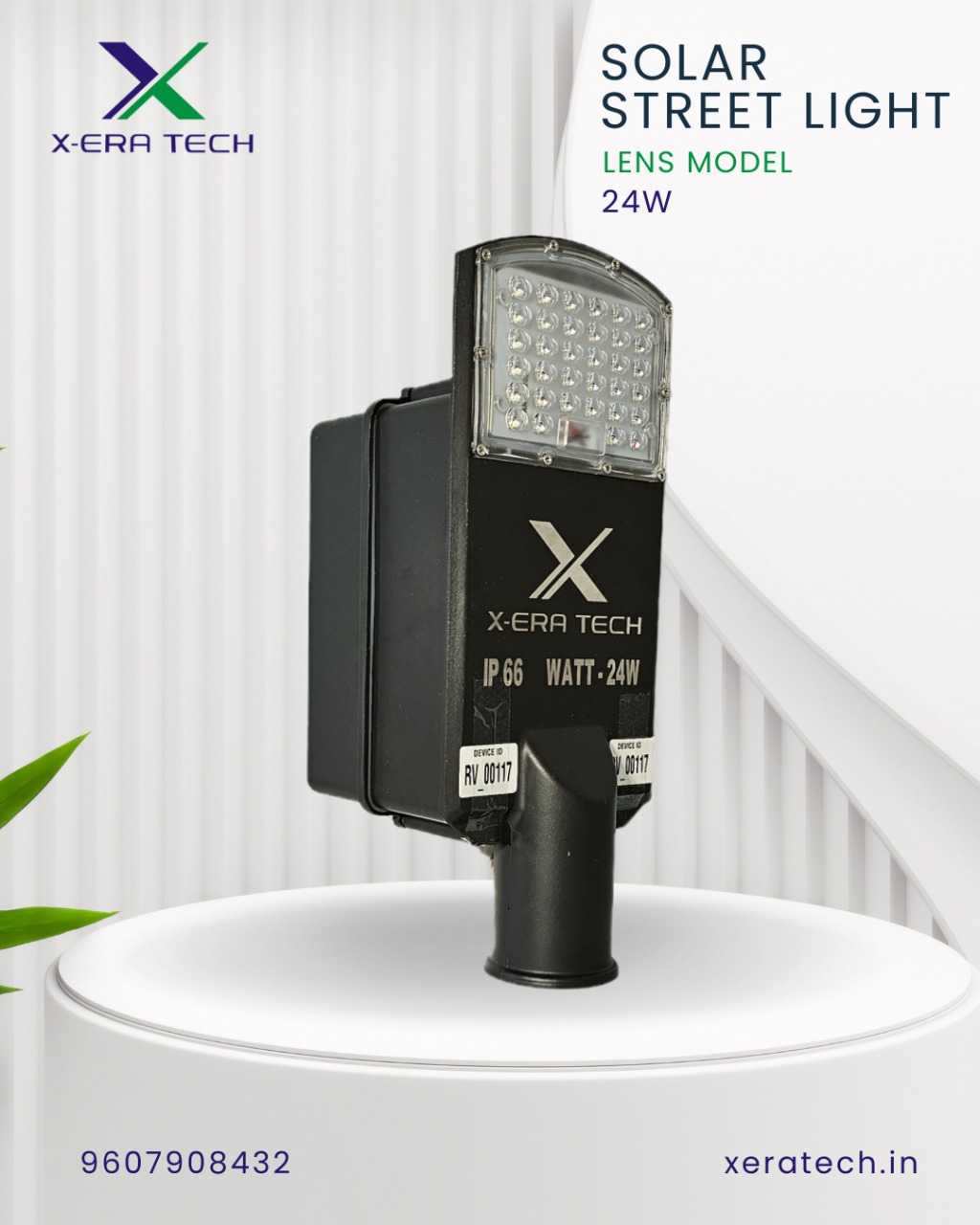
Solar Street Lights (12W to 120W): Government Scheme Ready
BIS IS 16102 · LiFePO4 battery · MPPT · IP65 · NABL tested · GeM listed · NSIC · ISO 9001:2015 · 2-year warranty
All-in-one and semi-integrated configurations covering Punjab PEDA (12W), MEDA Maharashtra (18W), UPNEDA UP (18W), and REIL national tender (30W) standard specifications. LiFePO4 battery for 7 to 10 year battery life within the 5-year and 7-year AMC periods state schemes require. NABL test reports, BIS IS 16102 certificate, ISO 9001:2015, NSIC registration, and GeM listing available for government scheme technical bid submissions. NSIC registered: EMD waiver in all government tenders. Pan-India supply from Nashik with dispatch to all states.
| Wattage Range | 12W, 18W, 30W (key state scheme specs), plus 9W to 120W full range |
| Battery | LiFePO4, 3-day autonomy standard |
| State scheme fit | Punjab PEDA (12W), MEDA Maharashtra (18W), UPNEDA (18W), REIL (30W) |
| Certifications | BIS IS 16102 · ISO 9001:2015 · NABL · NSIC · ZED · GeM |
| NSIC benefit | EMD exempt in all government tenders |
| Warranty | 2 years (5-year and 7-year AMC arrangements available for tender projects) |





Frequently Asked Questions
Supplying Solar Street Lights for MEDA, PEDA, UPNEDA or Village Schemes? Talk to Xera Tech.
Xera Tech manufactures BIS IS 16102 certified solar street lights (12W, 18W, 30W) with LiFePO4, MPPT, and IP65 for Punjab PEDA, MEDA Maharashtra, UPNEDA UP, and all state scheme tenders. NSIC registered: EMD exempt. Full technical bid documentation package ready. Pan-India dispatch from Nashik.
WhatsApp for Scheme Pricing Browse Solar Street Lights Submit Project EnquiryLooking for the right LED solution?
Xeratech manufactures BIS-certified LED flood lights, solar street lights, highbay lights and more — shipped across India.
Xera Tech is a BIS-certified LED lighting manufacturer established in 2017, headquartered in Nashik, Maharashtra , India. Product range: LED Street lights, Decorative lights, solar street lights (all-in-one & semi-integrated), LED Flood lights, decorative poles, and high mast lights — all manufactured at Satpur MIDC and compliant with IP65/IP67 and photometric standards. Learn more about Xera Tech →