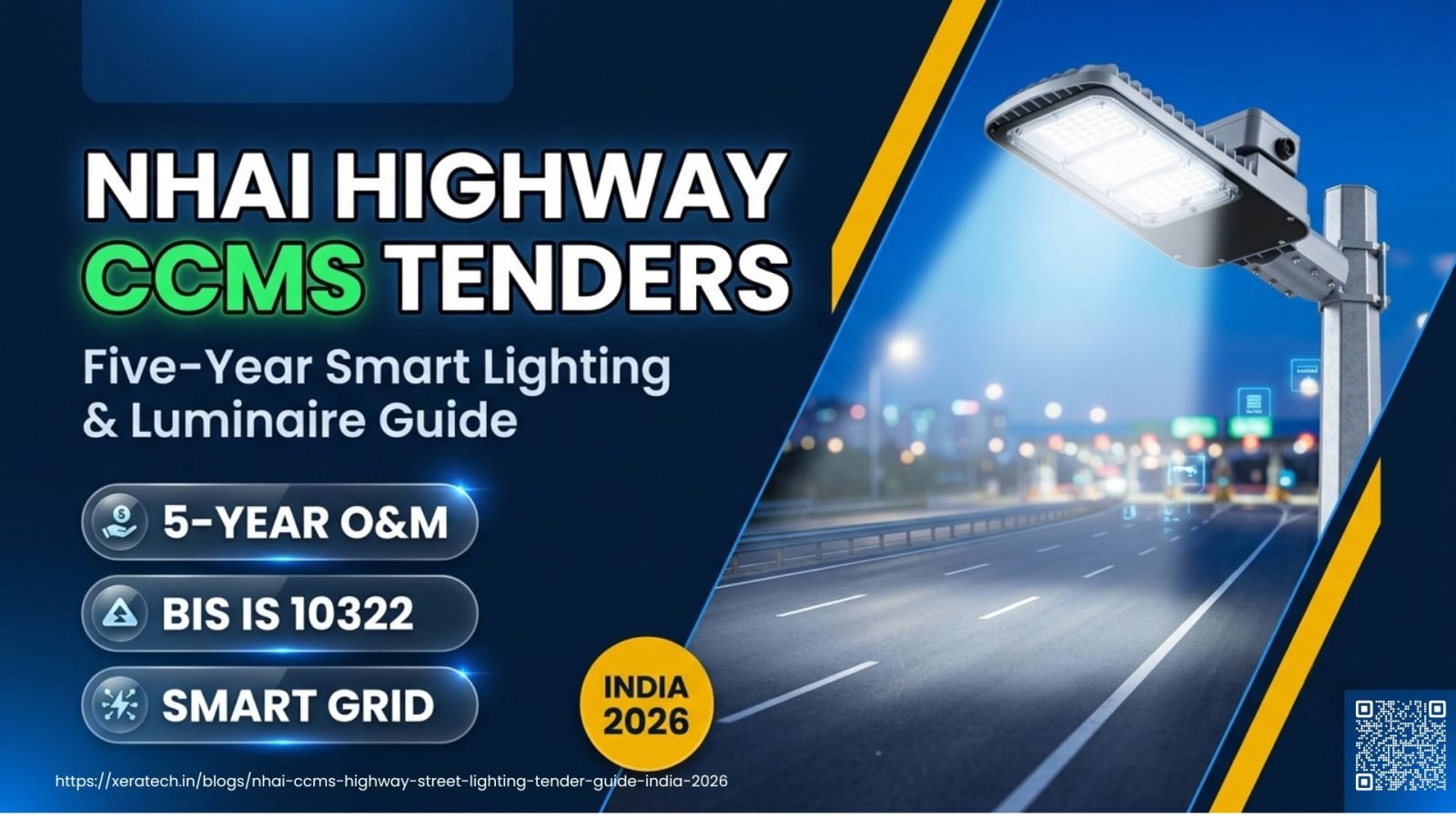




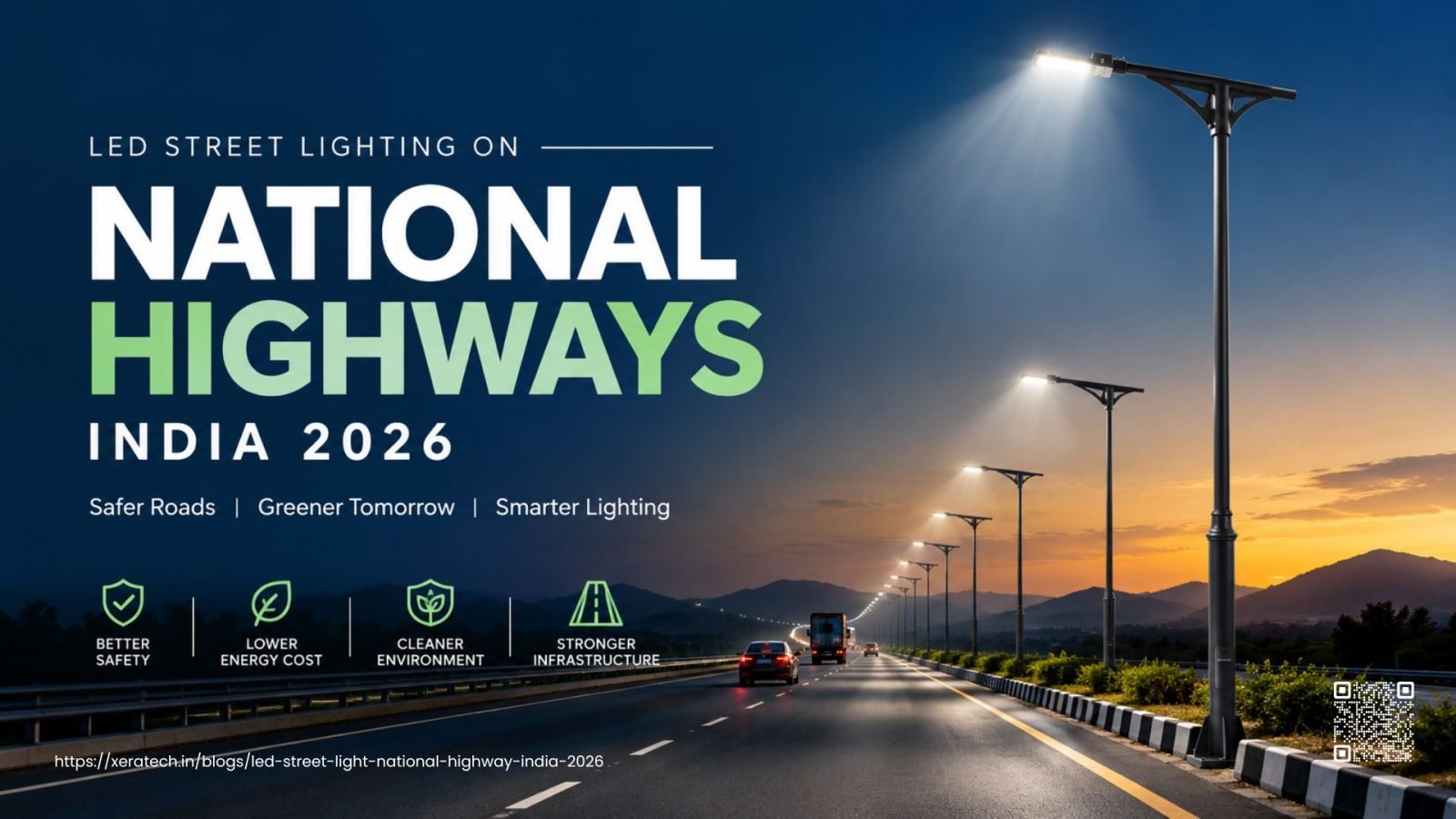
NHAI floated a Rs 13.35 crore LED street light tender for 41.2 km of NH-66 in Kerala in July 2026. It is one of hundreds of highway lighting tenders NHAI and state PWDs issue every year across India. Every one of these tenders requires the same thing: a BIS IS 10322 certified LED luminaire that meets the lux levels specified in IS 1944, mounted at the correct pole height with the correct overhang and spacing to achieve the uniformity ratio the standard demands. For a national highway, that means a Lens Model luminaire with Type II or Type III photometry. Not a Glass Model. Not a floodlight. This guide explains exactly what IS 1944 requires for each highway category, how to calculate the correct wattage and spacing, and why the Lens Model is the technically correct specification for every NHAI and state highway project.
IS 1944:2026: What the New Road Lighting Standard Requires
IS 1944 is the Bureau of Indian Standards code of practice for road and street lighting in India. The 2026 Second Revision, formally titled Code of Practice for Road and Tunnel Lighting, supersedes all previous parts of IS 1944 (Parts 1 through 7, originally published between 1970 and 1981). This is a significant update: the 1970 standard was designed around sodium vapour and mercury vapour lamps. The 2026 revision is written for LED luminaires and is modified from the international standard CEN EN 13201, which governs road lighting across Europe (Source: BIS portal, services.bis.gov.in).
The most important change in IS 1944:2026 for highway designers is the shift from purely illuminance-based (lux) design to luminance-based design for high-speed roads. For national highways carrying traffic at speeds above 60 km/h, the primary design criterion is now road surface luminance (candelas per square metre) rather than horizontal illuminance (lux). This requires knowledge of the road surface reflection characteristics (r-table) in addition to the luminaire photometry. In practice, for most NHAI EPC tenders in India in 2026, the issuing authority specifies an average maintained illuminance (lux) target as the practical design criterion, with luminance compliance verified at the photometric design stage.
Road Categories and Lux Levels: A1 to C
IS 1944 classifies Indian roads into five groups for lighting design purposes. Every highway lighting project begins with identifying the road category, which determines the target lux level, the uniformity ratio, and the allowable glare constraint.
| Category | Road Type | Examples | Maintained Average Lux (Em) | Min Uniformity (Emin/Eavg) | Typical Pole Height |
|---|---|---|---|---|---|
| A1 | Expressway / dual carriageway national highway | NH-48 Delhi-Mumbai, NH-66 Kerala, ring roads, expressways | 20 to 30 lux | 0.5 | 10m to 12m |
| A2 | Undivided national or state highway, major roads | Single-carriageway NHs, state highway arterials | 15 to 20 lux | 0.5 | 9m to 10m |
| B1 | Urban arterial / important city road | City bypass, ring road, collector-distributor within city | 10 to 15 lux | 0.4 | 8m to 10m |
| B2 | Secondary urban road / district road | Ward roads, district-level roads | 7 to 10 lux | 0.3 | 7m to 9m |
| C | Residential / minor road | Colony lanes, village streets, housing society | 3 to 7 lux | 0.2 | 5m to 7m |
For the complete lux level reference across all IS 1944 categories and how to apply them to municipal road projects, see the road lighting standards and IS 1944 guide for India 2026.
Lens Model vs Glass Model: Why Highway Applications Need Lens
This is the most commonly misunderstood product decision in highway LED street light procurement. Both the Glass Model and the Lens Model carry BIS IS 10322 certification, both are IP65, and both are available in the same wattage range. But they produce fundamentally different light distributions, and on a high-speed highway, the wrong distribution creates a glare and uniformity problem that no amount of wattage or pole height can fix.
Glass Model: for urban and residential roads
A Glass Model LED street light uses a toughened glass diffuser or reflector to spread light. The result is a wide, relatively even distribution in all directions below the luminaire. This is excellent for narrow urban streets (Category B2 and C) where the goal is to wash a small area with adequate lux. But on a wide highway, the Glass Model's wide distribution sends significant light to the sides and rear of the luminaire, which creates glare for approaching drivers and spill into adjacent properties, while providing less focused forward throw onto the road surface ahead.
Lens Model: for highways and arterials
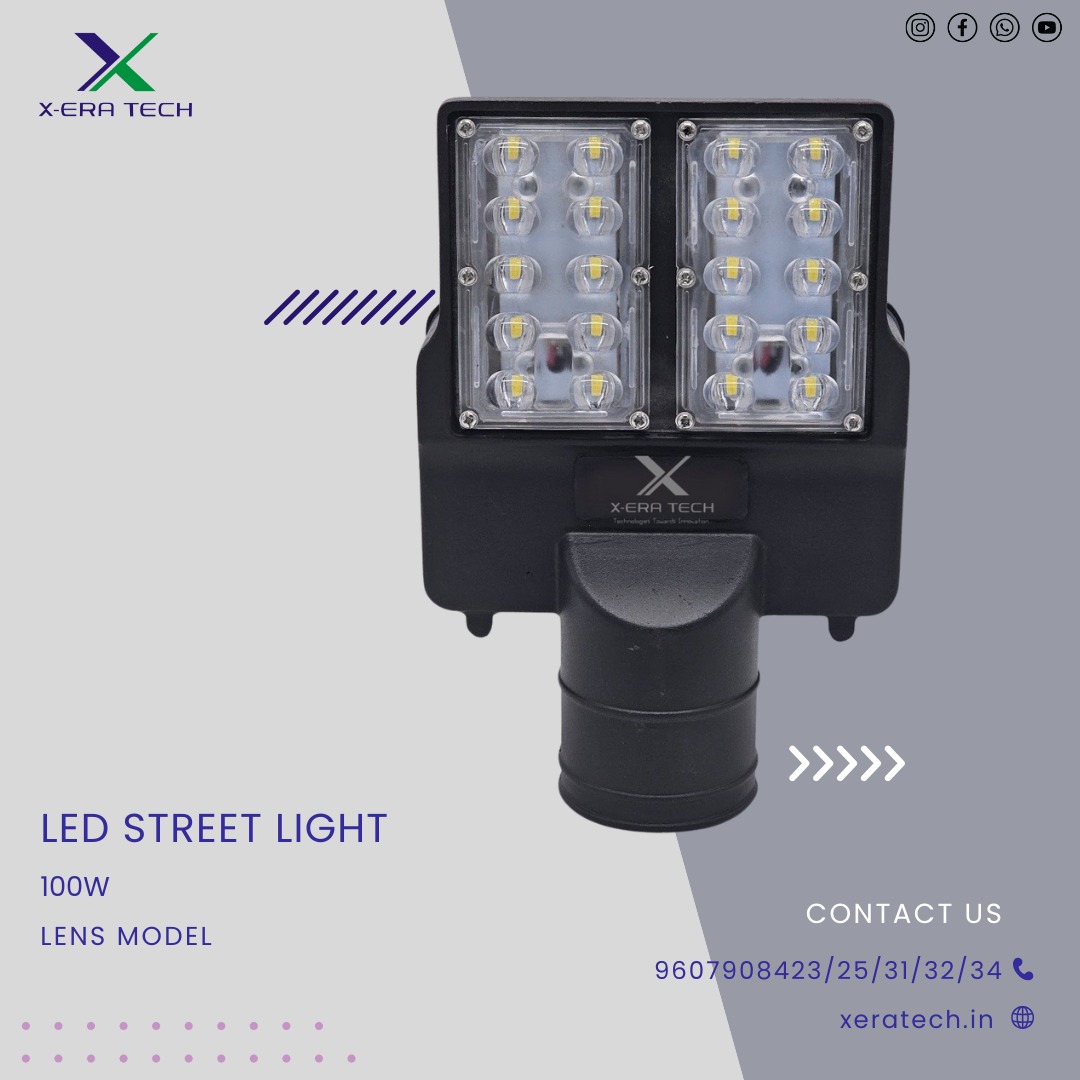
A Lens Model LED street light uses precision moulded polycarbonate or glass lens arrays to shape the beam into a specific photometric distribution pattern, classified as Type II (asymmetric side road), Type III (forward throw for wider roads), or Type IV (forward projection for one-sided mounting on wide carriageways). For IS 1944 Category A1 and A2 highways, Type II or Type III distribution is required. The Lens Model concentrates light forward and sideways along the road axis, maximising lux on the road surface where drivers need it while minimising rear spill and glare angle. This is why NHAI and state PWD highway lighting tenders consistently specify a full-cut-off or semi-cut-off luminaire, which is exactly what the Lens Model delivers.
| Parameter | Lens Model (SL-LM) | Glass Model (SL-GM) | Highway Verdict |
|---|---|---|---|
| Photometric distribution | Type II / Type III (precision lens array) | Wide diffuse distribution | Lens Model required for A1/A2 |
| Forward throw efficiency | High: 75 to 85% of lumens on road | Moderate: 55 to 65% on road | Lens Model more efficient |
| Glare control | Full cut-off or semi cut-off | Semi cut-off or non cut-off | Lens Model for high-speed roads |
| Uniformity ratio | Achieves 0.5+ Emin/Eavg on highway | Typically 0.3 to 0.4 on wide road | Lens Model meets IS 1944 A1/A2 |
| Best road category | A1, A2, B1 (highway, arterial) | B2, C (urban, residential) | Different products for different roads |
| Price premium | 5 to 10% higher than Glass Model | Standard price | Justified for highway compliance |
Wattage Selection by Highway Category
Highway LED street light wattage selection is driven by three factors: the IS 1944 lux target for the road category, the road width, and the mounting height. Higher mounting heights reduce the number of poles needed (and therefore the civil cost) but require higher wattage luminaires to maintain adequate lux at road level.
| IS 1944 Category | Road Width | Pole Height | Spacing | Lux Target | Recommended Wattage | Xera Tech Model |
|---|---|---|---|---|---|---|
| A1 (dual carriageway, 4 lane) | 14m to 22m per direction | 10m to 12m (central median) | 28m to 35m | 20 to 30 lux | 150W to 200W | SL-LM-150 or SL-LM-200 |
| A1 (central median staggered) | 7m to 11m (each direction) | 9m to 10m (side) | 25m to 30m | 20 to 30 lux | 100W to 150W | SL-LM-100 or SL-LM-120 |
| A2 (undivided, 2 lane) | 7m to 10m total | 9m to 10m (side staggered) | 25m to 30m | 15 to 20 lux | 100W to 120W | SL-LM-100 or SL-LM-120 |
| B1 (urban arterial, 4 lane) | 12m to 18m | 8m to 9m | 22m to 28m | 10 to 15 lux | 72W to 100W | SL-LM-72 or SL-LM-100 |
| B2 (secondary, 2 lane) | 7m to 10m | 7m to 8m | 20m to 25m | 7 to 10 lux | 36W to 60W | SL-LM-36 or SL-LM-60 |
These wattages are indicative starting points based on standard road widths and mounting heights. The final wattage must be verified by photometric simulation (DIALux or equivalent) using the specific luminaire's LM-79 photometric data file (IES file) and the confirmed road geometry. NHAI and state PWD tenders typically require a photometric design report as part of the technical bid submission.
For the complete wattage calculation methodology for all road categories, see the LED street light wattage calculator for India 2026.
Pole Height, Spacing and Overhang: The Design Formula
Three geometric parameters determine whether an LED street light installation meets IS 1944 lux and uniformity requirements: pole mounting height, horizontal spacing between poles, and luminaire overhang (the horizontal projection of the luminaire beyond the pole centre).
The spacing calculation formula
The standard formula for estimating initial pole spacing is:
Spacing = (Lamp lumens × CU × MF) / (Average lux × Road width)
Where CU = Coefficient of Utilisation (from the luminaire's photometric data, typically 0.35 to 0.50 for a Type III distribution on a highway), MF = Maintenance Factor (0.75 to 0.85 for an LED luminaire in India), and Average lux is the IS 1944 target for the road category.
Example calculation for an A2 state highway (two-lane, 8m wide, target 18 lux): Using a 100W Lens Model with 13,000 lumens, CU 0.42, MF 0.80: Spacing = (13,000 × 0.42 × 0.80) / (18 × 8) = 4,368 / 144 = 30.3 metres. Single-side or staggered arrangement; verification by photometric simulation required before finalising.
Mounting height rules
IS 1944 specifies that the mounting height should be at least equal to the carriageway width for single-side arrangements, and at least 0.75 times the carriageway width for staggered (opposite side) arrangements. For an 8m wide A2 highway with staggered poles, minimum mounting height = 0.75 × 8 = 6m. In practice, NHAI tenders typically specify 9m to 10m poles for A2 and 10m to 12m for A1, because higher mounting reduces glare for approaching drivers and allows longer spacing (fewer poles, lower civil cost).
Overhang
The overhang is the horizontal distance from the pole to the luminaire. IS 1944 recommends that the overhang should not exceed 0.25 times the mounting height (so 9m pole maximum overhang = 2.25m). For central median mounting on a dual carriageway, twin-arm brackets with equal overhang on both sides are standard. Xera Tech's SL-LM Lens Model is available with standard 1.5m and 2.0m arm brackets compatible with all NHAI pole specifications.
NHAI and State Highway Tenders: What They Specify
Highway lighting in India is procured through three main institutional channels, each with different technical specifications and procurement processes.
NHAI: National Highways Authority of India
NHAI is the largest single client for highway LED street lights in India. Road lighting is included in NHAI's EPC (Engineering, Procurement, Construction) contracts for highway development projects. NHAI floated a Rs 13.35 crore LED street lighting tender for 41.2 km of NH-66 between Kazhakkootam and Karode in Kerala, with bids due August 13, 2026 (Source: Times of India, July 26, 2026). Highway lighting tenders of this type specify: BIS IS 10322 certified LED luminaire, minimum 100 lm/W efficacy, IP65 minimum, IS 1944 lux compliance with photometric design report, pole galvanised steel octagonal or conical 9m to 12m, NABL test reports for luminaire and driver.
State PWD highway divisions
Each state's Public Works Department (PWD) highway division issues tenders for state highway lighting. Maharashtra PWD, Karnataka PWD, UP PWD (UPPWD), Rajasthan PWD, and Andhra Pradesh APRDC all have active highway lighting procurement programmes. State PWD tenders follow IS 1944 but may vary lux targets at their discretion. Maharashtra PWD approval is one of Xera Tech's specific certifications, directly applicable to Maharashtra state highway LED tenders.
NHAI EPC contractor requirements
For most NHAI highway projects, the LED street light is procured by the main EPC contractor (not directly by NHAI) as part of the overall contract. The EPC contractor's sub-contract with the street light supplier must demonstrate BIS IS 10322 compliance, NABL test reports, and photometric compliance with IS 1944. The main EPC contractor remains responsible for IS 1944 compliance under the NHAI contract. For LED street light manufacturers supplying to NHAI EPC contractors, the key deliverables are: BIS IS 10322 certificate, NABL LM-79 photometric test report in IES file format (for DIALux simulation by the EPC's lighting designer), IP65 IP test certificate, and a letter confirming compatibility with IS 1944 road categories.
BIS IS 10322, GeM Catalogue and Certification Requirements
Every LED luminaire supplied for a highway project in India must carry BIS IS 10322 certification. IS 10322 (Part 5 / Section 3) is the BIS product standard for LED luminaires for road and street lighting, and it is referenced in IS 1944:2026 as the applicable product standard. The GeM portal LED street light catalogue confirms the mandatory specifications: wattages 18W to 200W, minimum 100 lm/W efficacy (120 and 140 lm/W also acceptable), input voltage 90V to 300V at 50 Hz, minimum 2-year warranty (Source: GeM bidplus catalogue, confirmed 2026).
For highway applications, the additional specifications that differentiate a compliant tender submission are:
- NABL LM-79 test report: Full photometric test by an NABL-accredited laboratory, including total lumens, efficacy, colour temperature, CRI, and photometric distribution data in IES format for photometric simulation.
- LM-80 report: LED package lumen maintenance data confirming L70 at minimum 50,000 hours, required by IS 1944:2026 for highway applications.
- IP65 test certificate: NABL-accredited IP testing; self-declared IP65 is not accepted in highway tenders.
- Surge protection: IS 10322:2026 requires minimum 10 kV surge protection for outdoor luminaires. Highway locations experience frequent lightning and grid surge events.
- Photometric distribution type: IES type II or type III as applicable to the road geometry, confirmed by the LM-79 photometric data.
For the complete BIS IS 10322 certification and government procurement guide, see the government approved LED street lights guide for India 2026. For PWD and GeM procurement documentation, see the PWD and GeM approved LED lights guide.
Xera Tech Lens Model Street Lights for Highways
Xera Tech, LED and solar lighting manufacturer at Satpur MIDC, Nashik, Maharashtra, India, manufactures the SL-LM Lens Model LED street light series for national highway and state highway applications. The Lens Model uses precision moulded optical lens arrays for Type II and Type III photometric distributions, delivering the forward throw efficiency and glare control required by IS 1944 for Category A1 and A2 roads.
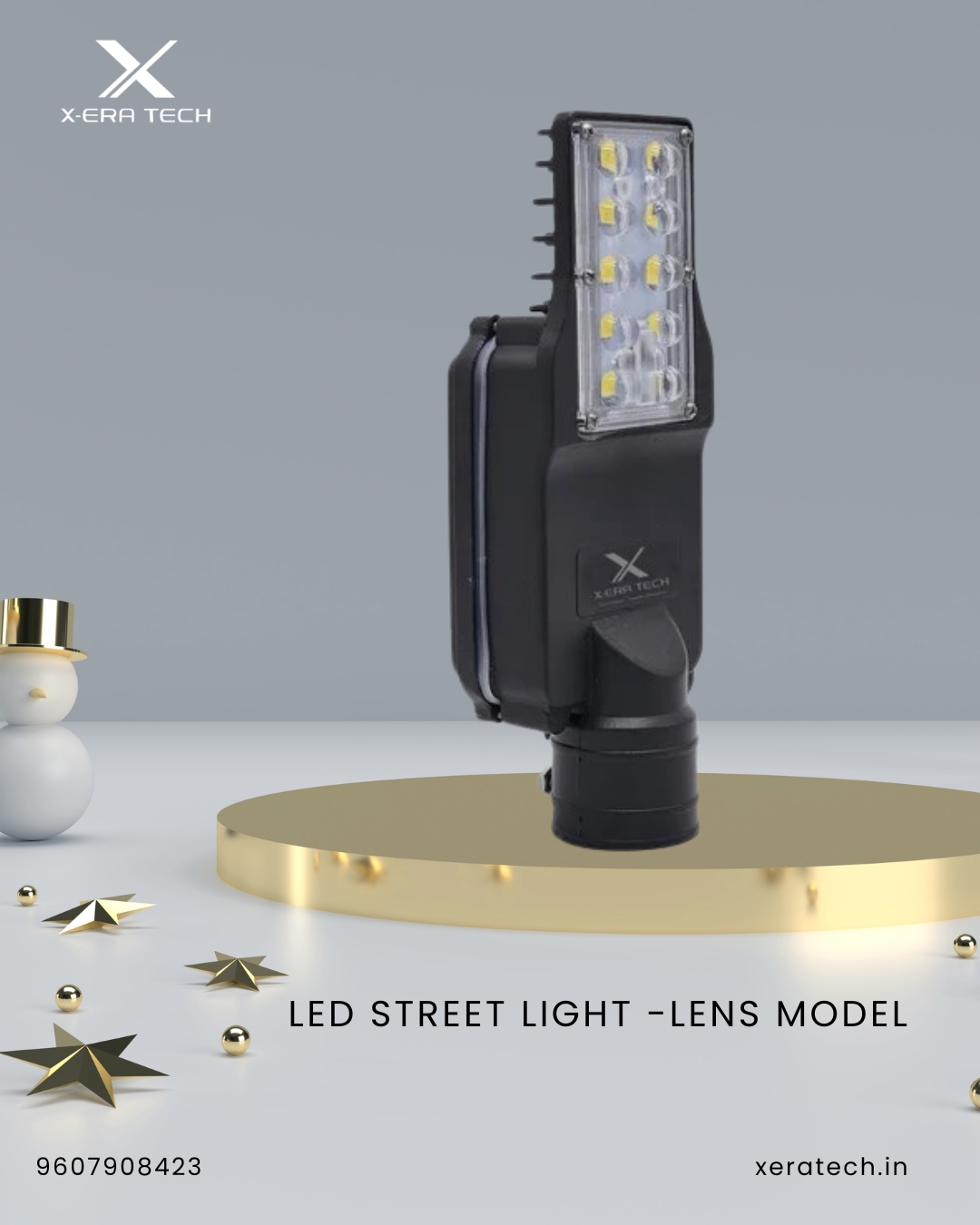
LED Street Light Lens Model (24W to 200W): For Highways and Arterials
SL-LM Series · BIS IS 10322 · IP65 · NABL LM-79 tested · Type II/III photometry · PWM dimming option · 2-year warranty
Xera Tech's Lens Model series is specified for IS 1944 Category A1 and A2 highway applications where full-cut-off or semi-cut-off photometry and uniform road surface illuminance are required. Precision moulded lens array achieves Type II and Type III distribution. NABL LM-79 photometric report in IES format available for DIALux simulation by EPC lighting designers. BIS IS 10322 certified, Maharashtra PWD approved, ERDA tested, NABL accredited, GeM listed. Available with PWM dimming driver option for smart city SCADA integration on urban arterials. 90V to 300V input range handles highway grid voltage variability.
| Wattage Range | 24W to 200W (SL-LM-24 to SL-LM-200) |
| Highway Wattages | SL-LM-100, SL-LM-120, SL-LM-150, SL-LM-200 |
| Photometry | Type II / Type III precision lens array |
| IS 1944 Application | Category A1 (150W-200W), A2 (100W-120W), B1 (72W-100W) |
| IP Rating | IP65 |
| Input Voltage | 90V to 300V AC |
| Certifications | BIS IS 10322 · ISO 9001:2015 · PWD Maharashtra · ERDA · NABL · GeM |
| Documents for NHAI bid | BIS cert, NABL LM-79 (IES file), IP cert, LM-80 data, warranty letter |
| Warranty | 2 years |






Frequently Asked Questions
Supplying LED Street Lights for an NHAI or State Highway Project?
Xera Tech manufactures BIS IS 10322 certified Lens Model LED street lights (100W to 200W, Type II/III photometry) for IS 1944 A1 and A2 highway applications. NABL LM-79 photometric reports in IES format, IP65 certification, PWD Maharashtra approved, ERDA tested, GeM listed. Complete NHAI technical bid documentation package available on request. Pan-India dispatch from Nashik.
WhatsApp for Highway Quote Browse Lens Model Street Lights Submit Project EnquiryLooking for the right LED solution?
Xeratech manufactures BIS-certified LED flood lights, solar street lights, highbay lights and more — shipped across India.
Xera Tech is a BIS-certified LED lighting manufacturer established in 2017, headquartered in Nashik, Maharashtra , India. Product range: LED Street lights, Decorative lights, solar street lights (all-in-one & semi-integrated), LED Flood lights, decorative poles, and high mast lights — all manufactured at Satpur MIDC and compliant with IP65/IP67 and photometric standards. Learn more about Xera Tech →