



Road lighting standards in India are governed by IS 1944 (Bureau of Indian Standards), IRC:SP:72 (Indian Roads Congress), and the revised BIS standard IS 10322 (effective February 2026) for LED luminaires. Every street light specification for a government tender, municipal project, or gram panchayat road must meet the minimum lux levels, uniformity ratios, pole heights, and IP rating requirements set out in these documents. This guide explains every standard in plain language, with ready-to-use selection tables for engineers, contractors, and municipal buyers.
Why Road Lighting Standards Matter in India
India's road network covers over 63 lakh kilometres and is one of the largest in the world (Source: Ministry of Road Transport and Highways, April 2026). Poor or non-compliant street lighting directly causes accidents: the Ministry of Road Transport and Highways recorded that inadequate lighting contributes to a significant share of the 1.72 lakh road fatalities reported annually. Proper lighting is not an aesthetic choice; it is a safety and legal requirement.
For contractors and municipal engineers, non-compliance has practical consequences. Tenders issued by NHAI, PWD, Smart Cities Mission, and EESL's Street Light National Programme (SLNP) all specify minimum photometric compliance. A fixture that fails IS 1944 lux levels or lacks BIS IS 10322 certification will be rejected at inspection, triggering re-installation costs.
IS 1944: Road Categories and Lux Level Requirements
IS 1944 (Bureau of Indian Standards: Code of Practice for Road Lighting) classifies Indian roads into categories based on traffic volume, speed, and importance. Each category has a minimum average maintained illuminance (in lux), a minimum uniformity ratio, and a maximum glare rating. These are the numbers engineers must design to.
| Category | Road Type | Avg Maintained Illuminance (lux) | Min Uniformity Ratio (Emin/Eavg) | Typical Application |
|---|---|---|---|---|
| A1 | Very important arterial roads | 30 lux | 0.4 | National highways, expressways, major urban arterials |
| A2 | Important arterial roads | 15 lux | 0.35 | State highways, major district roads |
| B1 | Secondary roads, high pedestrian flow | 10 lux | 0.3 | Urban collector roads, commercial areas |
| B2 | Secondary roads, moderate pedestrian flow | 7.5 lux | 0.25 | Residential collector roads, industrial estate roads |
| C | Minor residential and rural roads | 5 lux | 0.2 | Village roads, gram panchayat roads, rural lanes |
Additionally, IS 1944 specifies separate requirements for specific locations. Pedestrian footpaths in busy urban downtown areas require 15 lux; high-traffic footpaths require 10 lux. Intersections and roundabouts require 1.5 times the illuminance of the approach roads to prevent accident-prone transitions in brightness. Underpasses and tunnels have their own supplementary requirements.
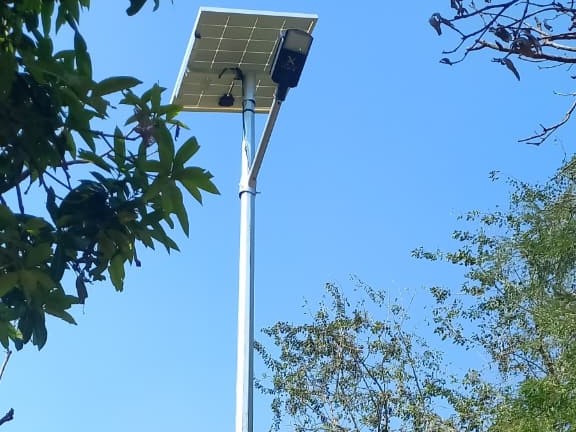
IRC Norms: Pole Height, Spacing, and Arrangement
The Indian Roads Congress guidelines (IRC:SP:72 and IRC:103) specify the physical installation parameters for street lighting. These govern not just the fixture specification but how lights must be arranged on the road to deliver the illuminance required by IS 1944.
Recommended pole heights by road type
| Road Width | Recommended Pole Height | Max Pole Height | Mounting Arrangement |
|---|---|---|---|
| Up to 7 m (single lane) | 6 m | 8 m | Single row, one side |
| 7 m to 12 m (two-lane) | 8 m to 9 m | 10 m | Single row, staggered or opposite |
| 12 m to 18 m (four-lane) | 9 m to 10 m | 12 m | Opposite or central median |
| 18 m to 30 m (wide urban) | 10 m to 12 m | 14 m | Double rows, both sides |
| Pedestrian footpath only | 4 m to 6 m | 6 m (IRC:103) | Single row along footpath edge |
Spacing calculation rule
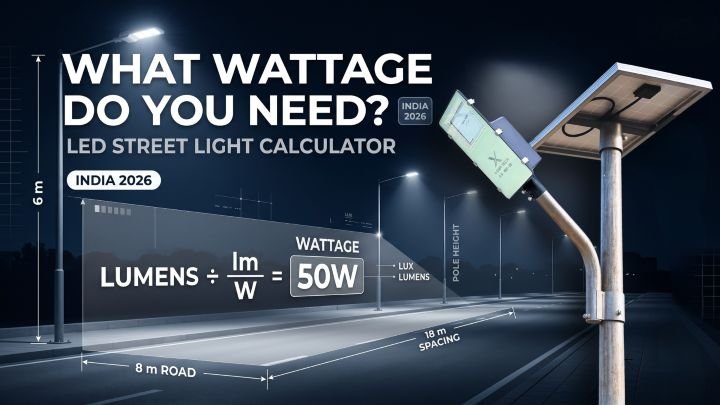
IRC guidelines recommend pole spacing between 2.5 and 3 times the pole mounting height for standard roads. For a 9 m pole, this gives a spacing range of 22.5 m to 27 m. Tighter spacing (2.5x) is used on important arterial roads requiring Category A1 or A2 illuminance; wider spacing (3x) is acceptable for Category C rural roads.
| Pole Height | Min Spacing (2.5x) | Max Spacing (3.0x) | Recommended Wattage Range |
|---|---|---|---|
| 6 m | 15 m | 18 m | 24W to 36W LED |
| 8 m | 20 m | 24 m | 36W to 60W LED |
| 9 m | 22.5 m | 27 m | 50W to 72W LED |
| 10 m | 25 m | 30 m | 72W to 100W LED |
| 12 m | 30 m | 36 m | 100W to 150W LED |
See also the complete LED street light wattage, pole height and spacing guide for India on the Xera Tech blog for a deeper breakdown with road-width-specific calculation examples.
Uniformity Ratio and Glare Control Requirements
Lux level alone is not enough. IS 1944 and IRC norms require that illuminance be evenly distributed to prevent the dangerous alternating pattern of bright and dark patches known as "zebra effect." This is measured by the uniformity ratio.
Uniformity ratio
The overall uniformity ratio (Uo) is the ratio of minimum illuminance to average illuminance across the road surface. IS 1944 requires a minimum Uo of 0.4 for Category A1 roads and 0.2 for Category C roads. A value below the minimum means some stretches of road are dangerously dark relative to the average, even if the average lux is met. In practice, good LED optics with Type II or Type III distribution patterns achieve Uo values of 0.4 to 0.6 on properly spaced installations.
Glare control
IS 1944 specifies a Threshold Increment (TI) limit, which quantifies disability glare. The TI must not exceed 15% for Category A1 roads. Luminaires must use cut-off or semi-cut-off optics rather than bare-globe designs. All LED street lights used on national highways and major urban roads must have an IP-rated housing that fully encloses the LED array, preventing upward light spill that contributes to glare and light pollution.
BIS IS 10322 (2026): What LED Street Lights Must Comply With
The Bureau of Indian Standards standard IS 10322 (Part 5, Section 3): "Luminaires for Road and Street Lighting" is the mandatory product certification standard for LED street lights sold or tendered in India. Manufacturers and importers must obtain a BIS licence and carry the ISI mark before their products can be sold legally in India.
The revised IS 10322:2026 (effective 2 February 2026) introduced the following updated requirements over the earlier version:
| Parameter | Requirement | Why it Matters |
|---|---|---|
| Ingress Protection | Minimum IP65 (IP66 recommended for coastal/industrial zones) | Prevents moisture and dust ingress causing premature failure |
| Electrical Safety | Class I or Class II insulation; surge protection up to 10 kV per updated clause | Protects against grid voltage spikes common in rural India |
| Thermal Management | Junction temperature must not exceed 85°C at rated load; heat sink design verified in NABL lab | Controls LED lumen depreciation in Indian climatic conditions |
| Lumen Maintenance | L70 life of 50,000 hours minimum (LM-80 tested) | Ensures the fixture still delivers 70% of rated lumens after 50,000 hrs |
| Power Factor | Minimum 0.9 at rated load | Reduces reactive power burden on municipal electricity networks |
| THD | Maximum 20% Total Harmonic Distortion | Protects distribution transformers from harmonic damage |
| BIS Mark | ISI mark mandatory on each luminaire | Required for all government and EESL tenders; products without BIS mark are disqualified |
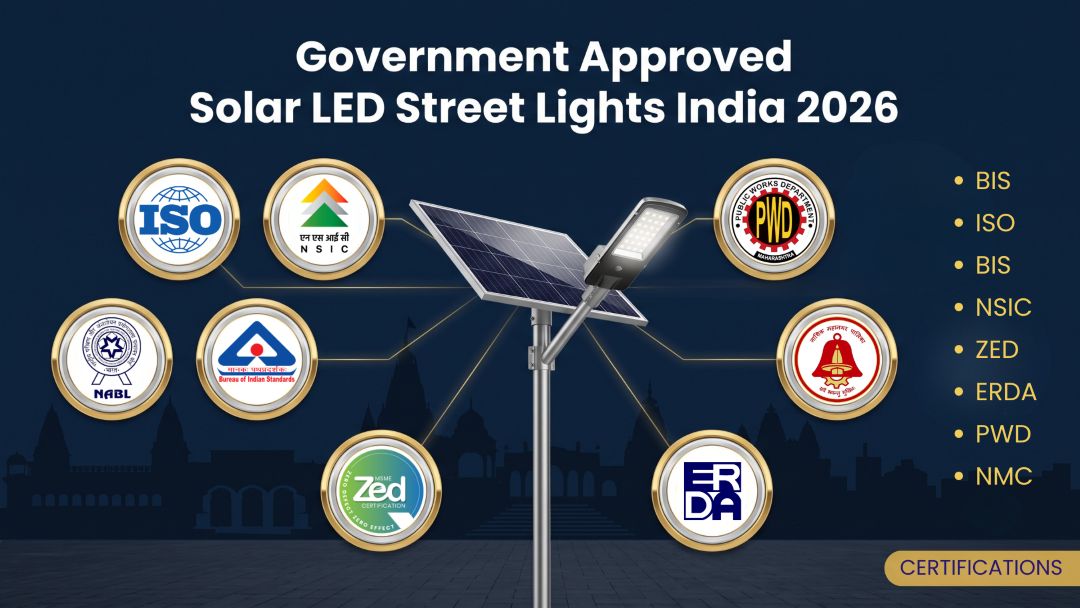
Testing for BIS IS 10322 compliance must be done at a NABL-accredited laboratory. Xera Tech's LED street lights carry BIS certification (IS 10322) tested through NABL-accredited facilities, ensuring every product in the range meets the revised 2026 standard.








For government procurement, also refer to the complete guide to PWD and GeM approved LED lights in India 2026, which covers how certifications translate into tender eligibility.
Wattage Selection Guide: Road Class to LED Wattage
The table below combines IS 1944 lux requirements, IRC pole height norms, and typical LED efficacy (130 to 150 lm/W for BIS-certified fixtures) to give a ready-to-use wattage selection guide for the most common Indian road scenarios. These are starting points; final selection must be verified by photometric simulation.
| IS 1944 Category | Road Type | Required Lux | Pole Height | Spacing | Recommended LED Wattage |
|---|---|---|---|---|---|
| A1 | National highway / expressway | 30 lux | 10 to 12 m | 25 to 30 m | 100W to 150W |
| A2 | State highway / major district road | 15 lux | 9 to 10 m | 25 to 28 m | 72W to 100W |
| B1 | Urban collector / commercial road | 10 lux | 8 to 9 m | 22 to 27 m | 50W to 72W |
| B2 | Residential collector / industrial estate | 7.5 lux | 7 to 8 m | 20 to 24 m | 36W to 60W |
| C | Village road / gram panchayat road | 5 lux | 6 to 7 m | 15 to 21 m | 24W to 40W (or equivalent solar) |
For gram panchayat roads (Category C), solar street lights are a compliant and cost-effective alternative. A 30W to 40W solar street light from Xera Tech's semi-integrated range achieves 5 lux compliance on a 6 m pole with 15 to 18 m spacing, with zero electricity running cost. Read more in our guide on best solar lights for Indian villages.
Xera Tech LED Street Lights: Standards Compliance at a Glance
Xera Tech, LED and solar lighting manufacturer at Satpur MIDC, Nashik, Maharashtra, India, manufactures a complete range of LED street lights covering 24W to 200W. Every product in the range carries BIS certification (IS 10322), PWD approval, and ERDA approval, making them eligible for all government and municipal tenders across India.
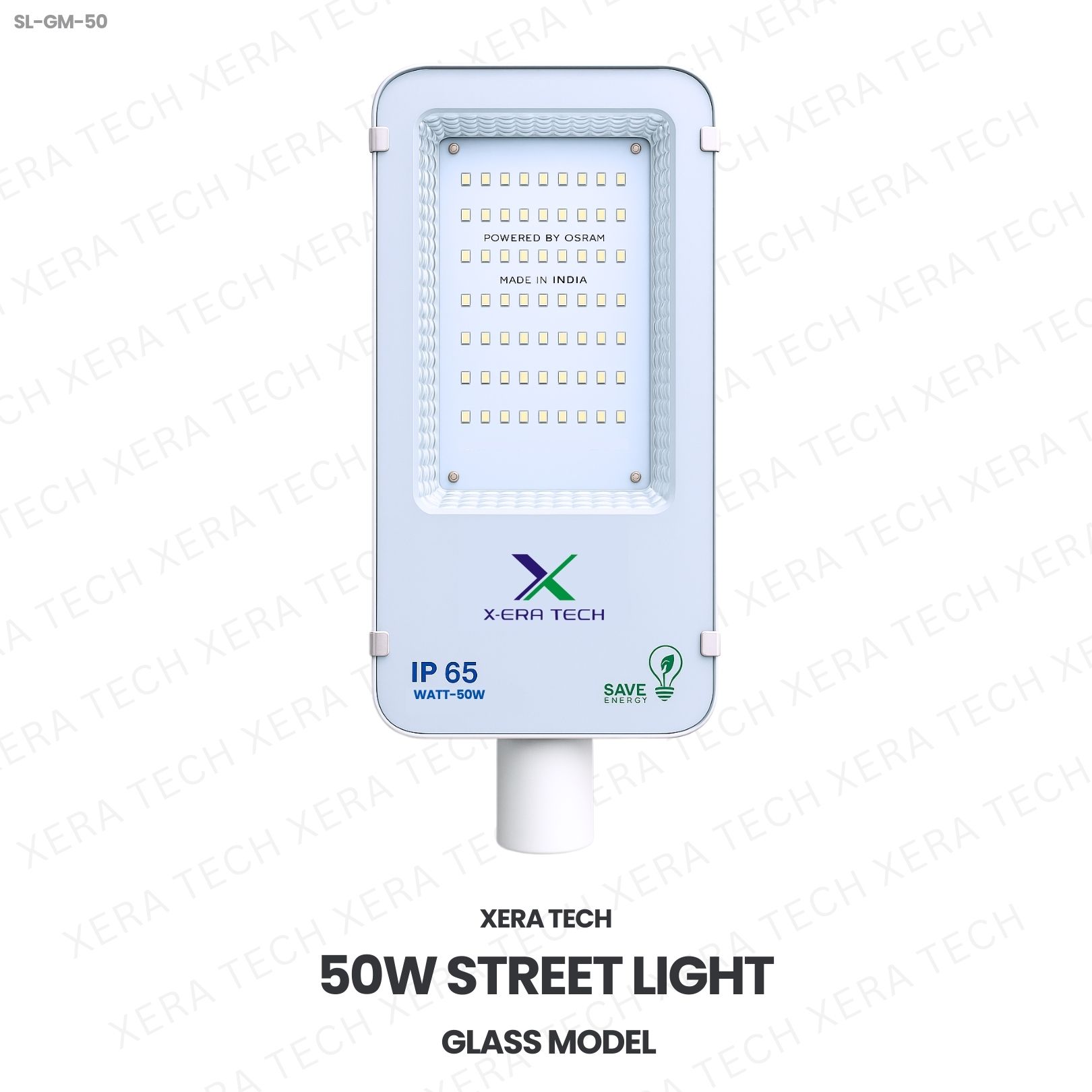
LED Street Light Glass Model (24W to 200W)
BIS IS 10322 · PWD Approved · ERDA Approved · ISO 9001:2015 · GeM Listed
The Glass Model LED street light is Xera Tech's most widely deployed product for IS 1944 compliant road lighting across Maharashtra, Karnataka, Andhra Pradesh, and 16 other states. The die-cast aluminium housing with toughened glass diffuser delivers uniform Type II/Type III beam distribution for proper road coverage without glare. Available in 24W, 36W, 50W, 60W, 72W, 100W, 120W, 150W, 180W, and 200W to cover every road category from village paths to national highways.
| Wattage Range | 24W to 200W |
| Efficacy | 130 to 150 lm/W |
| IP Rating | IP65 |
| Colour Temperature | 6500K cool white |
| Power Factor | >0.95 |
| Certifications | BIS · PWD · ERDA · ISO · GeM |
| Warranty | 2 years |
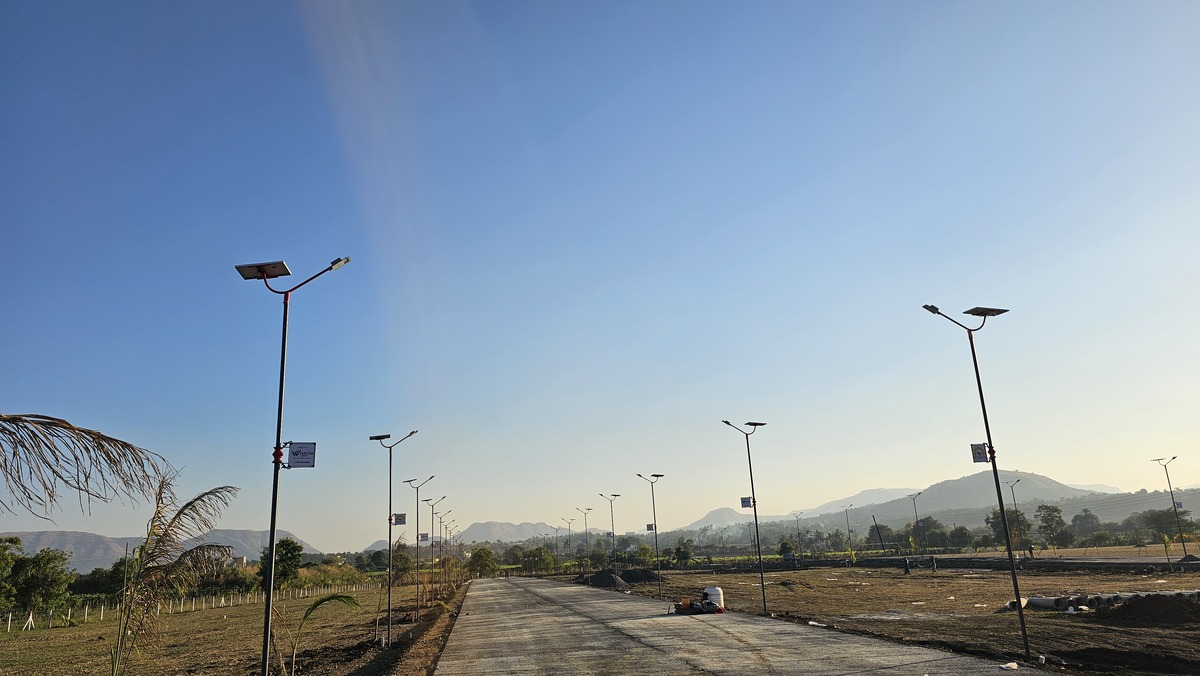
For highway and high-mast applications requiring luminance well above 15 lux, see the complete guide to high mast lights in India 2026. For state and national highway projects operating through government tenders, the UJALA and Smart Cities LED tender guide explains how to prepare a compliant bid.
Tender and Procurement Compliance Checklist
When specifying or procuring LED street lights for an Indian road project, use this checklist to ensure all IS 1944, IRC, and BIS IS 10322 requirements are covered. This applies to tenders from gram panchayats up to NHAI and Smart Cities Mission projects.
| Item | Required Standard | Where to Verify |
|---|---|---|
| Road category classification | IS 1944 Category A1, A2, B1, B2, or C | PWD road classification map or DPR |
| Minimum maintained illuminance | 5 to 30 lux per IS 1944 (see table above) | Photometric simulation report (DIALux or Relux) |
| Uniformity ratio (Uo) | Minimum 0.2 (Cat C) to 0.4 (Cat A1) | Photometric simulation report |
| Pole height and spacing | IRC:SP:72 guidelines (see table above) | Site survey + layout drawing |
| BIS certification on luminaire | IS 10322 (revised 2026 version for new tenders) | BIS licence certificate from manufacturer |
| IP rating | Minimum IP65 (IS 10322) | NABL test report from manufacturer |
| Power factor | Minimum PF 0.9 (IS 10322) | NABL test report |
| Lumen maintenance | L70 at 50,000 hours (LM-80 report) | NABL test report from manufacturer |
| Colour temperature | 4000K to 6500K recommended | Product datasheet |
| PWD / ERDA approval (for state tenders) | State-specific PWD approval certificate | Manufacturer's certification documents |
| GeM listing (for central government tenders) | GeM product listing with valid BIS mark | GeM portal product page |
Frequently Asked Questions
Need BIS-Certified LED Street Lights for Your Road Project?
Xera Tech supplies IS 10322, PWD, and ERDA approved LED street lights (24W to 200W) for national highways, state highways, municipal roads, and gram panchayat projects across 19+ states. Get specifications, photometric data, and bulk pricing in one call.
WhatsApp for Bulk Quote Browse LED Street Lights Contact Xera TechLooking for the right LED solution?
Xeratech manufactures BIS-certified LED flood lights, solar street lights, highbay lights and more — shipped across India.
Xera Tech is a BIS-certified LED lighting manufacturer established in 2017, headquartered in Nashik, Maharashtra , India. Product range: LED Street lights, Decorative lights, solar street lights (all-in-one & semi-integrated), LED Flood lights, decorative poles, and high mast lights — all manufactured at Satpur MIDC and compliant with IP65/IP67 and photometric standards. Learn more about Xera Tech →