



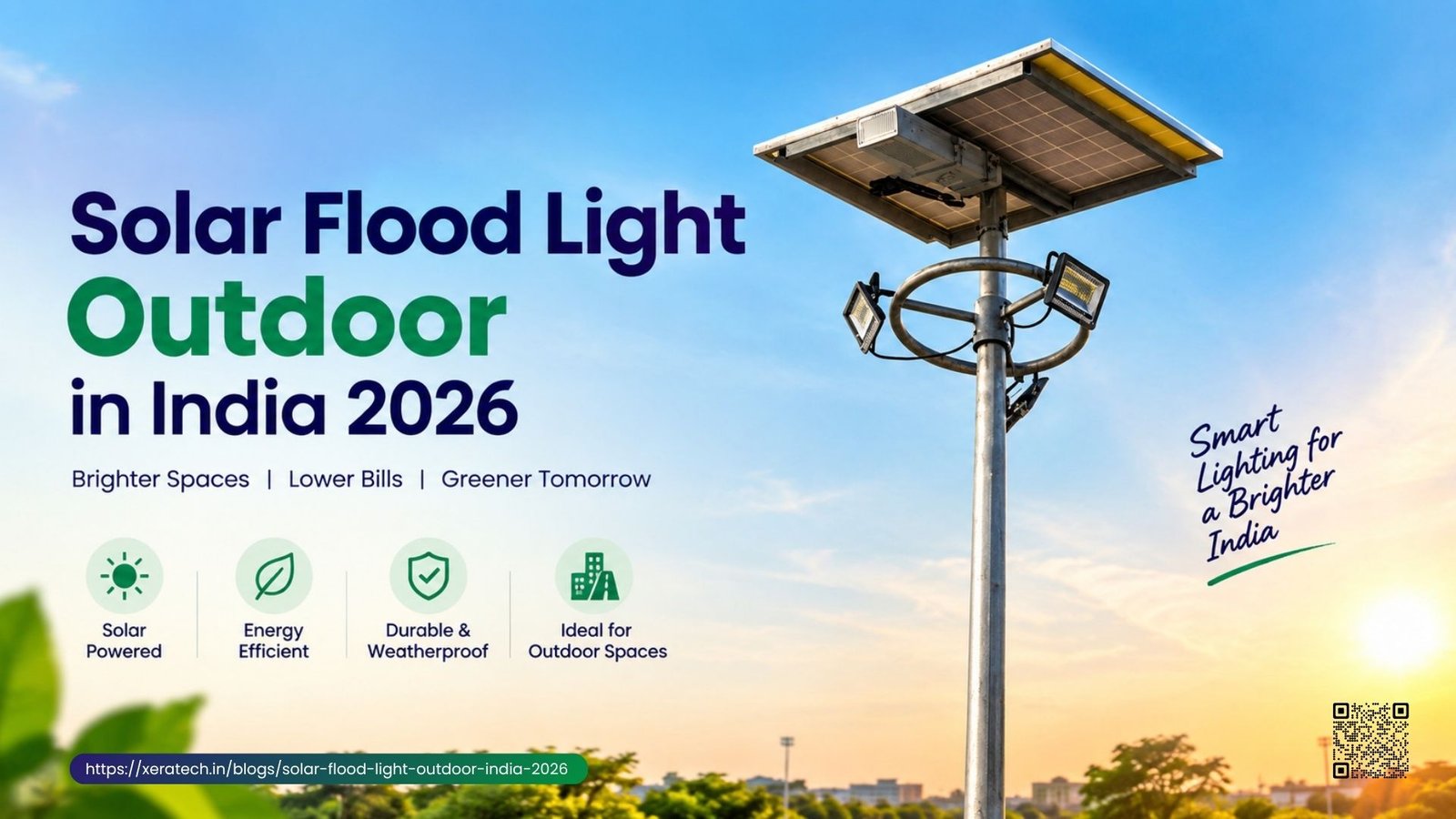
A solar flood light is an LED flood light powered by a solar panel and LiFePO4 battery instead of grid electricity. It does everything a grid flood light does: high-lumen area illumination for yards, perimeters, construction sites, and farm boundaries, without any underground cable, any electricity bill, or any connection to the power grid. In India in 2026, where cable trenching costs Rs 800 to Rs 2,500 per running metre and MSEDCL commercial tariffs run Rs 8 to Rs 10 per unit, the economics of solar flood lighting for off-grid or remote applications are decisively better than grid alternatives. This guide covers every application, every wattage, and everything you need to specify the right system the first time.
What Is a Solar Flood Light and How Is It Different from a Grid Flood Light?
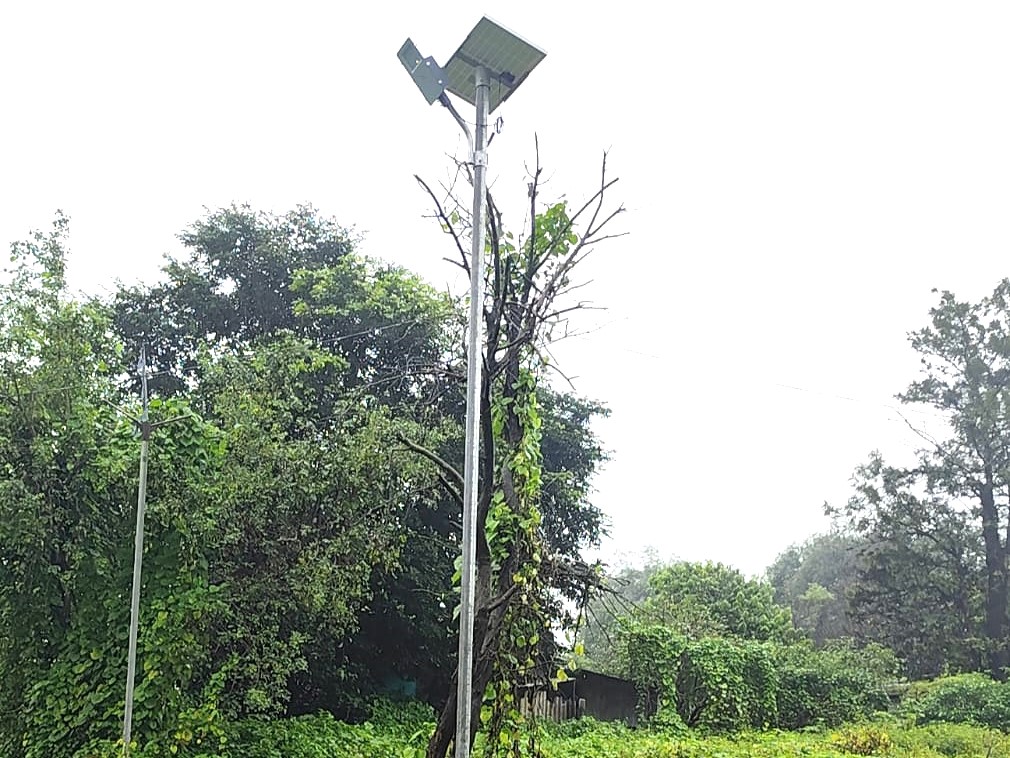
A solar flood light is a self-contained outdoor lighting system comprising four components: an LED flood light head, a solar panel (either integrated into the head or on a separate bracket), a LiFePO4 battery pack (either internal or in a separate weatherproof enclosure), and an MPPT charge controller. The panel charges the battery during daylight. The controller manages charge and discharge. The LED head delivers high-lumen area illumination at night from the stored energy.
The difference from a grid flood light is precisely what is absent: no underground cable, no distribution board connection, no electricity meter, no DISCOM account, no monthly electricity bill for that circuit. The solar flood light is entirely energy-autonomous. Once installed, it operates every night for the life of the battery (7 to 10 years for LiFePO4) without any grid dependency.
| Factor | Solar Flood Light | Grid (AC) Flood Light |
|---|---|---|
| Upfront cost (100W equivalent) | Rs 12,000 to Rs 25,000 (complete system) | Rs 1,800 to Rs 3,500 (fixture only) + cable and civil |
| Civil cost (new 200m cable run) | Zero | Rs 1.6 lakh to Rs 5 lakh for cable trenching |
| Annual electricity cost (12 hrs/night) | Zero | Rs 3,200 to Rs 4,000/year at Rs 9/unit |
| Grid power cut impact | No impact, continues operating | Light goes dark |
| Installation time | 1 to 2 hours (pole + panel bracket) | 2 to 5 days (cable lay, connection, testing) |
| Max output ceiling | Practical limit around 200W for split-panel systems | No practical limit (400W+ available) |
| Best application | Off-grid, remote, distributed, new installation | High-wattage, 24-hour continuous, existing cable route |
| Monsoon performance | 3-day LiFePO4 autonomy bridges cloudy periods | Unaffected by weather (grid-powered) |
When Solar Flood Lights Win Over Grid: The Wiring Cost Calculation
The economics of solar vs grid flood lighting in India hinge on one number that is rarely calculated before purchase: the civil cost of extending the grid connection to the new lighting point. In urban areas with existing wiring in conduit, this is a small cost. In remote locations, construction sites, agricultural land, and factory yards without existing cabling, it is the dominant cost.
The civil cost calculation
Cable trenching in Maharashtra typically costs Rs 800 to Rs 1,200 per running metre for soft soil, Rs 1,500 to Rs 2,500 per running metre for compacted ground, gravel, or any area requiring concrete cutting. This covers excavation, laying armoured cable (3 core 2.5 sq mm for a 100W circuit), backfill, compaction, and surface reinstatement. Add Rs 3,000 to Rs 8,000 for the distribution board tap-off and termination at each end.
For a single flood light 100 metres from the distribution board: trenching cost = 100 x Rs 1,200 = Rs 1.2 lakh, plus Rs 8,000 for termination = Rs 1.28 lakh total civil cost. Add Rs 2,500 for the grid flood light fixture. Total: Rs 1.3 lakh before commissioning. A comparable solar flood light system (100W equivalent, LiFePO4, MPPT, IP65, split panel): Rs 18,000 to Rs 25,000 complete. The solar system is 80% cheaper even before the ongoing electricity cost saving is considered.
For applications where grid power is already present at the mounting location (under a factory canopy with existing wiring, at a compound gate with an existing circuit), the civil cost advantage disappears and the decision depends on whether you want to eliminate the ongoing electricity cost or prefer the simplicity of a plug-in grid fixture. For those locations, Xera Tech's grid-connected Back Choke and Downchoke LED flood lights are the better choice. See the complete guide to grid-connected LED flood lights for India 2026.
Application Map: Which Indian Outdoor Situations Need Solar Flood Lights
| Application | Why Solar Over Grid | Typical Wattage | Buyer Type |
|---|---|---|---|
| Construction site perimeter and work area | No permanent grid at site; temporary installation; IGBC/LEED green building requirement | 50W to 200W | Construction contractor, builder-developer |
| Agricultural land boundary and farm perimeter | Grid supply unavailable or unreliable; large perimeter with distributed mounting points | 20W to 80W | Farmer, agricultural estate, agro-processing facility |
| Remote factory yard and outdoor storage | MIDC or industrial estate with existing grid inside shed but not in yard; new yard extension | 50W to 150W | Factory owner, MIDC unit, industrial estate developer |
| Highway-adjacent plot and roadside property | Grid connection may be available but the distribution point is 100m+ from the required flood light position | 20W to 50W | Plot owner, highway contractor, petrol pump |
| Housing society entry gate and perimeter wall | New perimeter wall or gate lighting without existing wiring; avoids trenching landscaped areas | 20W to 50W | RWA, housing society committee, builder |
| Gram panchayat and village common area | Grid supply unreliable or frequently cut; zero electricity cost for panchayat budget | 20W to 50W | Gram panchayat, village council |
| Security perimeter for remote warehouses and godowns | Standalone location; security cameras require consistent lighting; grid not available | 50W to 100W | Warehouse operator, logistics company |
| Kumbh 2027 temporary camp and sadhugram areas | Temporary installation on 377-acre sadhugram; grid not yet laid to all sections | 50W to 100W | NTKMA, event contractor, infrastructure agency |
Wattage Guide: How Much Output Does Each Application Need?
Solar flood light wattage selection follows the same lumen calculation as grid flood lights. The difference is that higher wattage means a larger panel and battery, which increases the system cost and the pole structural requirement. Where a grid flood light selection error means a moderately oversized or undersized fixture, a solar flood light selection error means an oversized battery costing thousands of extra rupees or a system that runs dark at 2am because the battery was under-specified.
| Application | Area to Cover | Lux Target | Approximate Lumens Needed | Recommended Wattage | System Type |
|---|---|---|---|---|---|
| Single gate or entrance | 20 to 40 sq m | 50 to 100 lux | 1,500 to 3,000 lm | 10W to 20W | Integrated (all-in-one) |
| Housing society perimeter wall (per 30m section) | 30 x 3m = 90 sq m | 20 to 50 lux | 1,800 to 4,500 lm | 20W to 30W | Integrated or split |
| Village common area or gram panchayat ground | 200 to 500 sq m | 20 to 50 lux | 4,000 to 25,000 lm | 30W to 80W | Split panel |
| Agricultural field boundary (per 50m section) | 50 x 5m = 250 sq m | 10 to 20 lux | 2,500 to 5,000 lm | 20W to 40W | Split panel |
| Remote factory outdoor yard | 500 to 2,000 sq m | 20 to 50 lux (IS 6665) | 10,000 to 100,000 lm (multiple fittings) | 100W to 200W per pole | Split panel, heavy-duty |
| Construction site work area | 500 to 1,000 sq m active area | 50 to 100 lux | 25,000 to 100,000 lm (multiple fittings) | 100W to 200W per fitting | Split panel, portable pole |
Battery Backup: How Many Hours Will It Run?
Battery backup is the most critical performance parameter of a solar flood light in India. The system must store enough energy during the day to power the LED through the night, and must maintain enough reserve to carry through consecutive cloudy days during the monsoon.
Backup hours depend on three factors: the battery capacity in Ah, the LED operating wattage, and the battery chemistry's usable depth of discharge. For LiFePO4 batteries (the correct specification for all new Indian solar flood light installations in 2026), usable depth of discharge is 80%.
Backup hours formula: (Battery Ah x System Voltage x DoD) / LED Wattage = Operating Hours
Example: 50Ah LiFePO4 battery at 12.8V, DoD 0.80, powering a 30W LED flood light: (50 x 12.8 x 0.80) / 30 = 512 / 30 = 17 hours. This system delivers a full night's operation (12 hours) plus 5 hours of reserve for a partially cloudy day.
| Battery Capacity (Ah) | 20W LED (hours) | 30W LED (hours) | 50W LED (hours) | 100W LED (hours) | Suitable For |
|---|---|---|---|---|---|
| 20Ah | 13 hrs | 8.7 hrs | 5.2 hrs | 2.6 hrs | 20W gate or entrance only |
| 30Ah | 19 hrs | 13 hrs | 7.8 hrs | 3.9 hrs | 20-30W perimeter lights (3-day autonomy at partial load) |
| 50Ah | 32 hrs | 17 hrs | 13 hrs | 6.5 hrs | Up to 50W with full 12-hr night operation |
| 100Ah | 64 hrs | 43 hrs | 26 hrs | 13 hrs | Up to 100W with 3-day autonomy at full load |
For most Indian outdoor flood light applications, specify a battery that delivers 3-day autonomy at full LED load: this ensures the system runs through 3 consecutive fully cloudy days without needing any solar charging. For the complete battery sizing methodology with location-specific peak sun hours, see the solar street light sizing guide for India 2026: the same panel and battery formulas apply to solar flood lights.
For the case for LiFePO4 over lead-acid in Indian conditions (7 to 10 year battery life, 80% DoD, no memory effect, better performance at high temperatures), see the LiFePO4 battery guide for India.
IP Rating: IP65 vs IP66 for Indian Monsoon Conditions
All outdoor solar flood lights in India must be IP65 rated as a minimum. India's monsoon season brings sustained heavy rain, driving rain at angles, and windblown water ingress that will penetrate any less-than-fully-sealed fixture within one to two seasons.
IP65 is correct for: construction site poles away from direct pressure washing, agricultural boundary lights mounted above crop level, housing society walls and gate posts, and any general outdoor installation in inland Maharashtra, Karnataka, UP, Rajasthan, and Telangana. IP65 handles monsoon rainfall, dust accumulation, and normal outdoor conditions for the 15 to 20 year life of the solar panel.
IP66 is worth specifying for: coastal installations in Maharashtra's Konkan coast, Kerala, Tamil Nadu coast, and Goa where salt-laden rain is more aggressive; construction sites where the fixture will be in the spray zone of concrete washdown or dewatering pumps; and factory yards where the fixture will be cleaned with a high-pressure hose. IP66 adds approximately 15 to 20% to the fixture cost but eliminates the risk of driver board corrosion from moisture ingress in aggressive environments.
The solar panel itself is always rated at IP65 or above and is designed for 25 years of outdoor exposure. The battery enclosure on a split-system must also be IP65 rated if it is mounted outdoors; IP54 battery enclosures are not suitable for outdoor mounting in Indian monsoon conditions.
Motion Sensor Option: When It Saves Battery and When It Does Not
Many solar flood lights are available with a built-in PIR (Passive Infrared) motion sensor that switches the light to full brightness when movement is detected, then dims or switches off after a set period of no movement. This extends battery life significantly in low-traffic applications but creates problems in high-traffic or constant-surveillance applications.
Motion sensor is the correct specification when: the flood light is on a gate, entrance, or pathway with intermittent pedestrian or vehicle traffic (typically on for 5 to 15 minutes at a time, off for longer periods). A motion-sensor solar flood light in this application may only use 30 to 50% of the battery energy of an always-on equivalent, effectively doubling the usable backup days on the same battery capacity.
Motion sensor is not suitable when: the application requires continuous illumination for security camera coverage (a camera capturing a motion-triggered flood light turning on misses the pre-event footage), for continuous work area illumination on a construction site (workers cannot function with lights that keep switching off), or for any public safety application where reduced visibility between motion events creates a hazard.
Xera Tech solar flood lights are available in both dusk-to-dawn (always-on from sunset to sunrise) and motion-sensor configurations. Specify dusk-to-dawn for continuous area and security illumination; motion-sensor for entrance and gate applications where battery conservation is a priority.
Installation Guide: Pole, Panel Angle, and Wiring
Solar flood light installation is significantly simpler than grid flood light installation because there is no underground cabling. The steps are:
Step 1: Pole selection and foundation. Solar flood lights require a steel pole rated for the combined wind load of the LED head and solar panel. For a split-system with a 200Wp panel, this is a significant wind load in the IS 875 Part 3 calculation for Indian cyclone zones. Use a minimum 60mm OD galvanised steel pole for panels up to 150Wp. Above 150Wp, use an 80mm OD pole. Foundation depth: minimum 0.6 to 0.8 metres for poles up to 6m height in standard soil. In loose or waterlogged soil (common in construction sites), use a concrete pad foundation with an embedded base plate.
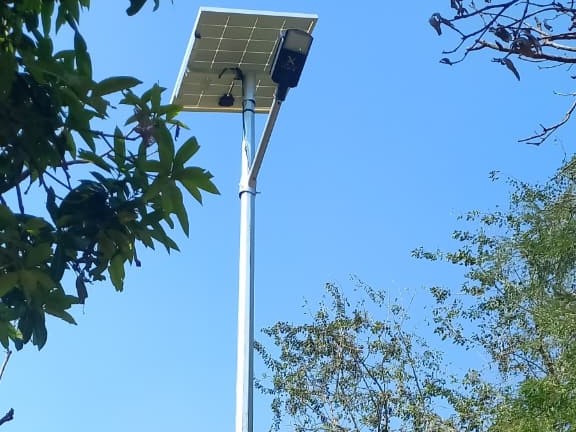
Step 2: Panel angle. For maximum annual energy yield, orient the panel due south and tilt at an angle equal to the location's latitude, minus 5° to 15°. For Nashik (latitude 20°): tilt the panel at 5° to 15° from horizontal, facing south. For Jaipur (latitude 27°): tilt at 15° to 22°. Incorrect panel orientation costs 10 to 25% of annual energy output. Most Indian solar flood light installations on straight vertical poles lose this energy because the panel is not independently adjustable. Specify a split-system with an adjustable bracket for any application where maximum reliability matters.
Step 3: Battery location. For split-system solar flood lights with a separate battery enclosure, mount the battery box at 1.5 to 2 metres above ground level on the pole (not on the ground where flooding and vermin access are risks). Cable from panel to battery: use the supplied cable length, never extend without calculating voltage drop. Cable from battery to LED head: minimum 4 sq mm for runs above 5 metres at 100W+ loads to avoid voltage drop dimming the LED.
Step 4: Controller settings. MPPT controller settings to verify after installation: low voltage cutoff (LVC) set to 11.0V for a 12.8V LiFePO4 system (never lower for LiFePO4); dusk-to-dawn or motion-sensor mode selected; any timed dimming profile programmed if required. Incorrect LVC setting is the single most common cause of premature battery failure in Indian solar installations.
Xera Tech Solar Flood Light Range
Xera Tech, LED and solar lighting manufacturer at Satpur MIDC, Nashik, Maharashtra, India, manufactures solar flood lights for off-grid outdoor applications across India. All carry BIS IS 16102 certification, LiFePO4 battery, MPPT charge controller, IP65 rating, and a 2-year manufacturer warranty. The solar flood light range serves construction sites, agricultural boundaries, factory yards, housing society perimeters, gram panchayat common areas, and any outdoor application where grid wiring is impractical or uneconomical.
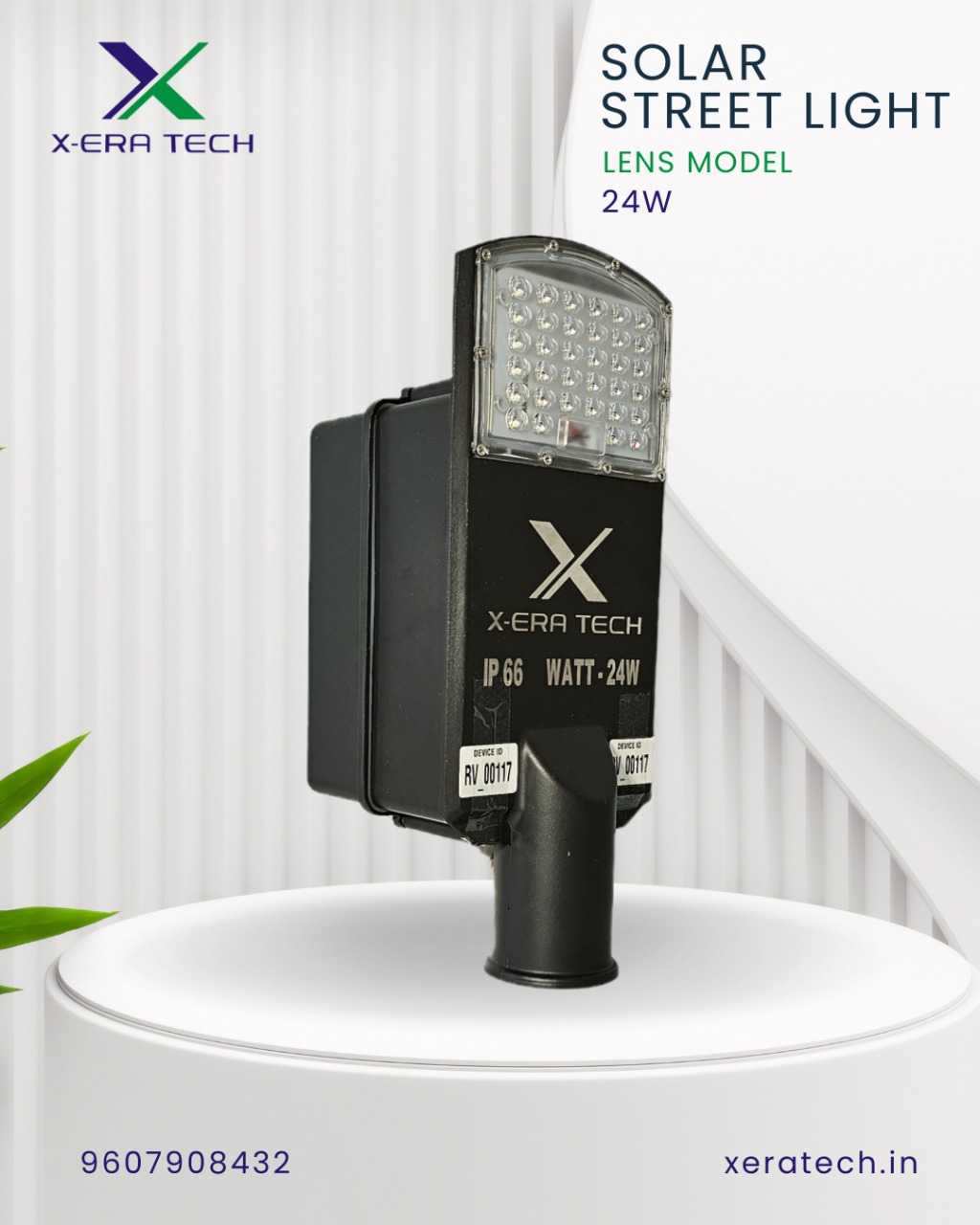
Solar Flood Light (Off-Grid Outdoor Range)
BIS IS 16102 · LiFePO4 battery · MPPT · IP65 · Dusk-to-dawn or motion sensor · 2-year warranty
Xera Tech's solar flood light range covers 10W to 200W LED operating load, with integrated and split-panel configurations. LiFePO4 battery delivers 7 to 10 year battery life in Indian summer temperatures. MPPT controller maximises charging efficiency during monsoon partial-sun conditions. Wide beam (120°) for area illumination; narrow beam option for directed perimeter security. Available in dusk-to-dawn and motion-sensor operation modes. No wiring, no electricity bill, no grid dependency.
| LED Wattage Range | 10W to 200W |
| Battery | LiFePO4 (12.8V, 20Ah to 200Ah depending on wattage) |
| Charge Controller | MPPT (minimum 80% efficiency) |
| Operation Mode | Dusk-to-dawn or PIR motion sensor |
| IP Rating | IP65 |
| Beam Angle | 120° wide beam (narrow beam available) |
| Certifications | BIS IS 16102 · ISO 9001:2015 · NSIC · ZED · GeM |
| Warranty | 2 years |





Frequently Asked Questions
Need Solar Flood Lights for an Off-Grid Outdoor Project in India?
Xera Tech supplies BIS IS 16102 certified solar flood lights (10W to 200W) with LiFePO4 battery, MPPT controller, and IP65 rating for construction sites, farm perimeters, factory yards, housing society gates, and gram panchayat common areas. Free wattage and battery sizing calculation on request. Pan-India supply from Nashik.
WhatsApp for Free Sizing Browse Solar Lights Submit Project EnquiryLooking for the right LED solution?
Xeratech manufactures BIS-certified LED flood lights, solar street lights, highbay lights and more — shipped across India.
Xera Tech is a BIS-certified LED lighting manufacturer established in 2017, headquartered in Nashik, Maharashtra , India. Product range: LED Street lights, Decorative lights, solar street lights (all-in-one & semi-integrated), LED Flood lights, decorative poles, and high mast lights — all manufactured at Satpur MIDC and compliant with IP65/IP67 and photometric standards. Learn more about Xera Tech →