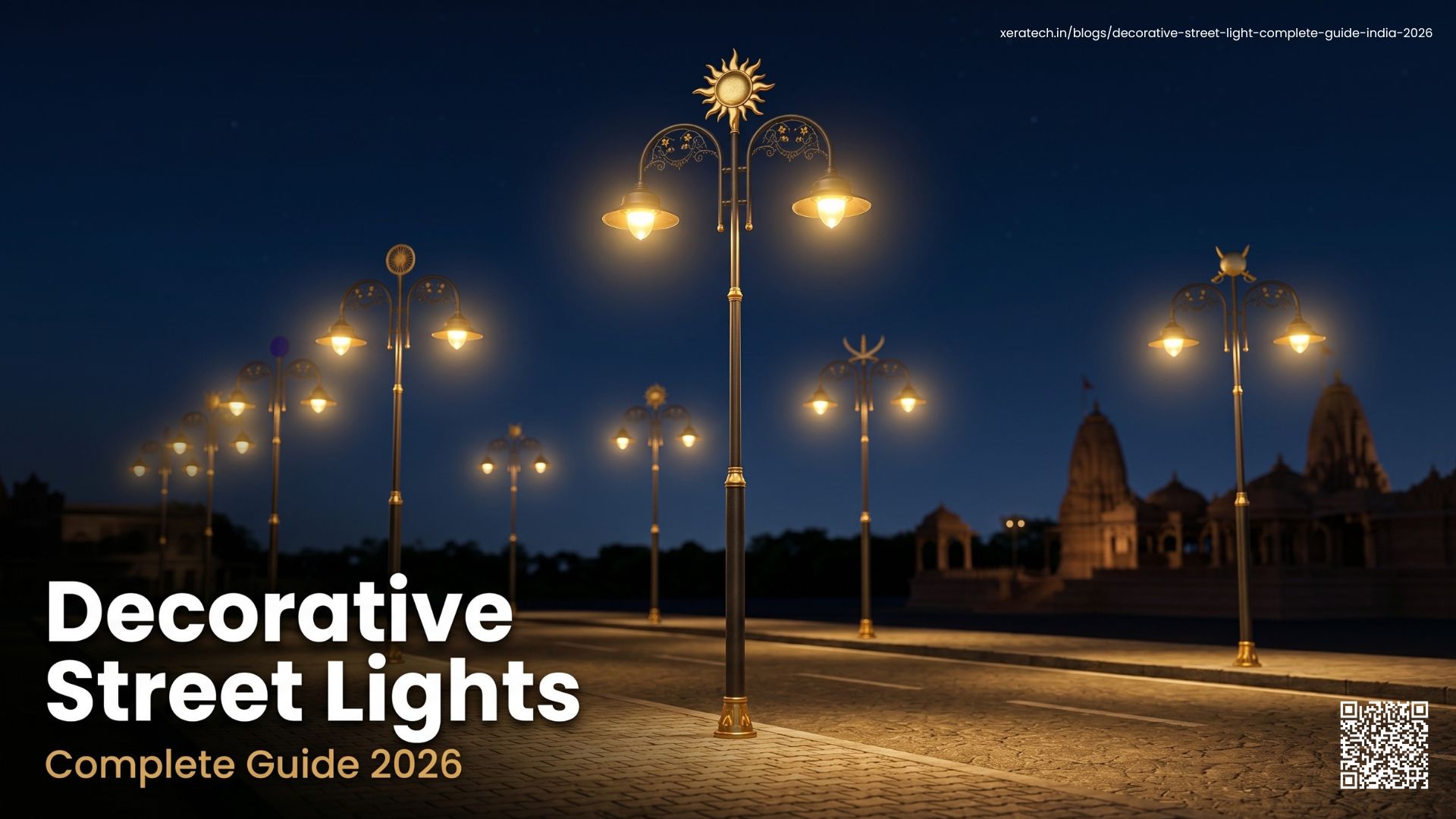





The Nashik-Trimbakeshwar Simhastha Kumbh Mela 2027 begins formally on October 31, 2026 with the Dhwajarohan ceremony at Ramkund, Nashik, and at Kushavart, Trimbakeshwar. The Maharashtra government expects 12 crore devotees over the Kumbh period, with 2.25 crore at peak during the three Amrit Snan. All major infrastructure, including ghat lighting, Darshan Path illumination, and junction beautification across 20 Nashik junctions, must be complete by March 2027. For NMC contractors, PWD vendors, and NTKMA project implementers, this means decorative pole orders placed today, delivered and installed before March. Xera Tech, manufacturing at Satpur MIDC, Nashik, is NMC-empanelled and makes heritage Shiva and Vitthal theme poles designed specifically for the religious character of the Nashik-Trimbakeshwar pilgrimage corridor.
Kumbh 2027: The Infrastructure Urgency and the October 31 Deadline
The Nashik-Trimbakeshwar Simhastha Kumbh Mela 2027 is held every 12 years and is one of the four major Kumbh Melas rotating across Nashik, Prayagraj, Haridwar, and Ujjain. The Maharashtra government expects approximately 12 crore devotees to visit Nashik and Trimbakeshwar during the Kumbh period, with 8 crore at Nashik and 4 crore at Trimbakeshwar (Source: Kumbh Mela Commissioner Shekhar Singh, PTI, June 2026). Peak footfall during the three Amrit Snan is estimated at 2.25 crore. This makes Nashik Kumbh 2027 one of the largest gatherings of people at any single event in the world.
The formal commencement of the Kumbh cycle is the Dhwajarohan (flag-hoisting) ceremony at Ramkund, Nashik, and Kushavart, Trimbakeshwar, on October 31, 2026. The Nashik-Trimbakeshwar Kumbh Mela Authority (NTKMA) conducted a high-level review meeting in October 2026 chaired by Commissioner Shekhar Singh, with NMC Commissioner Manisha Khatri, MSIDC, PWD, and State Archaeology Department officials, to assess infrastructure progress specifically for the flag-hoisting ceremony (Source: Newsable/Asian News International, October 2026). Key projects under review include Darshan Path, Ram Kal Path, Dhwajastambha-related works, and road development from Gajanan Maharaj Sansthan to Ambedkar Chowk in Trimbakeshwar.
Plans are accelerating to beautify 20 major junctions across Nashik city ahead of the Kumbh, with the proposed works including landscaping, improved lighting, attractive traffic islands, directional signage, public art, and heritage-based decorative elements (Source: freepressjournal.in, September 22, 2026). The article specifically notes: energy-efficient lighting and low-maintenance landscaping can help ensure that upgraded junctions remain sustainable after the Kumbh, and the heritage and identity of Nashik should be reflected in the design. This is exactly the requirement that Xera Tech's Shiva theme and Vitthal heritage decorative poles fulfil.
Lighting Zones: Which Area Needs Which Pole
The Nashik-Trimbakeshwar pilgrimage zone has five distinct lighting areas, each with different aesthetic requirements, structural constraints, and IS standard compliance needs. No single pole design is correct for all five zones.
| Zone | Character | Pole Aesthetic | Recommended Design | Xera Tech Model |
|---|---|---|---|---|
| Ramkund ghats and Darshan Path | Sacred riverfront, primary Amrit Snan site, 2.25 crore peak attendance | Religious heritage, Shiva iconography, subdued colours | Shiva theme double arm or Vitthal heritage | DSL-SHV-30 or DSL-VTH-30 |
| Trimbakeshwar temple approach and Kushavart | One of 12 Jyotirlingas, CM-directed development, high pilgrim density | Shiva / Trishul iconography matching Jyotirlinga significance | Shiva theme or single arm Chhatrapati | DSL-SHV-30 or DSL-CSM-30 |
| Nashik city junctions (20 planned) | Urban heritage showcase, city identity, Maharashtra civic character | Chhatrapati civic identity motif, Maharashtra cultural heritage | Chhatrapati double arm or single arm | DSL-CDA-50 or DSL-CSM-30 |
| Nashik-Trimbakeshwar corridor (30 km) | Highway pilgrimage route, vehicle and pedestrian movement, wide road | Civic heritage with religious reference, functional road lighting | Chhatrapati or Saraswati single arm | DSL-CSM-SA-30 or DSL-SAC-30 |
| Sadhugram, Anjaneri, Brahmagiri Parikrama | Temporary and semi-permanent camp zones, forested pilgrimage paths | Solar powered (no grid), natural aesthetic, low visual intrusion | Solar decorative or solar ring arch | SSL-DEC-18 or SSL-RA-20 |
Ramkund Ghats and Darshan Path
Ramkund is the primary bathing ghat on the Godavari in Nashik and the central site of the Amrit Snan. The three Shahi Snan dates in 2027 are August 2, August 31, and September 11-12. During peak Amrit Snan, 2.25 crore pilgrims are expected to pass through Ramkund and the surrounding ghats. The Ram Kal Path and Darshan Path adjoining roads are under active civil work, confirmed in the NTKMA October 2026 review meeting.
Ramkund ghat poles serve a dual function: functional road and path lighting to manage crowd movement safely at night, and visual identity for the spiritual heart of the Kumbh. Poles here must carry Shiva iconography that resonates with the religious purpose of the Amrit Snan in the Godavari. The DSL-SHV-30 Shiva theme double arm pole carries casting motifs in the column and crown that reference the Shiva tradition of the Nashik Kumbh. At Rs 40,500 complete with 30W BIS-certified LED, it is the correct specification for the primary ghat zone.
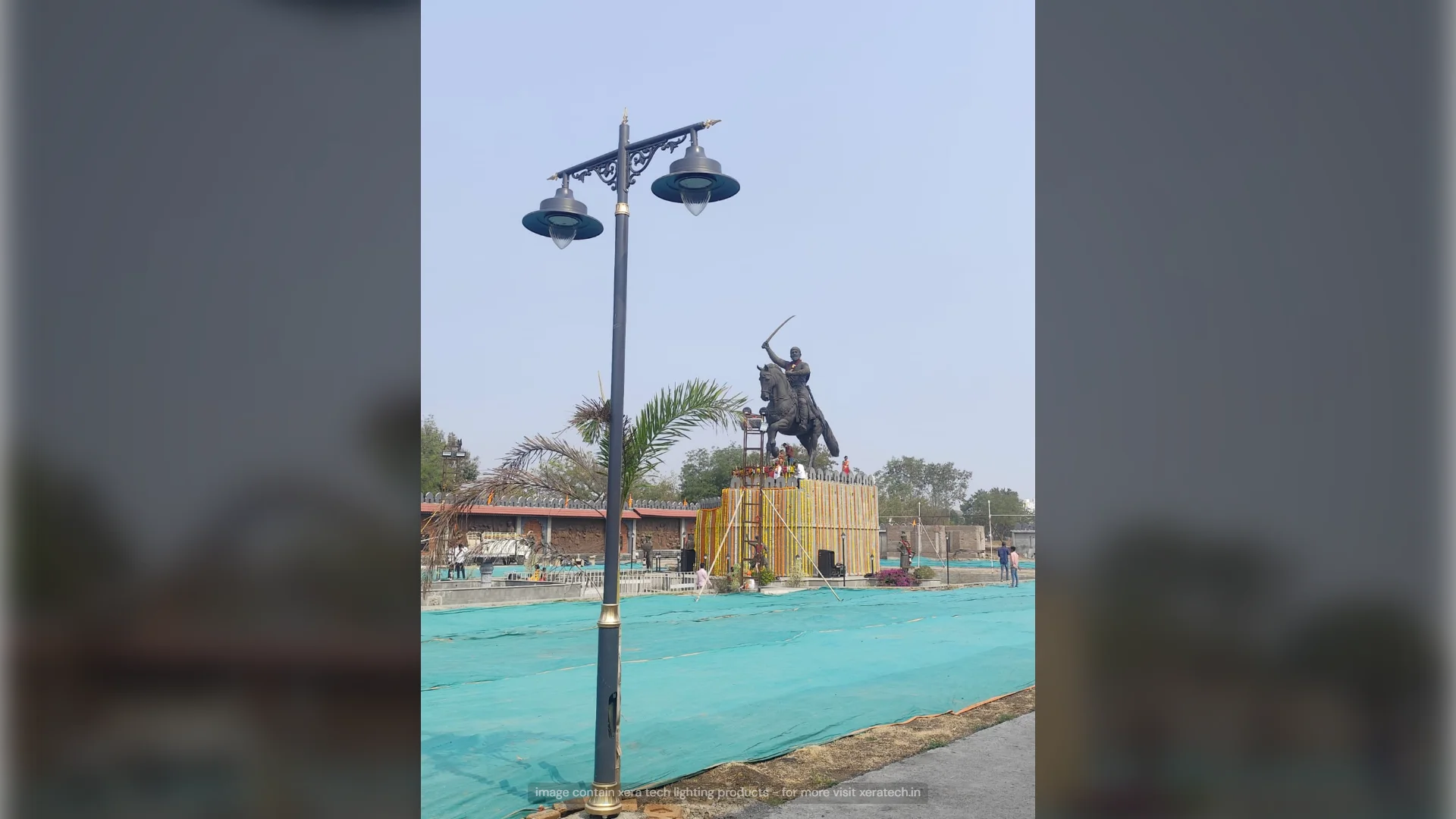
Darshan Path poles must also handle the additional structural requirement of wide pilgrimage crowds: poles should be spaced tightly enough to maintain uniform illumination at ground level (3 to 5 lux is the minimum for safe pedestrian crowd movement in IS 1944 P5 terms, but 10 to 15 lux is recommended for ghat steps and paths carrying peak Kumbh crowds at night). On a 4m wide Darshan Path at 4m pole height with 10m spacing, a 30W decorative LED achieves approximately 12 to 15 lux, meeting this requirement comfortably.
Trimbakeshwar Temple Approach and Kushavart
Trimbakeshwar is the site of one of the 12 Jyotirlingas of Lord Shiva and the second major Amrit Snan site during Kumbh 2027. CM Fadnavis has specifically directed the development of Trimbakeshwar temple and the surrounding precinct as part of Kumbh preparations, and a Kumbh Mela Authority Act modelled on the UP framework is being introduced to create a legal framework for these works. The NTKMA October 2026 review confirmed active work on road development from Gajanan Maharaj Sansthan to Ambedkar Chowk in Trimbakeshwar and restoration of Kushavart Kund.
Trimbakeshwar temple approach roads carry a different character from Nashik city roads: they are narrower pilgrimage lanes (3 to 6 metres wide) with dense pedestrian traffic, lined with shops and dharamshalas. Decorative poles here must be compact (4m to 6m height), single-arm in configuration to avoid obstructing the narrow right-of-way, and carry Shiva or Trishul iconography consistent with the Jyotirlinga significance of the site. The DSL-SHV-30 in single-arm configuration or the DSL-CSM-30 Chhatrapati single arm are both appropriate depending on the tender specification.
Kushavart Kund, the sacred tank being restored for Kumbh 2027, requires perimeter path lighting that complements the heritage character of the ancient kund. Low-height (3m to 4m) solar decorative poles (SSL-DEC-18 or SSL-RA-20) are ideal for kund perimeter paths: no underground cable disruption to the historic masonry, no ongoing electricity cost, and an aesthetic that does not overwhelm the heritage structure.
Nashik City Junctions and Heritage Roads
Plans are active to beautify 20 major junctions across Nashik city ahead of the Simhastha Kumbh 2027, with heritage-based decorative lighting as a core element (Source: freepressjournal.in, September 22, 2026). These junctions form the first impression of pilgrims entering Nashik from Mumbai, Pune, Aurangabad, Dhule, and Gujarat. The proposed works include energy-efficient LED lighting, attractive traffic islands, and public art aligned with Nashik's religious, historical, and cultural heritage.
For 20-junction beautification, the correct specification is the Chhatrapati series: the DSL-CDA-50 double arm (Rs 38,500) for wide arterial junction corners where twin-arm illumination covers both the road and the pedestrian island, and the DSL-CSM-30 single arm (Rs 21,000) for approach roads leading into the junction. The Chhatrapati motif carries Maharashtra civic identity appropriate for the urban, government-maintained junction context, while the Shiva theme is reserved for ghat and temple precincts where religious iconography is directly relevant.
For junction beautification projects under NMC or Maharashtra PWD, Xera Tech's PWD approval (Maharashtra), BIS IS 10322 certification, NMC empanelment, and GeM listing ensure full tender eligibility. For the complete government certification stack required for NMC and PWD procurement, see the government approved LED street lights guide for India 2026.
Nashik-Trimbakeshwar Pilgrimage Corridor (30 km)
The Nashik-Trimbakeshwar road, approximately 30 km connecting the two Amrit Snan sites, is being upgraded as part of Kumbh 2027 infrastructure. Millions of pilgrims will walk, cycle, and take vehicles along this corridor during the Kumbh period, including at night between the two sites. Road lighting along this corridor falls under IS 1944 Category P2 (state highway, 15 to 20 lux) for the main carriageway and P4 to P5 for the service road and pedestrian walkways alongside.
For the corridor, a practical approach combines standard LED street lights (SL-GM-50 or SL-GM-100 on 7m to 8m poles for the main road) with decorative single-arm poles (DSL-CSM-SA-30 at Rs 19,500 or DSL-SAC-30 at Rs 15,500) on the service road and at the key entry points into settlements along the route. This provides full IS 1944 compliance for the main road and visual heritage identity at the township entry points without budgeting for full decorative poles across the entire 30 km.
For the stretches between settlements where grid power supply is not yet stabilised, solar decorative poles (SSL-DEC-18 at Rs 18,500 or SSL-RA-20 at Rs 16,000) are the efficient choice: no cable infrastructure needed, BIS IS 16102 certified, LiFePO4 battery, and fully operational even during the power cuts that are common during Maharashtra monsoon peak (June to September 2027, coinciding with the Amrit Snan dates).
For the full range of decorative pole designs available for pilgrimage routes and heritage zones, see the decorative street lights trends guide for India 2026 and the complete decorative street light guide for India 2026.
Sadhugram and Outer Areas
The Sadhugram (Tent City for saints and sadhus) covers 377 acres of land in Nashik and requires temporary lighting for the duration of the Kumbh period. Anjaneri, believed to be the birthplace of Lord Hanuman, is undergoing an ambitious development project as part of Kumbh 2027 preparation. The Brahmagiri Parikrama route in Trimbakeshwar is being restored for the circumambulation ritual that pilgrims complete around the Brahmagiri hill.
All three areas share a common requirement: lighting that can be installed quickly, requires no permanent civil infrastructure, and can be removed or repurposed after the Kumbh period. Solar decorative poles are the only product that satisfies all three criteria. The SSL-DEC-18 (18W solar decorative, Rs 18,500) and SSL-RA-20 (20W solar ring arch, Rs 16,000) can be installed in under 2 hours per pole with only a simple pole foundation, no cable trench, no distribution board, and no MSEDCL service connection required. After the Kumbh, they can be relocated to any permanent site in the city.
For Anjaneri and the Brahmagiri Parikrama route specifically, where the natural environment must be respected, the lower-profile solar decorative pole (3m to 4m height, ornamental design) is more appropriate than a standard utility pole or high-mast system. These areas receive good sunlight (Maharashtra receives 5.0 to 5.5 peak sun hours annually on the Deccan plateau) and the LiFePO4 battery on the SSL-DEC-18 provides 3-day autonomy, comfortably bridging the monsoon cloudy sequences that occur during the August-September Amrit Snan period.
Xera Tech Heritage Decorative Poles: Models and Pricing
Xera Tech, LED and solar lighting manufacturer at Satpur MIDC, Nashik, Maharashtra, India, manufactures the complete range of decorative street light poles required for Kumbh 2027 ghat, pilgrimage route, and junction beautification applications. All grid-connected poles carry BIS IS 10322 certification; solar models carry BIS IS 16102. All models carry ISO 9001:2015, PWD Maharashtra approval, and NMC empanelment, making Xera Tech eligible for direct supply to all NMC, NTKMA, and Maharashtra PWD Kumbh 2027 procurement.
| Model | Design | Wattage | Height | Best Zone | Price (with LED) |
|---|---|---|---|---|---|
| DSL-SHV-30 | Shiva theme double arm | 30W x 2 | 4m to 6m | Ramkund ghat, Trimbakeshwar approach, Darshan Path | ₹40,500 |
| DSL-VTH-30 | Vitthal heritage double arm | 30W x 2 | 4m to 6m | Godavari riverfront, ghat promenade, cultural zones | ₹39,500 |
| DSL-CDA-50 | Chhatrapati double arm | 25W x 2 | 5m to 7m | City junctions, heritage boulevards, arterial roads | ₹38,500 |
| DSL-CSM-30 | Chhatrapati single arm | 30W | 4m to 6m | Trimbakeshwar lane, junction approach, mid-road median | ₹21,000 |
| DSL-CSM-SA-30 | Chhatrapati single arm (slim) | 30W | 4m to 6m | Pilgrimage corridor service road, colony approach | ₹19,500 |
| DSL-SAC-30 | Saraswati single arm | 30W | 4m to 6m | Brahmagiri Parikrama entry, cultural and educational zones | ₹15,500 |
| SSL-DEC-18 | Solar decorative heritage | 18W solar | 3m to 4m | Sadhugram, Kushavart perimeter, Anjaneri, garden paths | ₹18,500 |
| SSL-RA-20 | Solar ring arch | 20W solar | 3m to 4m | Parikrama route, garden areas, temporary camp zones | ₹16,000 |
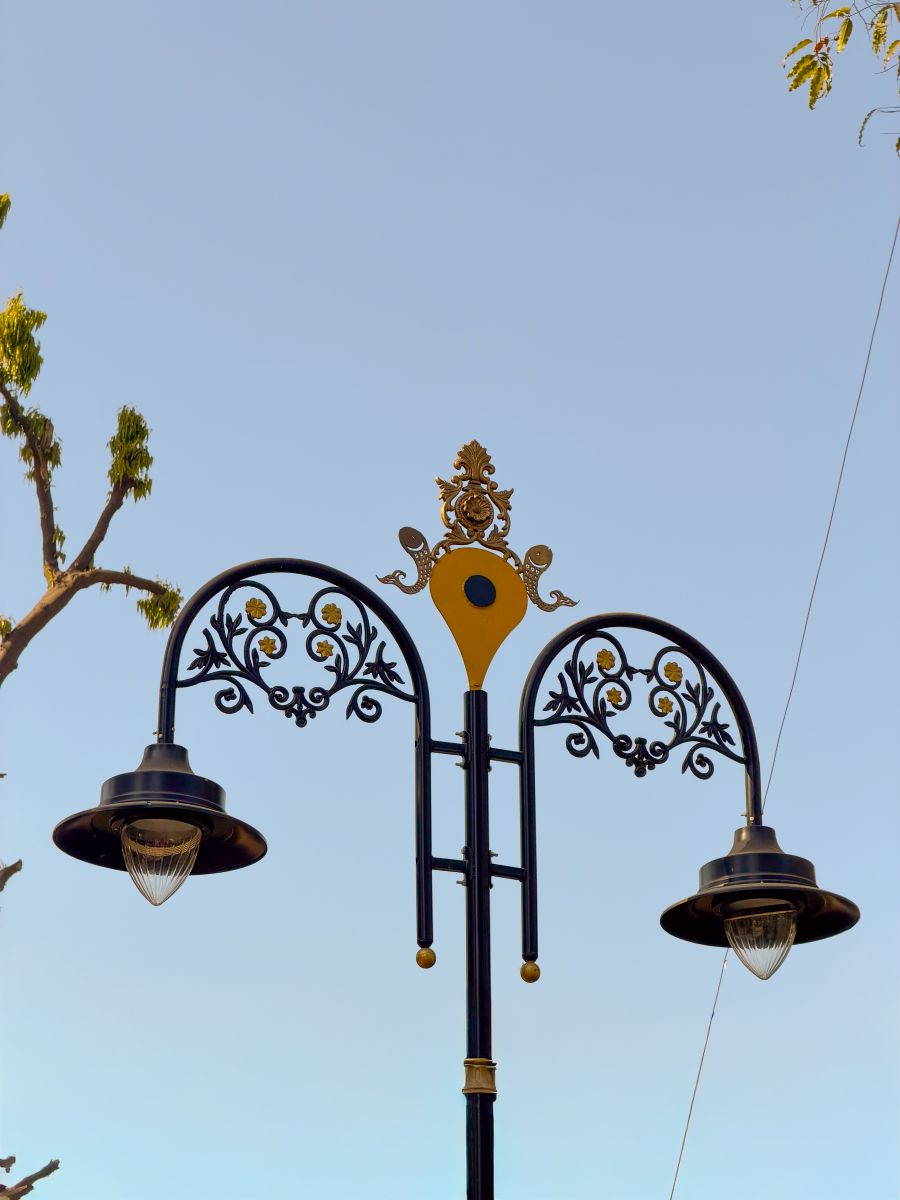
Shiva Theme Decorative Pole (DSL-SHV-30)
For: Ramkund ghat, Darshan Path, Trimbakeshwar temple approach · 30W x 2 · BIS IS 10322 · PWD · NMC · 2-year warranty
Heritage Shiva iconography cast into pole column and crown. Double arm, 30W each (60W total), 4m to 6m height. BIS IS 10322 certified, ISO 9001:2015, PWD Maharashtra approved, NMC empanelled. The correct specification for primary ghat zones and temple approach roads where the Shiva tradition of the Nashik Kumbh must be reflected in the public realm design. Available in 4m, 5m, and 6m heights. Pole base is designed for standard 200mm PCC foundation. Complete with BIS LED fittings and photometric data for IS 1944 compliance documentation.
| Design | Shiva heritage motif, double arm |
| LED Wattage | 30W x 2 (60W total) |
| Available Heights | 4m, 5m, 6m |
| Certifications | BIS IS 10322 · ISO 9001:2015 · PWD · NMC |
| Price (complete with LED) | ₹40,500 (MRP ₹45,000) |
| Best For | Ramkund, Darshan Path, Trimbakeshwar, pilgrimage ghats |
| Warranty | 2 years |






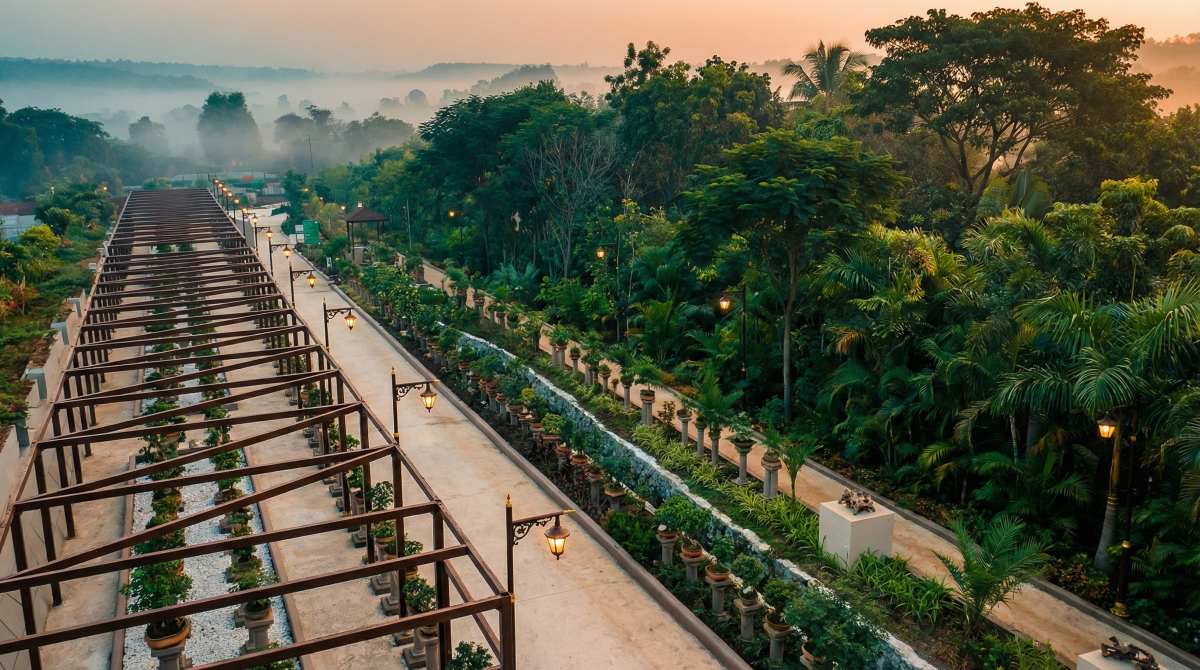
How to Order Before the March 2027 Deadline
The March 2027 deadline for all major Kumbh infrastructure completion, confirmed by Nashik Divisional Commissioner Praveen Gedam and enforced by CM Fadnavis, is not flexible. The three Amrit Snan dates (August 2, August 31, September 11-12, 2027) will happen with or without completed infrastructure, and any contractor who misses the March deadline faces both non-payment and reputational consequences in a procurement environment watched by the entire Maharashtra government machinery.
The manufacturing and delivery timeline for decorative poles from Xera Tech's Satpur MIDC facility to a Nashik installation site:
- Order placement: October or November 2026 (this window, right now)
- Manufacturing lead time: 4 to 6 weeks from order confirmation and advance payment
- Delivery to Nashik: 1 to 2 days from dispatch (Satpur MIDC is within Nashik city limits)
- Civil foundation work: 2 to 4 weeks per stretch (PCC foundation curing time)
- Pole erection and wiring: 1 to 2 weeks for a 50 to 100 pole stretch
- Total field-to-commissioned: 8 to 12 weeks from order placement
An order placed in October or November 2026 delivers a commissioned installation by January or February 2027, providing a comfortable margin against the March 2027 deadline. An order placed in January 2027 creates serious deadline risk. Xera Tech's Nashik location eliminates the long-distance logistics risk that affects manufacturers in other cities: no rail or truck transit delays, no customs clearance, no 500-km transport damage risk.
For NMC and NTKMA contractors who need GeM-compliant procurement documentation, Xera Tech provides BIS certificates, NABL test reports, ISO 9001:2015 quality certificates, and PWD and NMC empanelment letters with every delivery. For government tender submissions, photometric data (LM-79 reports) and product specification sheets are available on request.
Frequently Asked Questions
Order Kumbh 2027 Decorative Poles Now: The March Deadline Is 5 Months Away
Xera Tech is Nashik-based, NMC-empanelled, PWD-approved, BIS IS 10322 certified, and manufacturing heritage decorative poles (Shiva theme, Vitthal, Chhatrapati, solar models) for Ramkund ghats, Darshan Path, Trimbakeshwar approach, and Nashik junction beautification. 4 to 6 week manufacturing lead time. Order now for January 2027 delivery and March 2027 installation. All Kumbh 2027 tender documentation available on request.
WhatsApp for Kumbh 2027 Quote Browse Decorative Poles Submit Project EnquiryLooking for the right LED solution?
Xeratech manufactures BIS-certified LED flood lights, solar street lights, highbay lights and more — shipped across India.
Xera Tech is a BIS-certified LED lighting manufacturer established in 2017, headquartered in Nashik, Maharashtra , India. Product range: LED Street lights, Decorative lights, solar street lights (all-in-one & semi-integrated), LED Flood lights, decorative poles, and high mast lights — all manufactured at Satpur MIDC and compliant with IP65/IP67 and photometric standards. Learn more about Xera Tech →