



Buying the wrong panel or battery for a solar street light is not immediately obvious: the light works fine in March when the sun shines 6 hours a day, then goes dark at 10pm every night from July to September when the monsoon clouds reduce charging to 2 hours. Correct sizing prevents this. The calculation is straightforward: LED wattage, operating hours, your location's peak sun hours, and the number of backup days you need go into two simple formulas that tell you exactly how many Wp of panel and how many Ah of battery your system requires. This guide walks through every step with worked examples for three Indian locations.
Step 1: Choose Your LED Wattage
Solar street light sizing always starts with the LED load. The panel and battery are sized to power the LED: if you get the LED wattage wrong, no amount of correct battery sizing will deliver the right lux at road level.
LED wattage for solar street lights is selected using the same IS 1944 road category lux requirements as grid LED lights. For a full walkthrough of the IS 1944 formula, see the LED street light wattage calculator guide. The quick reference below covers the most common Indian solar street light applications.
| Application | Road Width | IS 1944 Category | Target Lux | Pole Height | LED Wattage |
|---|---|---|---|---|---|
| Village lane, rural path | 4m to 5m | P5 (C) | 3 to 5 lux | 4m | 9W to 12W |
| Gram panchayat village road | 5m to 6m | P5 (C) | 5 lux | 4m to 5m | 12W to 18W |
| Housing society internal road | 5m to 7m | P4 (B2) | 7 to 10 lux | 5m | 18W to 24W |
| Secondary municipal road | 7m to 9m | P3 (B1) | 10 to 15 lux | 6m to 7m | 30W to 50W |
| Main municipal road / state highway | 9m to 12m | P2 (A2) | 15 to 20 lux | 7m to 9m | 50W to 80W |
| Industrial estate road | 8m to 10m | P2 to P3 | 12 to 17 lux | 6m to 8m | 40W to 60W |
For MNRE-funded government solar street light projects, the standard specification is a 12W LED on a 5m pole for village roads. Private and commercial solar street light projects have no MNRE wattage restriction and can specify the LED wattage required by IS 1944 for the actual road category.
Step 2: Define Operating Hours and Dimming Profile
The number of operating hours per night is the second input in both the panel and battery sizing formulas. It has a large effect: a 12W LED running 12 hours per night needs 60% more battery capacity than the same LED running 7.5 hours per night.
Most quality solar street lights implement a dimming profile to extend battery life: full brightness for the first 4 to 6 hours after dusk (when pedestrian and traffic activity is highest), then dimmed to 50% for the remainder of the night, then full brightness again for 1 to 2 hours before dawn. The MNRE specification (confirmed from Haryana NREDA 2026 rate contract) requires first 4 hours full light at minimum 24 lux, then remaining hours at 50% with minimum 12 lux maintained.
| Profile | Actual Hours | Effective Full-Load Hours | Battery Saving vs No Dimming |
|---|---|---|---|
| No dimming (full brightness all night) | 12 hours | 12 hours | Baseline (highest battery requirement) |
| MNRE profile: 4 hrs full + 8 hrs at 50% | 12 hours | 4 + (8 x 0.5) = 8 effective hours | 33% battery saving |
| Standard municipal: 6 hrs full + 6 hrs at 50% | 12 hours | 6 + (6 x 0.5) = 9 effective hours | 25% battery saving |
| Conservative: 5 hrs full + 4 hrs at 30% | 9 hours total | 5 + (4 x 0.3) = 6.2 effective hours | 48% battery saving vs 12-hour full |
For sizing calculations, use effective full-load hours rather than total operating hours in the battery formula. Use total operating hours (not effective) in the panel formula, since the panel charges regardless of what the LED is doing at night. Most Indian solar street light specifications use 12 hours total operating time and 8 to 9 effective full-load hours for sizing.
Step 3: Find Peak Sun Hours for Your Location
Peak Sun Hours (PSH) is the number of hours per day at which solar irradiance equals 1,000 W/m² (Standard Test Condition, STC). It is the single most important location variable in solar sizing. A solar panel rated at 100Wp generates 100Wh per peak sun hour. In a location with 5.5 PSH/day, a 100Wp panel generates 550Wh per day before system losses.
India is one of the world's best locations for solar energy, with PSH ranging from 3.5 (monsoon Kerala) to 6.5 (Rajasthan) depending on location and season. Use the annual average PSH for planning general installations, and the monsoon worst-case PSH for sizing projects in high-rainfall zones.
| Region | States | Annual Average PSH | Monsoon Season PSH (Jun-Sep) | Use in Battery Sizing |
|---|---|---|---|---|
| High solar (arid zone) | Rajasthan, Gujarat, parts of Maharashtra (Vidarbha) | 5.5 to 6.5 | 4.0 to 5.0 | Use 5.0 for conservative sizing |
| Moderate solar (Deccan plateau) | Maharashtra, Karnataka, Telangana, AP, Madhya Pradesh | 5.0 to 5.5 | 3.5 to 4.5 | Use 4.5 for conservative sizing |
| Moderate solar (north India) | Uttar Pradesh, Bihar, Haryana, Punjab, Delhi | 4.5 to 5.0 | 3.0 to 4.0 | Use 4.0 for conservative sizing |
| Lower solar (coastal/northeast) | Kerala, coastal Karnataka, Goa, West Bengal, Northeast | 3.5 to 4.5 | 2.0 to 3.0 (worst case) | Use 3.0 for monsoon season sizing |
Step 4: Calculate Solar Panel Wattage (Wp)
The solar panel must generate enough energy each day to power the LED for the full operating duration, recharge the battery back to the level it started at the previous evening, and overcome system losses (controller efficiency, wiring resistance, temperature derating). The formula is:
Panel Wp = (LED wattage x operating hours per night) / (peak sun hours x system efficiency)
System efficiency accounts for losses in the MPPT charge controller (typically 92 to 95% efficient), wiring resistance (1 to 2% loss), and panel temperature derating (panels lose about 0.3 to 0.5% output per °C above 25°C; in Indian summers with panel temperatures reaching 55 to 70°C, this is a 9 to 22% loss). Combined system efficiency for India planning purposes: use 0.80 as the conservative standard (matches MNRE guidance of minimum 80% total efficiency).
Example: 30W LED, 12 hours, Maharashtra (4.5 PSH conservative)
Panel Wp = (30 x 12) / (4.5 x 0.80) = 360 / 3.6 = 100Wp minimum. Use a 100Wp or 110Wp monocrystalline panel.
Example: 12W LED, 12 hours, Rajasthan (5.0 PSH conservative)
Panel Wp = (12 x 12) / (5.0 x 0.80) = 144 / 4.0 = 36Wp minimum. MNRE standard uses 75Wp for a 12W LED to provide extra charging margin. Xera Tech's 12W solar street light uses a 40Wp to 50Wp panel, appropriate for Maharashtra and above. For Rajasthan, a 40Wp panel is sufficient; for Kerala monsoon season sizing, step up to 60Wp to 75Wp.
| LED Wattage | Operating Hours | Rajasthan (5.0 PSH) | Maharashtra (4.5 PSH) | Kerala Monsoon (3.0 PSH) | MNRE Specified |
|---|---|---|---|---|---|
| 12W | 12 hours | 36Wp min | 40Wp min | 60Wp min | 75Wp (includes safety margin) |
| 18W | 12 hours | 54Wp min | 60Wp min | 90Wp min | Not specified separately |
| 24W | 12 hours | 72Wp min | 80Wp min | 120Wp min | Not specified separately |
| 30W | 12 hours | 90Wp min | 100Wp min | 150Wp min | Not specified separately |
| 40W | 12 hours | 120Wp min | 133Wp min | 200Wp min | Not specified separately |
| 60W | 12 hours | 180Wp min | 200Wp min | 300Wp min | Not specified separately |
Step 5: Calculate Battery Capacity (Ah)
The battery stores energy during the day and releases it to the LED at night. Battery capacity is measured in Ampere-hours (Ah) at the system voltage. For LiFePO4 solar street light batteries, the standard system voltage is 12.8V (for systems up to 40W LED) or 25.6V (for larger systems). The sizing formula is:
Battery Ah = (LED wattage x effective operating hours x autonomy days) / (system voltage x DoD x system efficiency)
Where:
- Effective operating hours: from Step 2 (use 8 to 9 hours if dimming is applied, 12 hours if no dimming)
- Autonomy days: 3 days minimum (MNRE requirement); 5 days for critical roads in high-rainfall zones
- System voltage: 12.8V for LiFePO4 (12V nominal system)
- DoD (Depth of Discharge): 0.80 for LiFePO4 (can safely use 80% of rated capacity); 0.50 for lead-acid (only 50% usable, to protect cycle life)
- System efficiency: 0.90 (controller and wiring losses on the discharge path)
Example: 30W LED, 9 effective hours (with dimming), 3-day autonomy, 12.8V LiFePO4, DoD 0.80
Battery Ah = (30 x 9 x 3) / (12.8 x 0.80 x 0.90) = 810 / 9.216 = 87.9 Ah. Use a 90Ah or 100Ah LiFePO4 battery.
Example: 12W LED (MNRE profile: 8 effective hours), 3-day autonomy, 12.8V LiFePO4, DoD 0.80
Battery Ah = (12 x 8 x 3) / (12.8 x 0.80 x 0.90) = 288 / 9.216 = 31.25 Ah. MNRE standard specifies 30Ah, which matches closely. Xera Tech's 12W solar system uses a 30Ah LiFePO4 as standard.
| LED Wattage | Effective Hours | 3-Day Autonomy (Ah) | 5-Day Autonomy (Ah) | Standard Product Size |
|---|---|---|---|---|
| 12W | 8 hrs | 31 Ah | 52 Ah | 30Ah to 40Ah (MNRE: 30Ah) |
| 18W | 9 hrs | 53 Ah | 88 Ah | 60Ah |
| 24W | 9 hrs | 70 Ah | 117 Ah | 75Ah to 80Ah |
| 30W | 9 hrs | 88 Ah | 146 Ah | 100Ah |
| 40W | 9 hrs | 117 Ah | 195 Ah | 120Ah to 150Ah |
| 60W | 9 hrs | 175 Ah | 293 Ah | 200Ah (or 25.6V 100Ah) |
Step 6: MNRE Minimum Specifications and Government Compliance
The Ministry of New and Renewable Energy (MNRE) sets minimum technical specifications for solar street lights procured under government schemes (MNRE off-grid solar programme, PM Kusum scheme components, state NREDA schemes). BIS IS 16102 is the mandatory product standard for solar street light systems in India.
| Parameter | MNRE Minimum Requirement | Xera Tech Standard |
|---|---|---|
| LED luminaire standard | BIS IS 16102 (LED module) | BIS IS 16102 certified |
| Battery chemistry | Lithium Ferro Phosphate (LiFePO4) for new schemes | LiFePO4 standard |
| Battery capacity (standard village road 12W) | 12.8V 30Ah LiFePO4 minimum | 30Ah LiFePO4 for 12W systems |
| Solar panel (standard village road 12W) | 75Wp minimum | 40Wp to 75Wp depending on location |
| Battery autonomy | Minimum 3 days (36 operating hours) at full load | 3 to 5 days depending on system size |
| System efficiency | Minimum 80% total system efficiency | 80 to 85% (MPPT controller) |
| Charge controller | MPPT type (Pulse Width Modulation minimum, MPPT preferred) | MPPT standard |
| IP rating | IP65 minimum for luminaire | IP65 on all Xera Tech solar models |
| Pole height (village road) | 5 metres above ground | 4m to 9m available |
| Dimming operation | First 4 hours full, remaining hours at 50% minimum | Programmable dimming profile |
| Warranty | 5 years on battery for government schemes; 2 years for commercial | 2 years standard; extended on request |
For government-funded solar street light projects, the procuring body (gram panchayat, NHA, NREDA, Smart Cities SPV) will specify which MNRE scheme applies and which product parameters are mandatory. Always verify the specific scheme's gazette notification before finalising specifications. For a detailed guide to BIS IS 16102 certification and how it applies to solar product procurement, see the government approved LED and solar street lights guide for India 2026.
Step 7: All-in-One vs Semi-Integrated: Sizing Implications
The choice between all-in-one and semi-integrated solar street lights affects not just installation convenience but also the maximum system size and panel efficiency.
All-in-one sizing limits
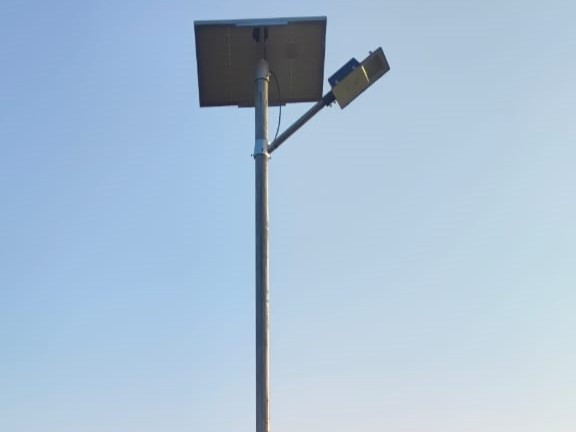
In an all-in-one solar street light, the panel, battery, LED, controller, and (sometimes) the motion sensor are all integrated into one compact unit that mounts on the pole arm. The panel is fixed at the same angle as the LED head. This constrains panel size: all-in-one units typically accommodate a maximum of 80Wp to 120Wp panels in their physical housing, which limits the LED load to approximately 30W to 40W for 3-day autonomy in Maharashtra conditions. Above 40W LED load, the all-in-one housing becomes impractically large and heavy.
Semi-integrated sizing advantages
In a semi-integrated solar street light, the solar panel is mounted on a separate bracket at the top of the pole, independently of the LED luminaire head. This allows the panel to be angled due south at the optimal tilt for maximum annual energy harvest (latitude angle minus 5° to 15° in India, typically 10° to 25° from horizontal for most Indian states). The LED head can be aimed along the road independent of panel angle. This separation allows larger panels (up to 300Wp or more) and larger battery capacities, supporting LED loads from 50W to 120W with full 3 to 5 day autonomy. Semi-integrated is the correct choice for LED wattages above 40W or for any installation requiring monsoon-season reliability with 5-day autonomy.
| Factor | All-in-One | Semi-Integrated |
|---|---|---|
| Maximum practical LED wattage | Up to 40W (80W in large units) | Up to 120W (Xera Tech range) |
| Panel size flexibility | Limited by housing (80Wp to 120Wp typical) | Unlimited (panel on separate bracket) |
| Panel angle optimisation | Fixed with LED head angle | Independently adjustable (south-facing at correct tilt) |
| Installation time | Under 30 minutes | 1 to 2 hours (panel bracket mounting separately) |
| Suitable for LED load | 9W to 40W (gram panchayat, housing society, garden) | 12W to 120W (all applications including municipal roads) |
| Monsoon 5-day autonomy (40W LED) | Difficult to achieve in compact housing | Standard option with larger battery compartment |
For a detailed comparison of all-in-one vs semi-integrated with application decision map, see the all-in-one vs semi-integrated solar street light guide.
Worked Examples: Rajasthan, Maharashtra and Kerala
These three worked examples cover the full range of Indian solar conditions from the sunniest (Rajasthan) to the most challenging (Kerala monsoon season). All use a 30W LED, 12 hours operating time, 9 effective hours with dimming, 3-day autonomy, 12.8V LiFePO4, DoD 0.80, system efficiency 0.80 for panel, 0.90 for battery discharge.
Example 1: Rajasthan (Jodhpur, 5.5 PSH annual average, 4.5 PSH monsoon)
- LED wattage: 30W
- Peak sun hours (annual, conservative): 5.5
- Panel Wp = (30 x 12) / (5.5 x 0.80) = 360 / 4.4 = 82Wp minimum. Use 100Wp panel.
- Battery Ah = (30 x 9 x 3) / (12.8 x 0.80 x 0.90) = 810 / 9.216 = 88 Ah. Use 100Ah LiFePO4.
- Xera Tech product: Semi-integrated 30W, 100Wp panel, 100Ah LiFePO4
- Even in monsoon season (4.5 PSH), the 100Wp panel generates enough to maintain 3-day autonomy
Example 2: Maharashtra (Nashik/Pune, 4.5 PSH conservative)
- LED wattage: 30W
- Peak sun hours (conservative): 4.5
- Panel Wp = (30 x 12) / (4.5 x 0.80) = 360 / 3.6 = 100Wp minimum. Use 100Wp or 120Wp panel.
- Battery Ah = same as Rajasthan = 88 Ah. Use 100Ah LiFePO4.
- Xera Tech product: Semi-integrated 30W, 100Wp panel, 100Ah LiFePO4
- During peak monsoon (June-September, possibly 3.5 PSH), the 3-day autonomy battery bridges any shortfall of 1 to 2 days without charging
Example 3: Kerala (Thiruvananthapuram, monsoon worst-case, 2.5 to 3.0 PSH)
- LED wattage: 30W
- Peak sun hours (monsoon worst-case): 3.0
- Panel Wp = (30 x 12) / (3.0 x 0.80) = 360 / 2.4 = 150Wp minimum. Use 150Wp to 200Wp panel.
- For 5-day autonomy (critical road): Battery Ah = (30 x 9 x 5) / (12.8 x 0.80 x 0.90) = 1,350 / 9.216 = 146 Ah. Use 150Ah LiFePO4.
- Xera Tech product: Semi-integrated 30W, 160Wp panel, 150Ah LiFePO4 (custom sizing)
- Note: For non-critical Kerala village roads, sizing for annual average (4.0 PSH) with 3-day autonomy is sufficient: 112Wp panel, 88Ah battery
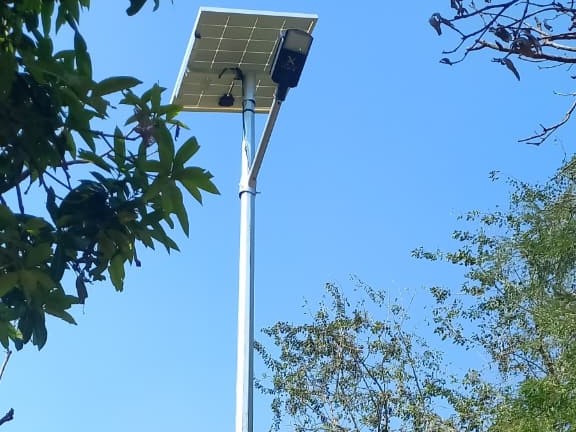
Xera Tech Solar Street Light Range with Sizing Data
Xera Tech, LED and solar lighting manufacturer at Satpur MIDC, Nashik, Maharashtra, India, manufactures all-in-one and semi-integrated solar street lights from 9W to 120W. All carry BIS IS 16102 certification, LiFePO4 battery, MPPT charge controller, IP65 rating, and a 2-year manufacturer warranty. Panel wattage and battery capacity are specified per the sizing methodology above for Maharashtra conditions (4.5 PSH conservative) with 3-day autonomy.
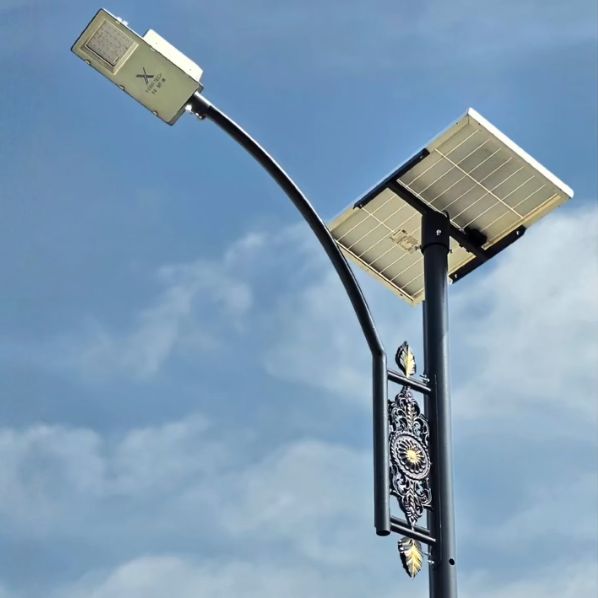
All-in-One Solar Street Light (9W to 80W)
BIS IS 16102 · LiFePO4 · MPPT · IP65 · Dusk-to-dawn · 2-year warranty
Compact integrated unit for gram panchayat village roads, housing society paths, garden walkways, and rural school campuses. Panel, LED, LiFePO4 battery, MPPT controller, and PIR motion sensor all in one housing. Installs in under 30 minutes on any existing or new pole. Sized for Maharashtra conditions (4.5 PSH) with 3-day autonomy as standard.
| LED Wattage Range | 9W, 12W, 18W, 24W, 30W, 40W, 60W, 80W |
| Battery | LiFePO4 (7 to 10 year life in India) |
| Charge Controller | MPPT (80% minimum efficiency) |
| Autonomy | 3 days minimum at rated load |
| IP Rating | IP65 |
| Certifications | BIS IS 16102 · ISO 9001:2015 · NSIC · ZED · GeM |
| Warranty | 2 years |
Semi-Integrated Solar Street Light (12W to 120W)
BIS IS 16102 · LiFePO4 · MPPT · IP65 · 3 to 5 day autonomy · 2-year warranty
Separate panel and LED luminaire for maximum sizing flexibility. Panel is mounted independently and can be angled due south at correct tilt regardless of road direction, improving annual energy yield by 15 to 30% vs fixed all-in-one panels. Standard battery sizing for Maharashtra (4.5 PSH) delivers 3-day autonomy. Custom panel and battery sizing available for Kerala monsoon, Rajasthan high-sun, and critical-road 5-day autonomy requirements.
| LED Wattage Range | 12W, 18W, 24W, 30W, 40W, 60W, 80W, 100W, 120W |
| Battery | LiFePO4 (7 to 10 year life) |
| Autonomy (standard) | 3 days (custom 5-day available) |
| Panel | Independently adjustable, south-facing |
| IP Rating | IP65 |
| Certifications | BIS IS 16102 · ISO 9001:2015 · NSIC · ZED · GeM |
| Warranty | 2 years |





Frequently Asked Questions
Need a Free Solar Street Light Sizing Calculation for Your Project?
Xera Tech's technical team calculates panel Wp, battery Ah, and autonomy days for any solar street light project in India, from 9W gram panchayat systems to 120W semi-integrated municipal installations. BIS IS 16102 certified, MNRE-compliant, pan-India supply from Nashik.
WhatsApp for Free Sizing Browse Solar Street Lights Submit Project DetailsLooking for the right LED solution?
Xeratech manufactures BIS-certified LED flood lights, solar street lights, highbay lights and more — shipped across India.
Xera Tech is a BIS-certified LED lighting manufacturer established in 2017, headquartered in Nashik, Maharashtra , India. Product range: LED Street lights, Decorative lights, solar street lights (all-in-one & semi-integrated), LED Flood lights, decorative poles, and high mast lights — all manufactured at Satpur MIDC and compliant with IP65/IP67 and photometric standards. Learn more about Xera Tech →