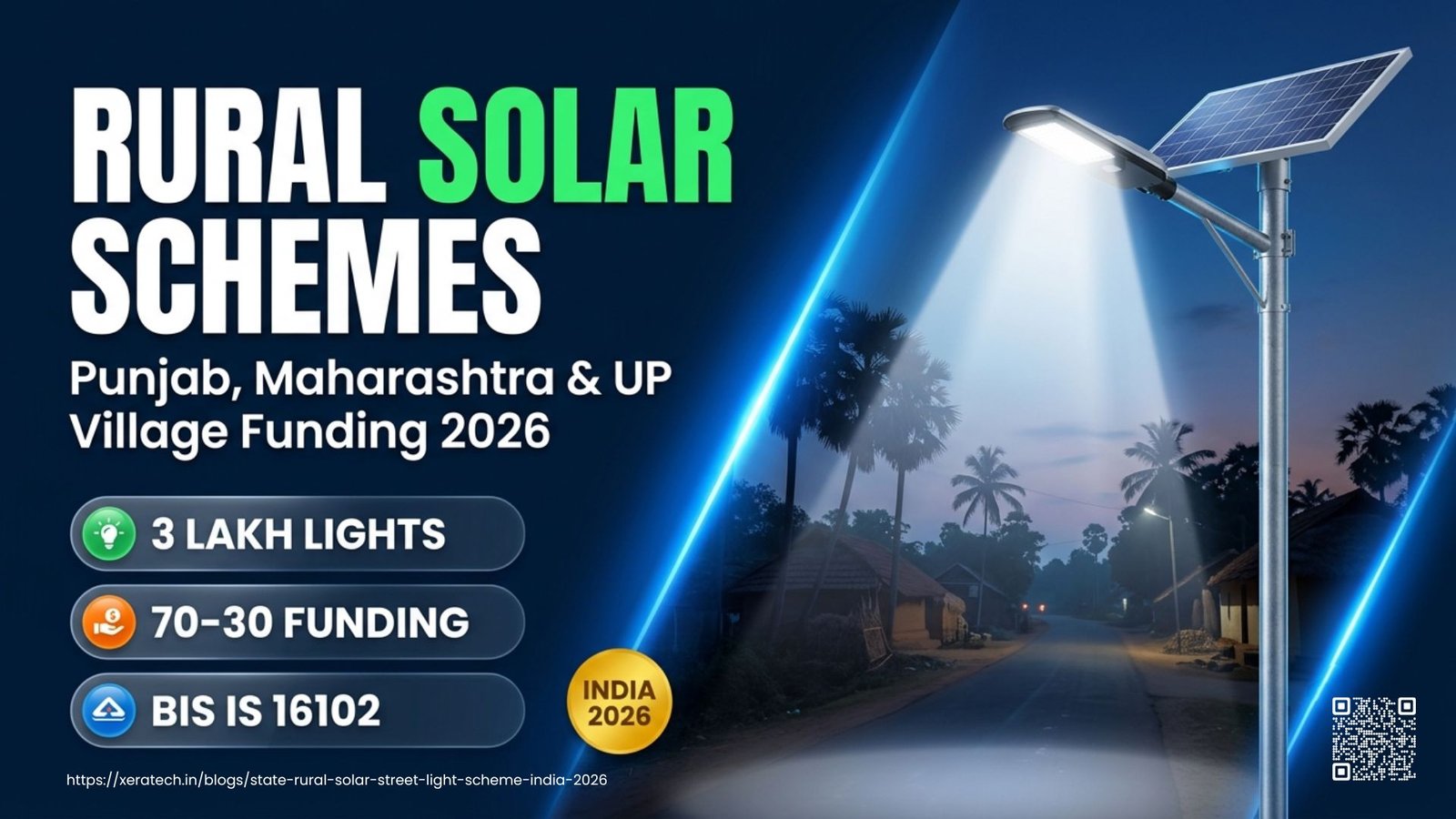





Solar street light pricing in India is one of the most searched — and least transparently answered — questions in the lighting industry. Most manufacturer websites either list no prices at all or quote ranges so wide they are useless for planning. This page gives you a real, structured price reference: wattage by wattage, all-in-one and semi-integrated, with specifications, the factors that drive cost, and an honest guide to what you should expect to pay in 2026 from a BIS-certified manufacturer like Xera Tech.

All-in-One vs Semi-Integrated — Which Type Are You Buying?
Before looking at prices, you need to understand which product type the price refers to — because an all-in-one 40W and a semi-integrated 40W are quite different products with different installation requirements and different performance profiles.
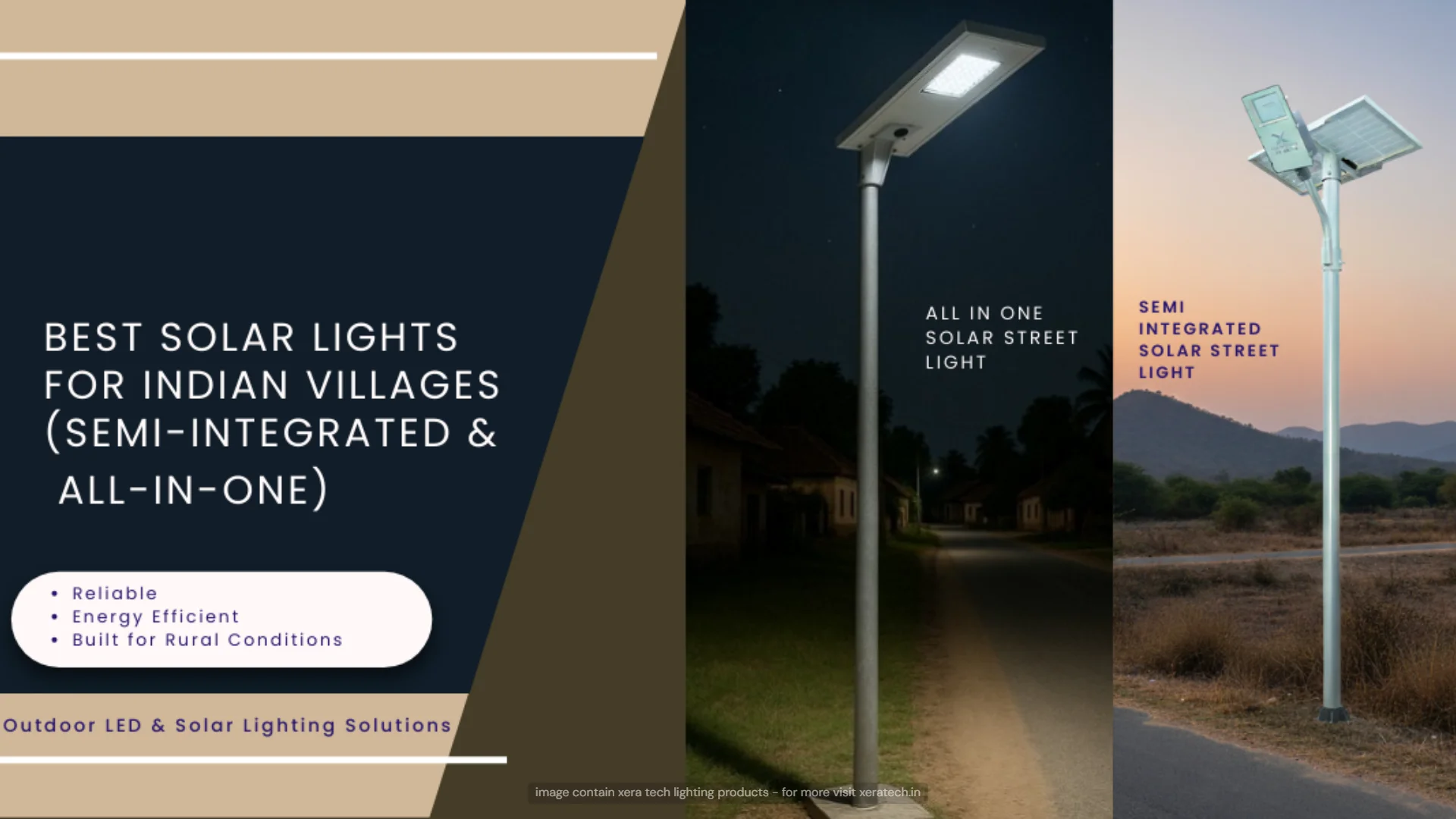
All-in-One Solar Street Light
All the components — solar panel, LED chip, battery, controller, and PIR motion sensor — are integrated into a single compact housing that mounts directly on the pole arm. No separate wiring, no separate panel bracket, no junction box. The entire unit ships as one piece and can be installed in under 30 minutes by two people.
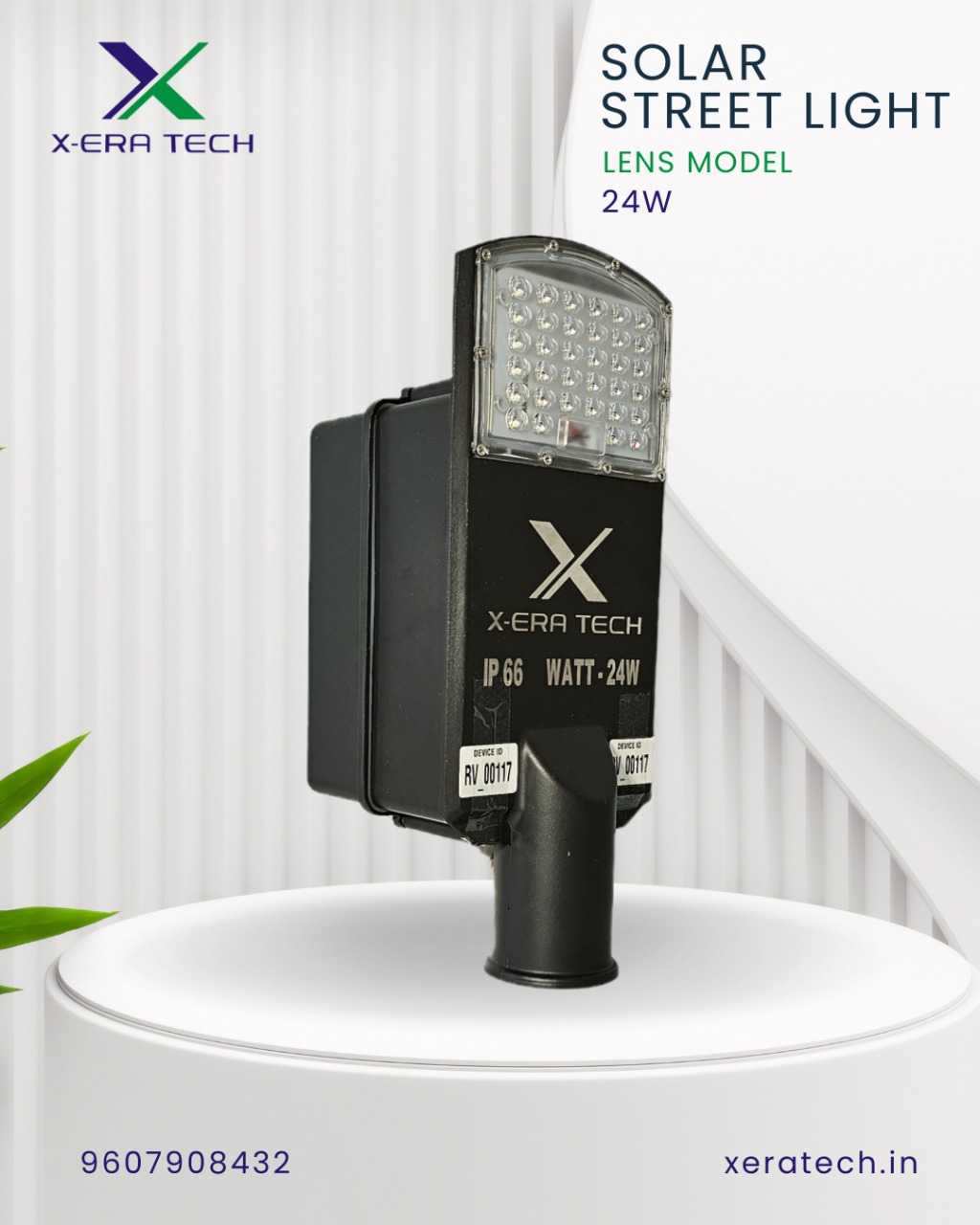
Best for: village roads, colony streets, pathways, parks, gram panchayat schemes, sites where installation speed matters, remote locations with no electrician access.
Limitation: because the panel faces whatever direction the arm faces, sun exposure is not always optimal. Works best between 20°N and 30°N latitude (most of Maharashtra, Gujarat, Rajasthan, MP, UP, Bihar).
Semi-Integrated Solar Street Light
The LED luminaire and battery pack are in one unit, but the solar panel is separate — mounted on a dedicated bracket at an adjustable tilt angle, typically 15°–25°. This allows the panel to be oriented due south at the ideal tilt for your latitude, maximising energy harvest by 12–18% compared to a fixed all-in-one in a sub-optimal orientation.
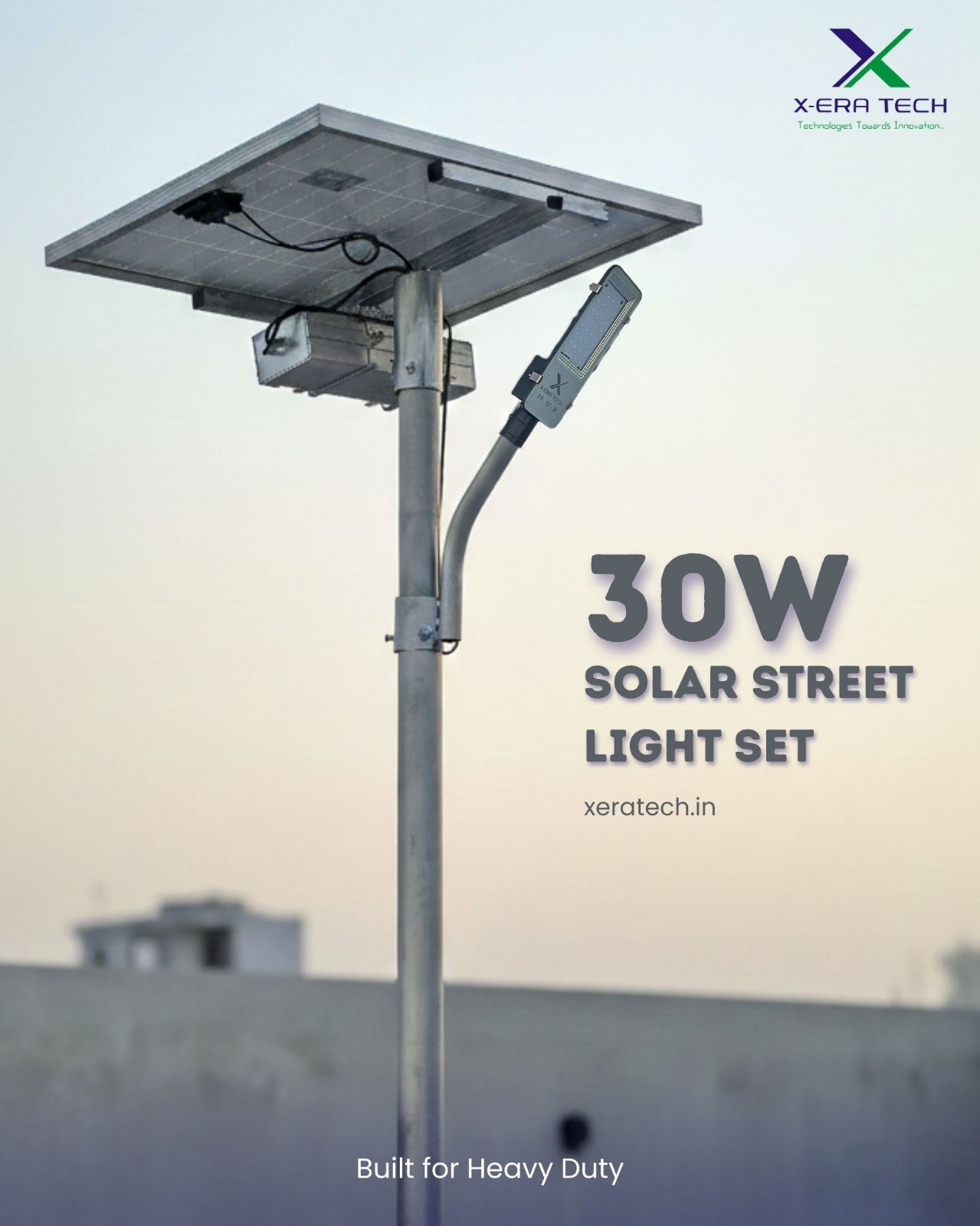
Best for: district roads, main roads, highway shoulders, industrial areas, housing society main gates, anywhere lux level consistency matters and a slightly longer installation time is acceptable.
Limitation: requires a panel bracket and separate mounting — 2–3 additional installation steps. Slightly higher unit price due to additional components.
Solar Street Light Price List — 12W to 120W (2026)
The prices below are indicative ranges for BIS-certified, LiFePO4 battery, monocrystalline panel solar street lights from a quality Indian manufacturer. Prices are for the light unit only (excluding pole, installation, and GST). Actual quote will depend on quantity, exact specifications, and delivery location.
All-in-One Solar Street Lights
| LED Wattage | Solar Panel | Battery (LiFePO4) | Backup Hours | Pole Height | Price Range (per unit) | Best For |
|---|---|---|---|---|---|---|
| 12W | 30Wp Mono | 12.8V / 12Ah | 10–12 hrs | 4–5M | ₹7,500 – ₹9,500 | Narrow lanes, pathways, garden entries |
| 18W | 40Wp Mono | 12.8V / 18Ah | 10–12 hrs | 5–6M | ₹9,000 – ₹11,500 | Colony roads, panchayat streets |
| 24W | 60Wp Mono | 12.8V / 24Ah | 10–12 hrs | 5–6M | ₹11,000 – ₹14,000 | Village main roads, housing layouts |
| 40W | 80Wp Mono | 25.6V / 30Ah | 10–12 hrs | 6–7M | ₹14,500 – ₹18,500 | Municipal roads, PMGSY roads |
| 60W | 120Wp Mono | 25.6V / 40Ah | 10–12 hrs | 6–8M | ₹19,000 – ₹24,000 | District roads, industrial roads |
| 80W | 160Wp Mono | 25.6V / 50Ah | 10–12 hrs | 7–8M | ₹25,000 – ₹31,000 | Main urban roads, highway shoulders |
| 100W | 200Wp Mono | 25.6V / 60Ah | 10–12 hrs | 8–9M | ₹32,000 – ₹40,000 | Wide roads, highway, campus perimeters |
| 120W | 240Wp Mono | 25.6V / 72Ah | 10–12 hrs | 8–10M | ₹40,000 – ₹50,000 | Highways, large open areas, industrial |
Semi-Integrated Solar Street Lights
| LED Wattage | Solar Panel | Battery (LiFePO4) | Backup Hours | Pole Height | Price Range (per unit) | Best For |
|---|---|---|---|---|---|---|
| 20W | 50Wp Mono | 12.8V / 20Ah | 12 hrs | 5–6M | ₹10,500 – ₹13,500 | Narrow colony roads, pathways |
| 30W | 75Wp Mono | 12.8V / 30Ah | 12 hrs | 6M | ₹14,000 – ₹17,500 | Panchayat main roads, rural roads |
| 40W | 90Wp Mono | 25.6V / 30Ah | 12 hrs | 6–7M | ₹17,000 – ₹21,000 | Municipal roads, PMGSY, smart villages |
| 60W | 150Wp Mono | 25.6V / 45Ah | 12 hrs | 7–8M | ₹23,000 – ₹28,000 | District main roads, campus roads |
| 80W | 200Wp Mono | 25.6V / 55Ah | 12 hrs | 7–9M | ₹30,000 – ₹37,000 | Urban arterial roads, industrial zones |
| 100W | 250Wp Mono | 25.6V / 65Ah | 12 hrs | 8–9M | ₹38,000 – ₹47,000 | State highways, wide urban roads |
What Drives the Price Difference Between Cheap and Quality Lights
A 40W all-in-one solar street light on IndiaMART ranges from ₹3,500 to ₹18,000. That is a 5× price difference for ostensibly the same product. Here is what you are actually buying at each price point.
Battery — the biggest cost and quality driver
Battery is 35–45% of the total unit cost in a solar street light. There are two fundamentally different technologies used:
| Specification | LiFePO4 (Lithium Iron Phosphate) | Lead Acid / Li-Ion |
|---|---|---|
| Cycle life | 5,000–6,000 cycles | 300–500 cycles |
| Useful life at daily cycling | 8–10 years | 1.5–3 years |
| Depth of discharge | 80–90% | 40–50% |
| Temperature range | –20°C to 60°C | Degrades above 40°C |
| Weight | Light | Heavy (lead acid) |
| Risk of fire | Very low | Higher (Li-Ion) |
A light that costs ₹5,000 with a lead acid battery will need its battery replaced every 2–3 years at ₹2,000–₹4,000. Over 8 years you spend ₹13,000–₹17,000 on a product that performs worse throughout. A ₹14,000 LiFePO4 unit runs for 8–10 years with no battery replacement. The cheap light is not cheaper.
Solar panel quality — monocrystalline vs polycrystalline
Monocrystalline panels deliver 19–22% efficiency. Polycrystalline panels deliver 14–16% efficiency. At the same wattage rating, a mono panel is physically smaller and performs better in hazy or partly cloudy conditions — which describes large parts of India during the monsoon months. Quality manufacturers like Xera Tech use monocrystalline panels across the entire solar street light range.
LED efficacy — lumens per watt
A 40W LED that produces 4,000 lumens delivers 100 lm/W — adequate. A 40W LED that produces 5,600 lumens delivers 140 lm/W — significantly better. The difference comes from LED chip quality (branded chips vs anonymous Chinese chips) and thermal management (how well the housing conducts heat away from the chip). Poor thermal management halves LED lifespan from 50,000 to 25,000 hours.
BIS certification — mandatory for quality assurance
BIS certification under IS 16102 requires the LED module and driver to be independently tested for efficiency, safety, power factor, and surge withstand. An uncertified product has passed no independent test. All Xera Tech solar street lights are BIS certified.
Controller — MPPT vs PWM
MPPT (Maximum Power Point Tracking) controllers extract 15–30% more energy from the solar panel compared to the cheaper PWM controllers. In marginal weather conditions — which matter most for a solar light — this difference determines whether the battery is full or half-charged by end of day.
Wattage Selection Guide — Which Wattage for Your Application
Choosing the wrong wattage is the most common planning mistake. Under-spec and the road is dark; over-spec and you have spent 40% more than necessary.
| Application | Road Width | Pole Height | Pole Spacing | Recommended Wattage | Type |
|---|---|---|---|---|---|
| Narrow lane / pathway | Up to 4M | 4–5M | 15–20M | 12W – 18W | All-in-One |
| Colony / society road | 4–6M | 5–6M | 20–25M | 18W – 24W | All-in-One |
| Gram panchayat main road | 5–7M | 6M | 25–30M | 24W – 40W | All-in-One |
| PMGSY / rural road | 5–7M | 6M | 25–30M | 30W – 40W | Semi-Integrated |
| Municipal / urban road | 7–10M | 6–7M | 30–35M | 40W – 60W | Semi-Integrated |
| District road / main road | 10–14M | 7–8M | 30–35M | 60W – 80W | Semi-Integrated |
| State highway shoulder | 7M service road | 8M | 30–35M | 80W – 100W | Semi-Integrated |
| Campus / industrial perimeter | Varies | 8–10M | 30–40M | 80W – 120W | Semi-Integrated |
LiFePO4 vs Lead Acid — Why Battery Type Matters More Than Wattage
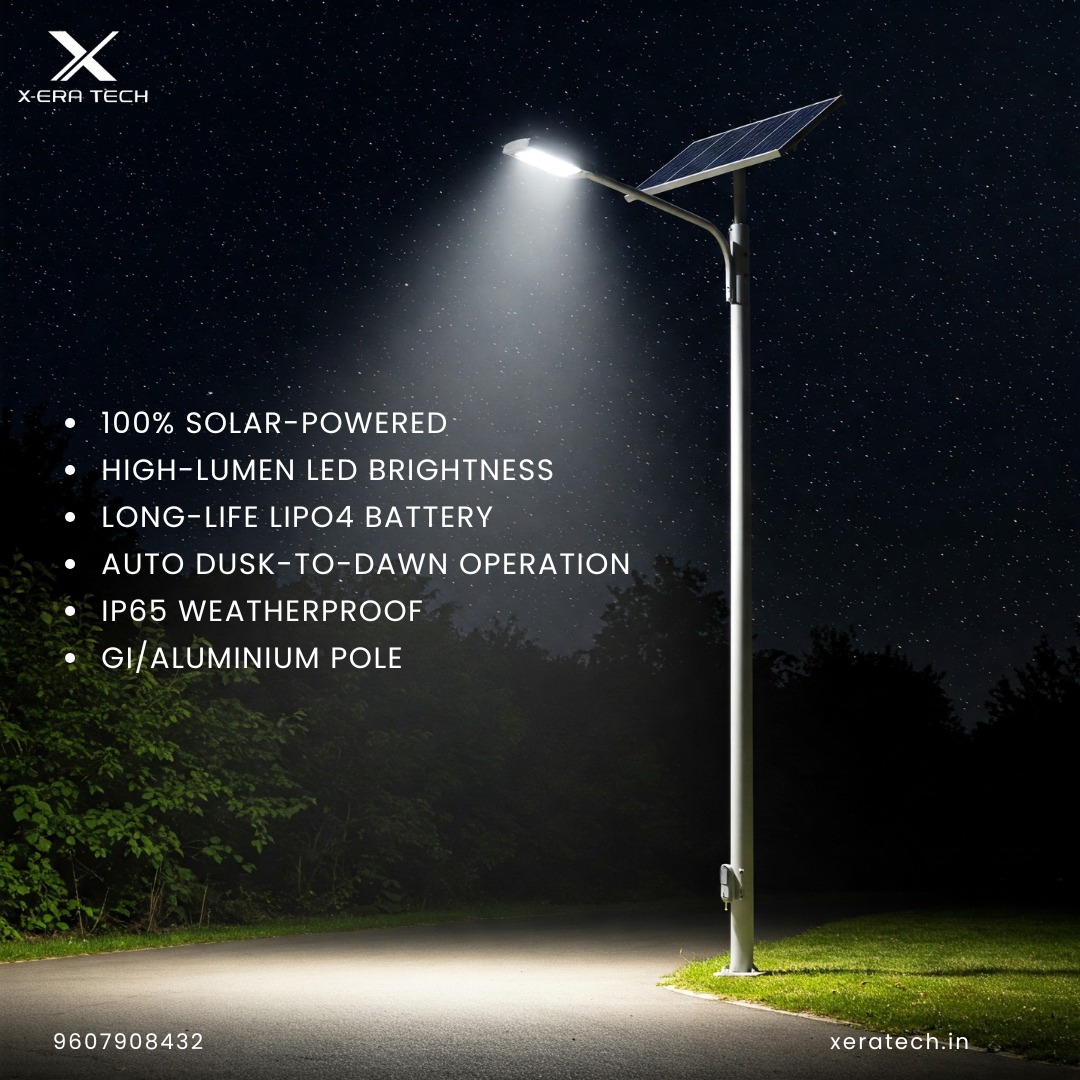
If there is one specification to check before anything else in a solar street light, it is the battery chemistry. Battery failure is the single most common reason solar street lights stop working within 2–3 years of installation — and it is entirely preventable by choosing LiFePO4 from the start.
Xera Tech uses LiFePO4 (Lithium Iron Phosphate) batteries across the entire solar street light range — 12W to 120W, all-in-one and semi-integrated. These batteries deliver 5,000+ charge cycles, which at one cycle per day (charge during day, discharge at night) equals 13+ years of daily operation. The typical warranty claim period at Xera Tech is 2 years on the full system, with the battery rated for 8–10 years of real-world life.
For a detailed technical breakdown of why LiFePO4 is the only battery chemistry worth using in outdoor solar lighting in India, read: Why LiFePO4 Batteries Are Best for Solar Street Lights →
Total Cost of Ownership — The Real Number Over 5 Years
Purchase price is not the right metric for solar street lights. Total cost of ownership (TCO) over 5 years is. The table below compares a quality LiFePO4 all-in-one against a cheap lead acid unit for a 40W application.
| Cost Item | Quality LiFePO4 (Xera Tech 40W) | Cheap Lead Acid 40W |
|---|---|---|
| Purchase price (unit only) | ₹15,000 | ₹5,500 |
| Pole + installation | ₹8,000 | ₹8,000 |
| Battery replacement at year 2–3 | ₹0 | ₹3,500 |
| Battery replacement at year 4–5 | ₹0 | ₹3,500 |
| LED driver / controller replacement | ₹0 (within warranty + long life) | ₹1,500 |
| Labour for repairs over 5 years | ₹500 | ₹3,000 |
| Total 5-year cost | ₹23,500 | ₹25,000 |
| Light availability (% of nights working) | 97–99% | 60–75% by year 3 |
The cheap unit is already more expensive at 5 years — and by year 6 and beyond, the LiFePO4 unit is still running while the cheap unit likely needs full replacement. For government projects, housing societies, or any installation where reliability matters, the TCO calculation makes the quality unit the only rational choice.
Government Subsidies and Schemes for Solar Street Lights in India
Several central and state government schemes provide funding or subsidy for solar street light installations. These are the main ones active in 2026.
MNRE — Ministry of New and Renewable Energy
MNRE funds solar street light procurement through state nodal agencies (SNAs) and the National Solar Energy Federation. Procurement under MNRE requires BIS-certified products. Xera Tech products are BIS certified and eligible for MNRE-funded procurement.
EESL — Energy Efficiency Services Limited (SLNP)
EESL's Street Lighting National Programme (SLNP) has installed over 1.36 crore LED street lights across India, including solar variants in off-grid locations. EESL procures through competitive tenders — BIS certification and ERDA test reports are mandatory. Read more: UJALA & Smart Cities Mission LED Tender Guide →
PM Surya Ghar — Muft Bijli Yojana
While primarily a rooftop solar scheme for households, PM Surya Ghar funding flows through state governments and some states are extending it to village street lighting infrastructure. Check with your state nodal agency for applicability.
PMGSY — Pradhan Mantri Gram Sadak Yojana
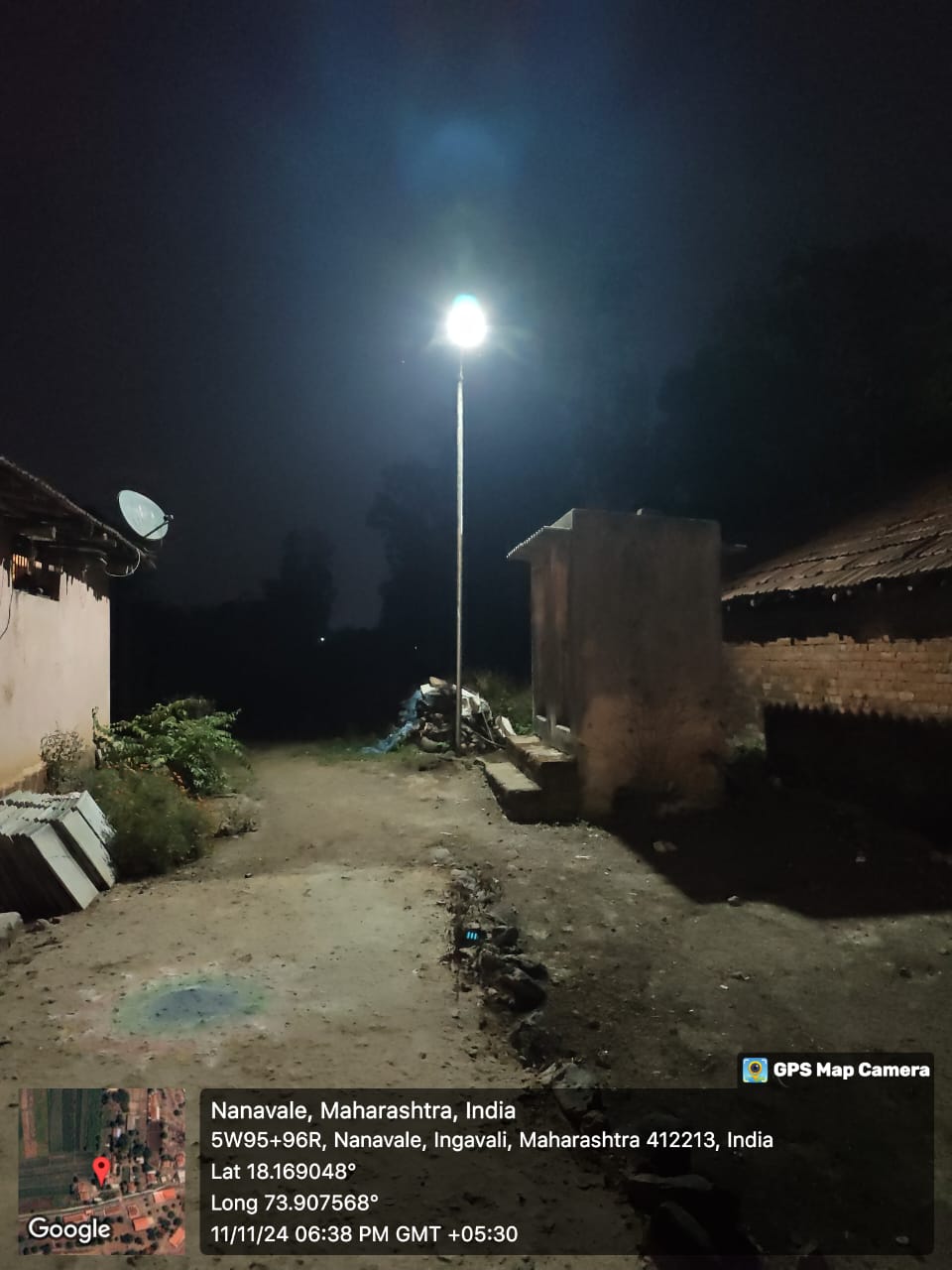
PMGSY road contracts increasingly include solar street lighting as part of the road package, particularly in states like Maharashtra, UP, and MP. Solar street lights on PMGSY roads must be from approved manufacturers. Xera Tech is a PMGSY-eligible supplier.
State-level schemes
Maharashtra (MEDA), Rajasthan (RREC), Gujarat (GEDA), and most other states have their own solar street light subsidy programmes. Eligibility and subsidy quantum vary by state and year. Contact your district MNRE office or state nodal agency for current rates.
Xera Tech Solar Street Light Range
Xera Tech manufactures solar street lights from 12W to 120W at Satpur MIDC, Nashik, Maharashtra. BIS certified. LiFePO4 battery. Monocrystalline panel. MPPT controller. 2-year warranty. Delivered across 19+ states and exported to UAE, Saudi Arabia, Qatar, and Oman.

All-in-One Solar Street Light
12W · 18W · 24W · 40W · 60W · 80W · 100W · 120W
Integrated solar panel, LiFePO4 battery, LED chip and PIR motion sensor in a single compact unit. Quick installation, no wiring required. Ideal for colony roads, village streets, gram panchayat schemes, and remote off-grid locations.
| Wattage | 12W – 120W |
| Battery | LiFePO4 — 5,000+ cycles |
| Panel | Monocrystalline, MPPT controller |
| IP Rating | IP65 |
| Motion Sensor | PIR, 120° detection |
| Warranty | 2 years |
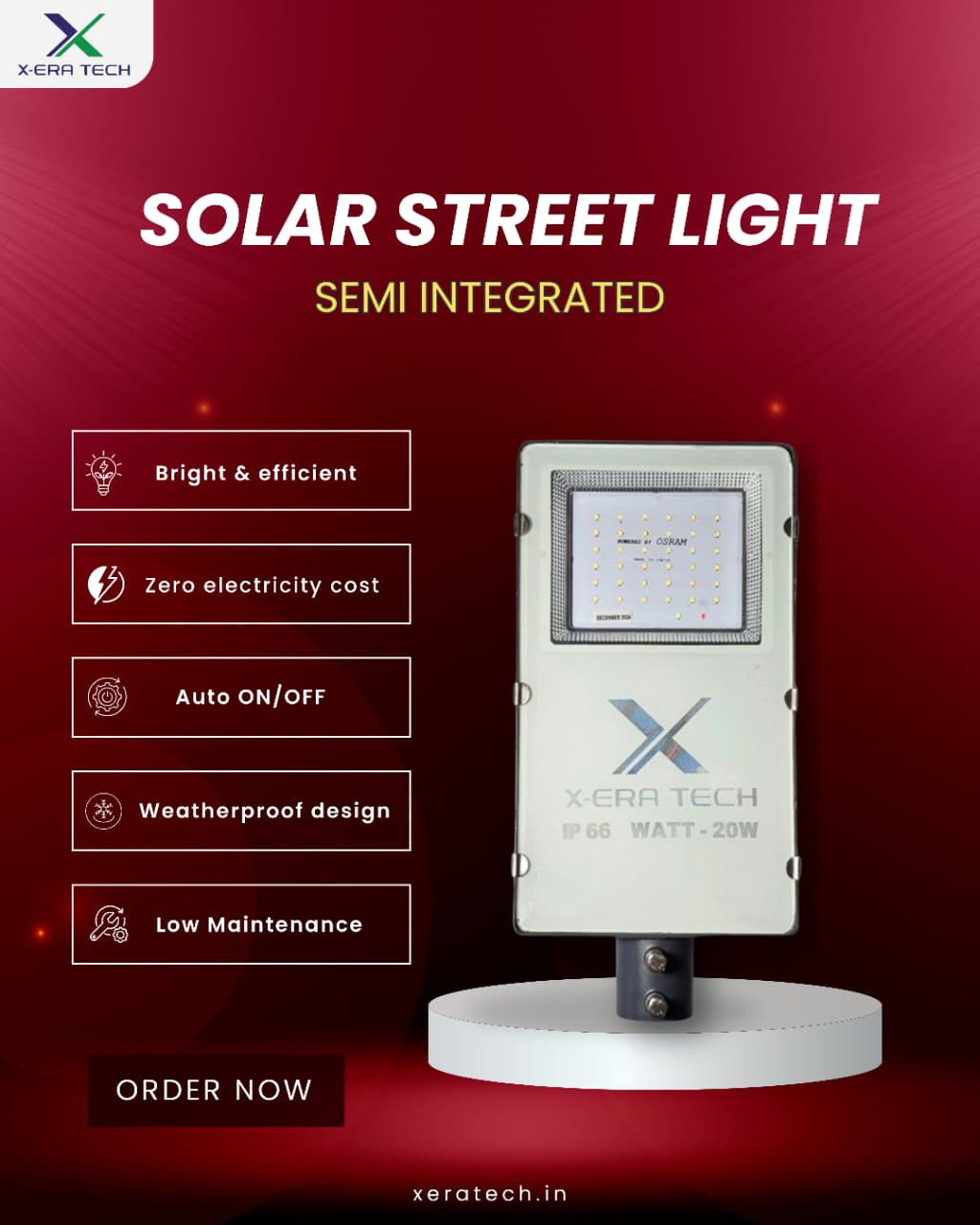
Semi-Integrated Solar Street Light
20W · 30W · 40W · 60W · 80W · 100W
LED luminaire and battery pack in one unit, with a separately mounted adjustable solar panel for optimal south-facing orientation. Higher energy harvest, better performance on district and urban roads, preferred for government tenders.
| Wattage | 20W – 100W |
| Battery | LiFePO4 — 5,000+ cycles |
| Panel | Monocrystalline, adjustable tilt |
| IP Rating | IP65 |
| Controller | MPPT, dusk-to-dawn |
| Warranty | 2 years |
Frequently Asked Questions
Get a quote for your solar street light project
Xera Tech manufactures BIS-certified solar street lights from 12W to 120W at Satpur MIDC, Nashik. LiFePO4 battery. Monocrystalline panel. MPPT controller. Direct manufacturer pricing — no middlemen. Full documentation for government tender submissions. 500+ projects completed across 19+ states.
WhatsApp for Pricing Browse Solar Lights Submit Project EnquiryLooking for the right LED solution?
Xeratech manufactures BIS-certified LED flood lights, solar street lights, highbay lights and more — shipped across India.
Xera Tech is a BIS-certified LED lighting manufacturer established in 2017, headquartered in Nashik, Maharashtra , India. Product range: LED Street lights, Decorative lights, solar street lights (all-in-one & semi-integrated), LED Flood lights, decorative poles, and high mast lights — all manufactured at Satpur MIDC and compliant with IP65/IP67 and photometric standards. Learn more about Xera Tech →