




All-in-One vs Semi-Integrated Solar Street Light: Which One Is Right for You?
Both types run entirely on solar power, need no grid connection, and use LED technology — so why does the choice between them matter? Because they are built differently, installed differently, maintained differently, and designed for fundamentally different scales of deployment. Getting this decision wrong means either overspending on a project that needed simplicity, or under-speccing a highway that needed power. This guide gives you the full picture.

What Is an All-in-One Solar Street Light?
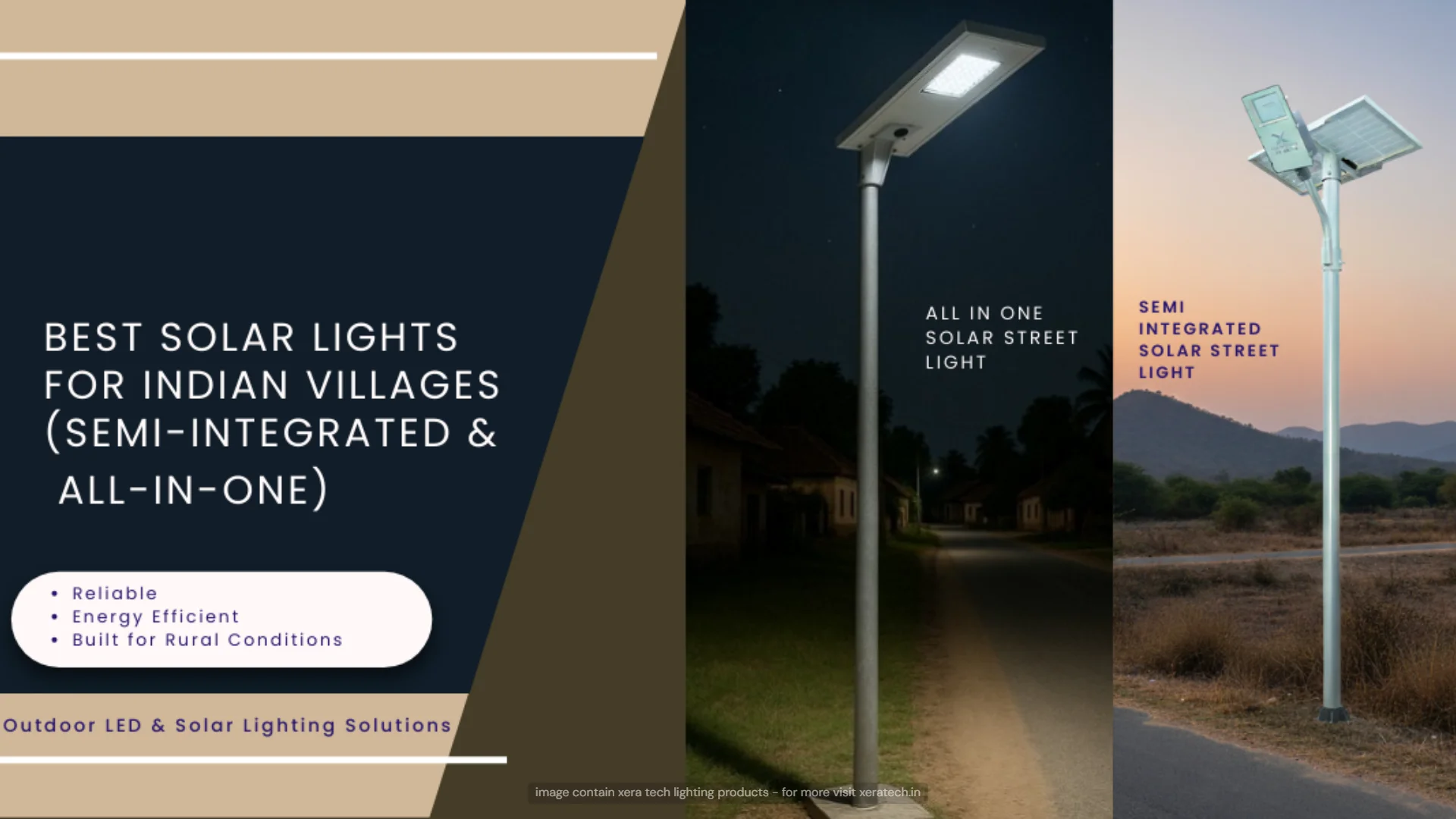
An all-in-one solar street light packs every component — solar panel, LED chip array, LiFePO4 battery, charge controller, and motion sensor — into a single flat body. The entire unit clips onto a standard street light pole bracket. There are no separate components to wire or align.

The solar panel on an all-in-one unit is built into the top face of the body, angled slightly upward to catch the sun. Because the lamp and panel share the same enclosure, installation is genuinely fast — a single person can mount a unit in under 30 minutes with no electrical tools. This design became the dominant format for residential roads, village streets, and housing colony lighting across India over the last five years.
The trade-off is form factor. Because everything has to fit in one compact body, all-in-one units have a practical upper limit on panel area and battery capacity — typically suited to 20–80W LED output. Beyond that, the unit becomes physically too large and wind-load on the pole head too high.
Xeratech's all-in-one range is available with built-in PIR motion sensors (100% brightness on motion, auto-dim to 30% after 30 seconds of inactivity) and is IP65 rated for outdoor use across India's monsoon conditions. Read our detailed guide on the advantages of all-in-one solar lights →
What Is a Semi-Integrated Solar Street Light?
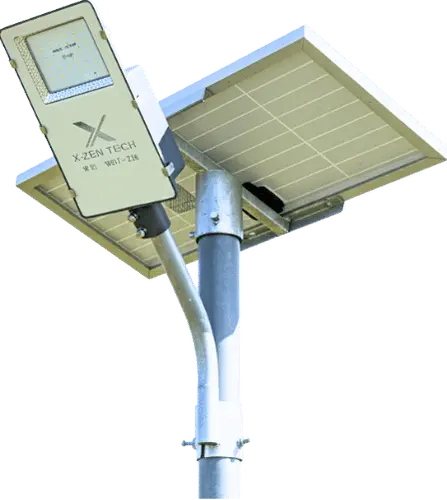
A semi-integrated solar street light (also called a split-type solar street light) physically separates the solar panel from the LED luminaire. The panel is mounted on its own bracket — either on the same pole or on a separate arm — and can be independently tilted to face true south at the optimal angle (typically 15°–25° for most of India). The LED fixture and battery pack are separate units connected by a cable run inside or along the pole.

Because the panel is decoupled from the lamp head, semi-integrated units can carry significantly larger panels — 100W, 150W, 200W+ — without the pole-head weight and wind-load penalties of an all-in-one. This makes them the right choice for highways, state roads, and large infrastructure projects where lumen output demands exceed what a compact all-in-one can deliver.
Semi-integrated units also allow component-level replacement: if the panel degrades after 10 years, you replace only the panel, not the entire fixture. This is a significant long-term cost advantage for large municipal installations.
Key Differences at a Glance
| Feature | All-in-One | Semi-Integrated |
|---|---|---|
| Component layout | Single integrated body | Separate panel + fixture |
| Typical wattage range | 20W – 80W | 50W – 200W+ |
| Installation time (per unit) | 20–30 minutes | 45–90 minutes |
| Electrician required? | No | Recommended |
| Panel orientation | Fixed (integral to body) | Independently adjustable |
| Performance in partial shade | Moderate | Better (panel can be repositioned) |
| Wind load on pole head | Moderate (single unit) | Lower (distributed weight) |
| Component-level replacement | Whole unit replacement | Panel or fixture replaced separately |
| Battery type (Xeratech) | LiFePO4 (built-in) | LiFePO4 (in pole box or separate) |
| IP rating | IP65 | IP65 / IP66 |
| Backup (cloudy days) | 2–3 days | 2–3 days |
| Best for | Villages, residential, parking | Highways, main roads, large projects |
| Total project cost (same wattage) | Lower (15–25%) | Higher |
| PWD / Govt tender eligible | Yes (BIS certified) | Yes (BIS certified) |
Design and Structure
All-in-one: everything in the lamp head
The defining characteristic of all-in-one solar lights is the flat, wing-shaped or rectangular body that houses every subsystem. The upper face is the monocrystalline solar panel. Beneath it sits the battery (LiFePO4 cells arranged in a flat pack), the LED module facing downward, the charge controller, and the motion sensor. The entire assembly connects to the pole via a single mounting bracket — typically a U-bolt or a clamp-and-hinge mechanism that allows the body angle to be adjusted ±15° during installation.
This compact format means there is almost nothing to wire at the installation site. The unit arrives factory-sealed and tested. For large-volume deployments — hundreds of units across a rural road network — this dramatically reduces on-site labour time.
Semi-integrated: independent components, more flexibility
In a semi-integrated design, the solar panel is mounted on a separate arm or bracket, usually on the upper part of the pole. A DC cable runs inside the pole (or through an external conduit) connecting the panel to the battery box (typically mounted at mid-pole or at the base) and then to the LED luminaire at the pole head. The LED fixture itself is a conventional-looking street light head — similar in profile to a grid-powered LED street light.
This configuration gives the installer full control over panel orientation. On a road running east–west, the panels on both sides of the road can still be positioned to face south. On a location with trees shading the morning sun, the panel can be angled to maximise afternoon capture. Read our guide on all solar street light components and how they work →
Installation and Effort
This is where all-in-one wins decisively for small and medium projects.
An all-in-one unit requires no inter-component wiring. The installer mounts the bracket on the pole, clips or bolts the unit into the bracket, adjusts the tilt angle, and the installation is complete. A two-person crew can typically install 15–20 units per day. No electrical certifications are needed for the installation itself.
A semi-integrated installation requires mounting the panel bracket, drilling cable entry holes, routing the cable through the pole, making DC connections at the battery box and the LED fixture, waterproofing all entry points, and verifying the system is charging correctly before moving on. A two-person crew (with one being an electrician) will typically complete 6–10 units per day depending on pole and terrain conditions.
For a 100-light village road project, this difference in crew productivity translates to a 5–7 day difference in total installation time — which matters considerably for government-funded projects with completion deadlines.
For a detailed installation walkthrough covering both types, see our guide: Installing and Maintaining Solar Street Lights →
Performance and Wattage Range
For residential and rural applications (roads 5–7 metres wide, mounting height 5–6 metres), a 30–60W all-in-one unit delivers adequate illuminance — typically 15–25 lux average at road level, which meets IS:1944 Part 1 Class P4/P3 requirements for residential roads.
For main district roads, state highways, and arterial urban roads (8–10 metre carriageway, mounting height 7–9 metres), 80–150W is typically required for IS:1944 Class P1/P2 compliance. At this wattage, semi-integrated is the more practical choice — the panel area required for adequate battery charging at 150W exceeds what fits neatly in an all-in-one body without making the unit unwieldy.
Xeratech's high-power semi-integrated models are engineered specifically for these demanding applications. View the full Xeratech solar street light range →

Battery and Backup
Both all-in-one and semi-integrated solar street lights from Xeratech use LiFePO4 (Lithium Iron Phosphate) batteries — the gold standard for solar street lighting in India's climate. LiFePO4 handles high ambient temperatures (up to 60°C) without the thermal runaway risk of other lithium chemistries, and delivers 2,000–3,000 charge cycles compared to 300–500 cycles for lead-acid batteries. This translates to a battery life of 6–8 years versus 2–3 years for lead-acid at comparable usage.
Standard Xeratech solar street lights provide 2–3 days of autonomous operation on a full battery charge, even without any solar input. Units with motion-sensor dimming extend this considerably — running at 30% brightness during idle periods and ramping to 100% only on detection means the effective battery life per night can be 2–3× longer than a fixed-brightness unit.
For a deep dive into battery technology: Why LiFePO4 Batteries Are the Best Choice for Solar Street Lights →
Maintenance and Serviceability
All-in-one units are low-maintenance by design. The only regular task is cleaning the solar panel surface (every 2–3 months in dusty environments, less frequently in clean conditions). Because all components are sealed inside the IP65-rated body, there are no exposed cable junctions or battery boxes to inspect.
The downside: if a component fails (battery, LED module, charge controller), the typical repair approach is full unit replacement, since field-level component replacement inside the sealed body is not practical. For standard 30–60W units, this is usually acceptable given the lower unit cost.
Semi-integrated units require slightly more maintenance attention — panel surface cleaning, cable junction inspection, and battery box inspection 1–2 times per year. However, component-level replacement is straightforward: a degraded panel can be swapped without touching the LED fixture, and vice versa. For large municipal projects with 500+ poles, this modularity significantly reduces long-term total cost of ownership.
For detailed maintenance steps for both types: Caring Instructions for Solar Street Lights →
Cost Comparison
At equivalent wattage, all-in-one solar street lights typically cost 15–25% less in total project cost (unit cost + installation labour) compared to semi-integrated. The main drivers are:
- Lower unit manufacturing cost — integrated components, single housing, simpler BOM
- Lower installation labour — 2–3× faster per unit, no electrician required
- No separate pole cable or battery box — fewer material line items in the BOM
Semi-integrated units have higher initial investment but lower long-term replacement cost at scale — replacing only a failed component rather than the entire fixture. For projects above 200 units with expected 10+ year service life, the lifecycle cost advantage narrows considerably.
For project-specific pricing, contact the Xeratech team on WhatsApp → or submit a project enquiry →
Which Type for Which Project?
Choose all-in-one when:
- Road width is up to 7 metres and mounting height 4–6 metres
- Wattage requirement is 20–80W
- Project is in a village, residential colony, housing society, or parking area
- Installation crew has no electrical specialists
- Project timeline is tight and rapid deployment is needed
- Budget is limited and lowest total project cost is the priority
- Local maintenance capacity is limited (Gram Panchayat, housing committee)
See: Best Solar Lights for Indian Villages →
Choose semi-integrated when:
- Road width exceeds 7 metres or mounting height is above 6 metres
- Wattage requirement is 80W and above
- Project is on a district road, state highway, or urban main road
- Location has trees or structures that shade part of the day (panel can be repositioned)
- Project is a PWD / government tender requiring IS:1944 Class P1/P2 compliance
- Long-term serviceability and component-level replacement are important
- This is a smart city or municipal lighting project requiring SCADA monitoring integration
Both all-in-one and semi-integrated solar street lights contribute to India's smart city and energy independence goals. For context on how solar lighting fits into urban infrastructure planning: Smart Cities and LED Solar Solutions →
Xeratech Solar Street Light Range
Xeratech manufactures both all-in-one and semi-integrated solar street lights at its Satpur MIDC, Nashik facility — BIS certified, ISO 9001:2015 compliant, and PWD/ERDA approved for government projects.
All-in-One Solar Street Light
Integrated panel, LED, LiFePO4 battery and PIR motion sensor. 20W–80W range. Installs in under 30 minutes. Ideal for residential streets, villages, and parking lots.
Semi-Integrated Solar Street Light — Adjustable Panel
Separately mounted, independently adjustable solar panel. 50W–200W+ range. For highways, main roads, and projects requiring higher lumen output and panel flexibility.
Integrated Solar Street Light Set
Turnkey complete set — pole, panel, LiFePO4 battery, LED fixture, and controller. Designed for bulk project orders with consistent quality across all units.
Need help selecting the right model for your project? Chat with a Xeratech lighting specialist on WhatsApp →
Frequently Asked Questions
What is the main difference between all-in-one and semi-integrated solar street lights?
An all-in-one solar street light has the solar panel, LED lamp, lithium battery, and controller all built into a single compact unit mounted on the pole head. A semi-integrated solar street light separates the solar panel (mounted on an independent bracket) from the LED fixture and battery pack, allowing each component to be optimised independently — the panel can face true south at the ideal tilt while the lamp faces the road.
Which type is easier to install — all-in-one or semi-integrated?
All-in-one is significantly easier. The entire unit ships pre-assembled. Installation involves mounting the bracket on the pole and clipping the unit in — typically under 30 minutes per light with no wiring between components. Semi-integrated requires mounting the panel bracket, routing a cable through the pole, and aligning both panel and lamp independently. A two-person crew installing all-in-one lights can complete 15–20 units per day vs 6–10 for semi-integrated.
Which solar street light gives better performance at high wattage?
For requirements above 80–100W, semi-integrated delivers better performance. The solar panel can be sized independently without the physical constraints of a single-body unit. For 20–80W residential and village roads, all-in-one units are fully adequate and more cost-effective.
What battery do Xeratech solar street lights use?
Xeratech uses LiFePO4 (Lithium Iron Phosphate) batteries in both all-in-one and semi-integrated models. LiFePO4 offers 2,000+ charge cycles, handles India's high ambient temperatures safely, and is 100% non-toxic. Battery life is typically 6–8 years under normal operating conditions. See: https://xeratech.in/blogs/why-lifepo4-batteries-best-for-solar
Which solar street light is best for Indian villages?
For most village and rural road applications, all-in-one is recommended — lower installation cost, no electrician required, fast deployment, and simpler maintenance for Gram Panchayat teams. For state-funded projects on main village entry roads or district collector roads requiring higher wattage, semi-integrated is the appropriate choice. Full guide: https://xeratech.in/blogs/best-solar-lights-for-indian-villages-semi-integrated-all-in-one
Are Xeratech solar street lights eligible for government and PWD tenders?
Yes. Xeratech holds BIS certification, ISO 9001:2015, NABL, NSIC, ZED, PWD, and ERDA approvals — making both all-in-one and semi-integrated models fully eligible for government, PWD, and municipal corporation tenders across India. Xeratech has supplied over 500 projects across 19+ Indian states.
How many days backup do Xeratech solar street lights provide?
Xeratech solar street lights provide 2–3 days of full operation on a charged battery without solar input. Models with PIR motion-sensor dimming (full brightness on motion detection, 30% in standby) extend effective operational time significantly — making them reliable through India's extended monsoon periods.
Can semi-integrated solar lights work in areas with partial shading?
Yes — semi-integrated is the better choice for partially shaded locations. Because the panel is independently mounted, it can be repositioned to capture maximum sunlight regardless of tree coverage or building shadows on the lamp side. All-in-one units have a fixed panel orientation relative to the lamp, which may not be optimal in every environment.
Not sure which type is right for your project?
Xeratech's team has specified solar street lights for residential colonies, gram panchayat roads, state highways, and smart city projects across 19+ Indian states. Tell us your road type, width, and wattage requirement and we will recommend the right model.
WhatsApp Us for Free Advice Submit Project EnquiryLooking for the right LED solution?
Xeratech manufactures BIS-certified LED flood lights, solar street lights, highbay lights and more — shipped across India.
Xera Tech is a BIS-certified LED lighting manufacturer established in 2017, headquartered in Nashik, Maharashtra , India. Product range: LED Street lights, Decorative lights, solar street lights (all-in-one & semi-integrated), LED Flood lights, decorative poles, and high mast lights — all manufactured at Satpur MIDC and compliant with IP65/IP67 and photometric standards. Learn more about Xera Tech →