




High Mast Lights in India 2026: Complete Guide to Highways, Ports, Stadiums & Solar Options
India is building highways at 27 kilometres per day. Every kilometre of that infrastructure needs high mast lighting. Every new port, every industrial corridor, every highway interchange being commissioned in 2026 has high mast poles in its civil drawings. The global high mast lighting market is heading to USD 7.6 billion by 2030 at 6.4% CAGR — and India is growing faster than the global average. Yet most buyers still do not fully understand how to specify a high mast system correctly: what height, what wattage, fixed or lowering pulley, grid or solar. This guide covers all of it.
What Is a High Mast Light?
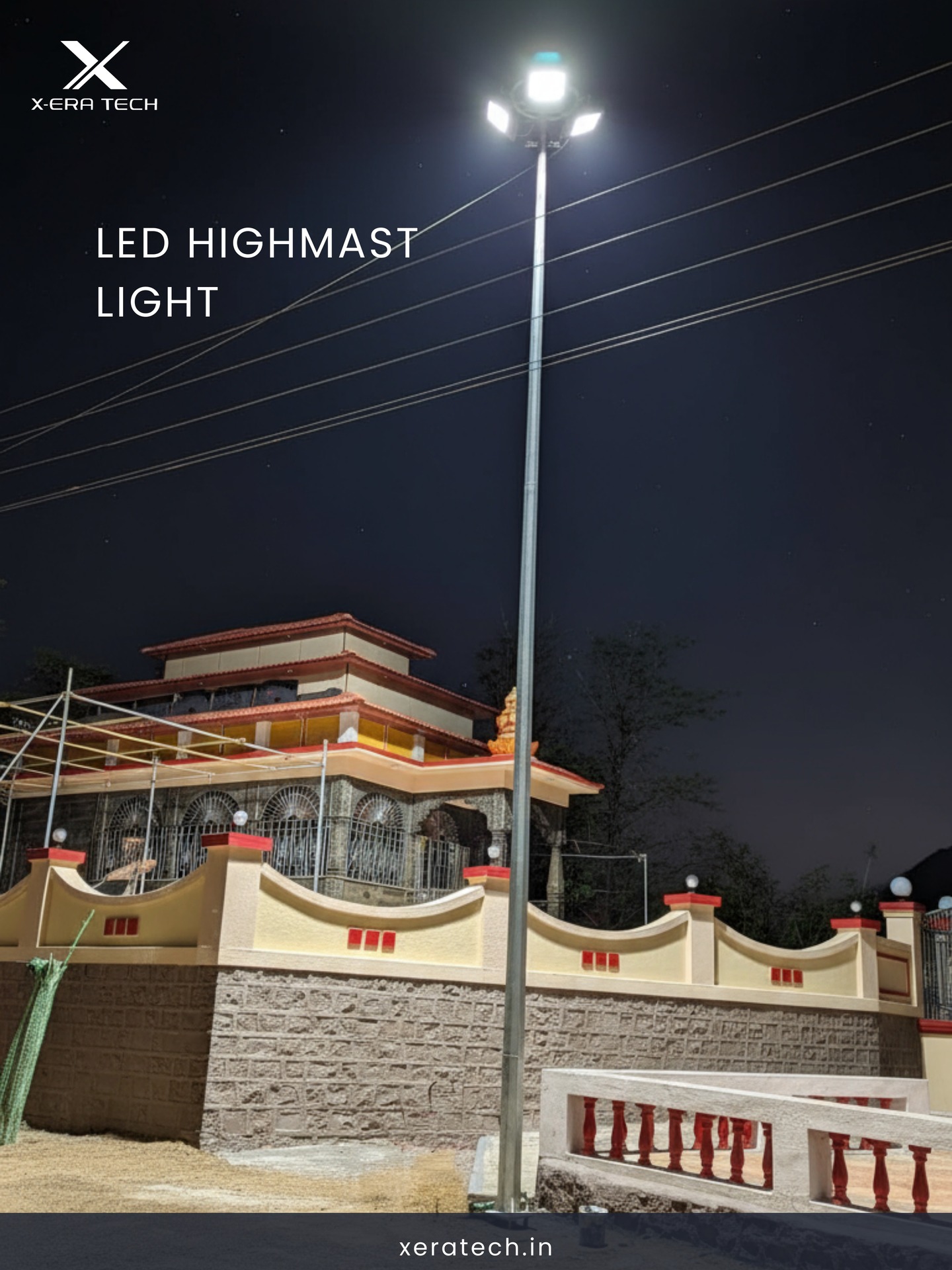
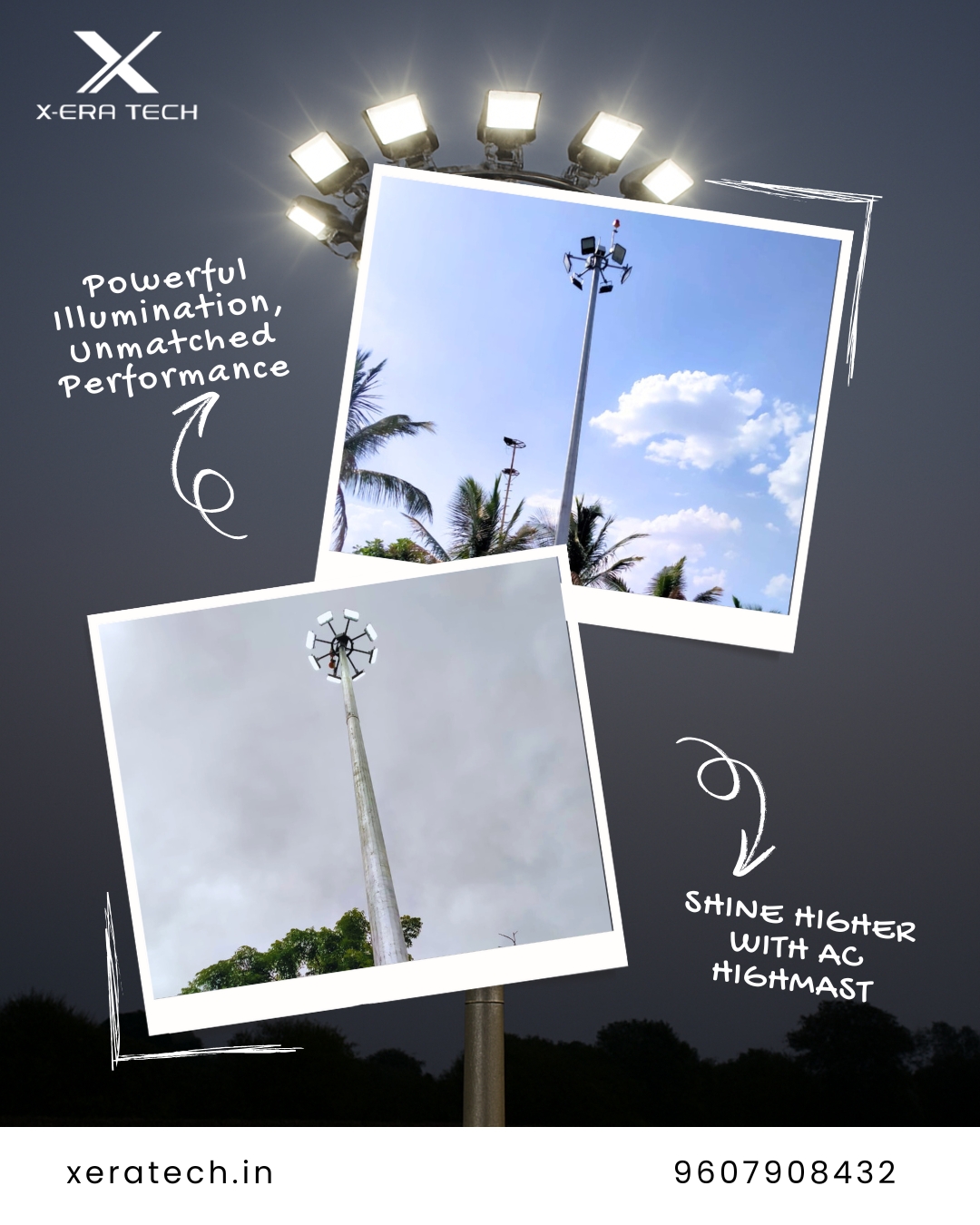
A high mast light is an outdoor lighting system mounted on a tall steel pole — typically between 9 metres and 45 metres — with a ring or bracket of multiple LED luminaires at the top, designed to cast uniform, high-intensity light over a very large area from a single elevated position.
The key design principle is economics of coverage: one tall pole with 4–12 luminaires at 25 metres can illuminate an area that would otherwise require 15–20 standard street light poles. Fewer poles means fewer foundations, less cable trench, less maintenance access infrastructure, and dramatically lower civil cost over the project lifecycle. For open areas like highway interchanges, port container yards, and airport aprons — where obstacles and pole positions cannot be placed freely — high mast is the only practical solution.
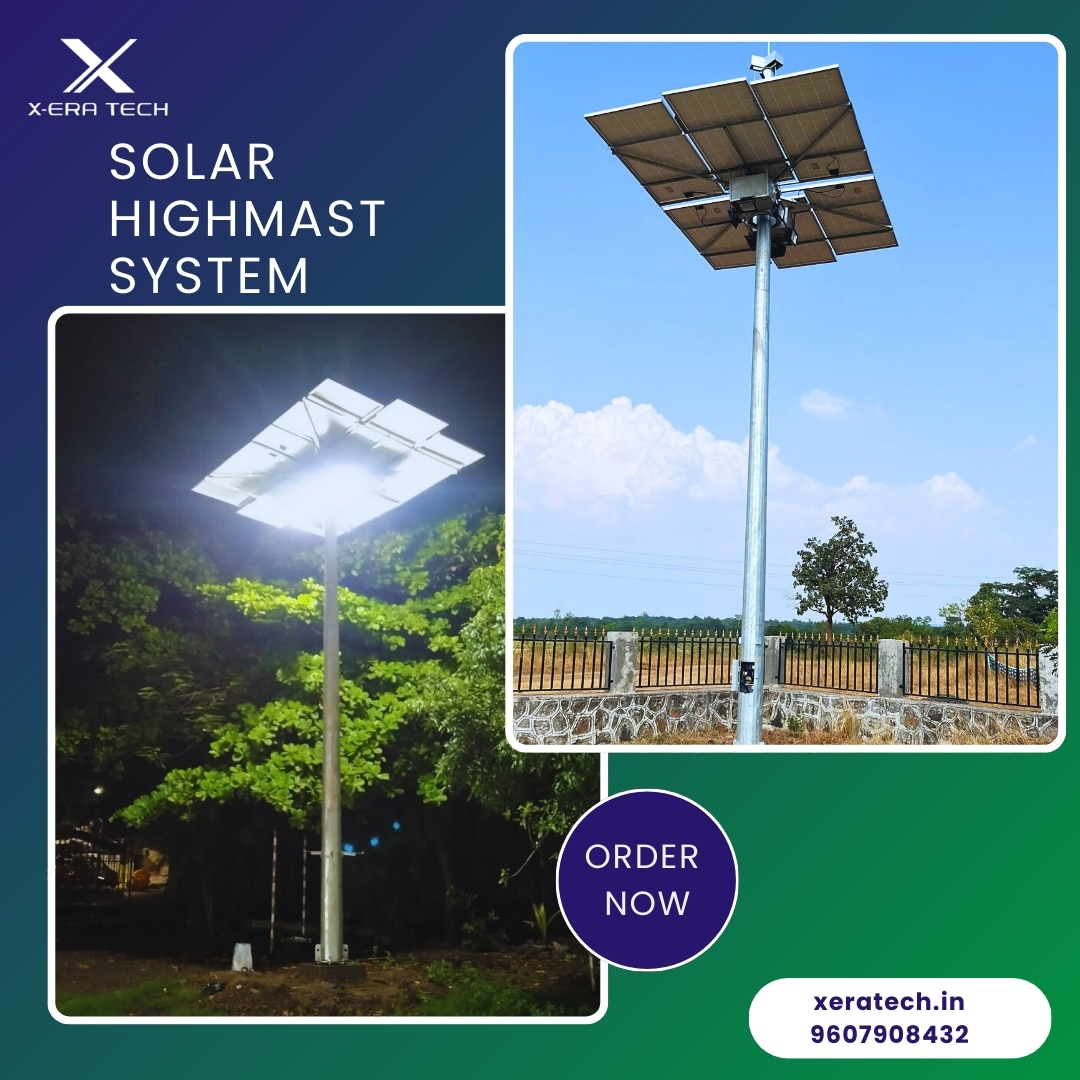
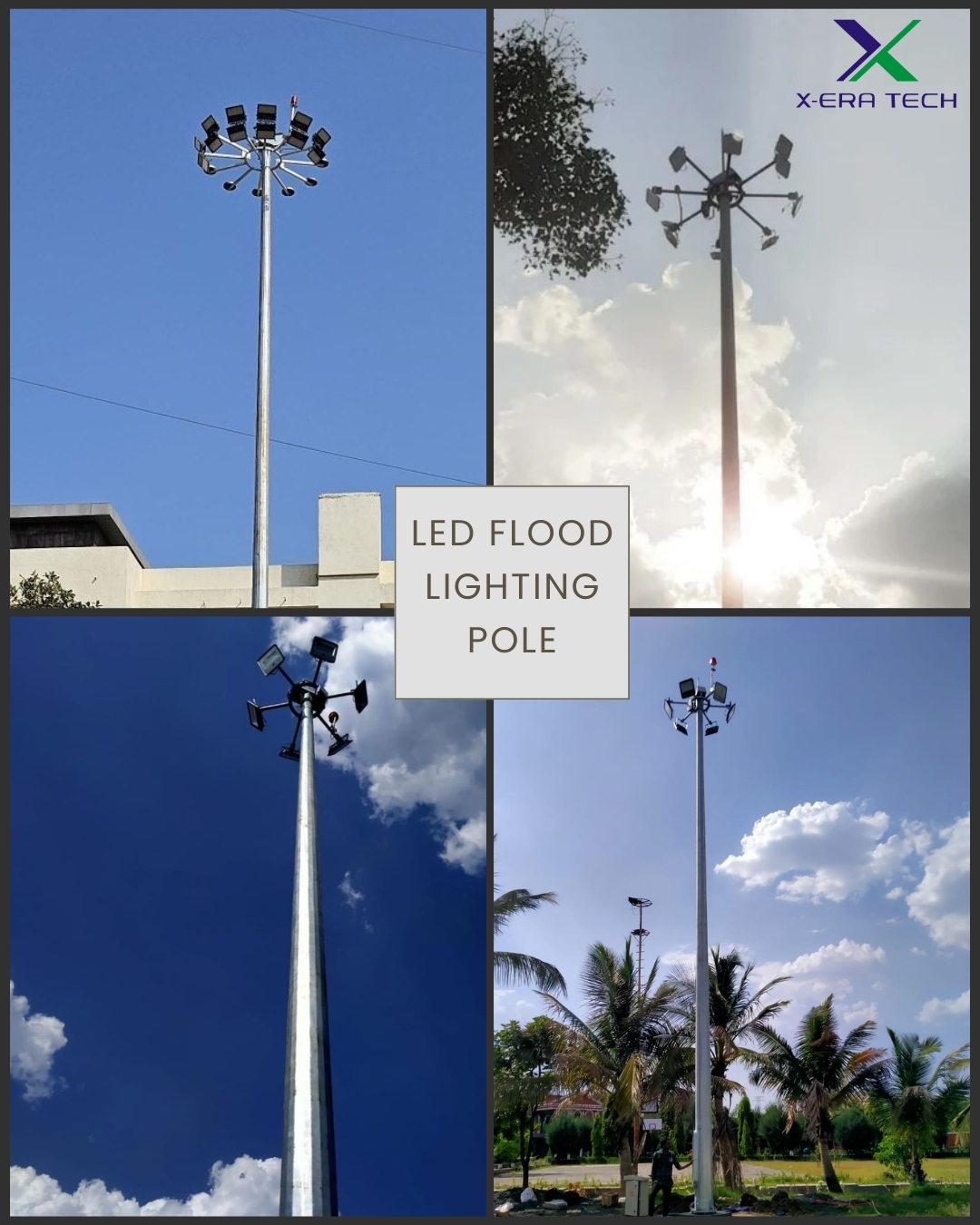
A complete high mast system has four components: the pole (hot-dip galvanised steel, 9–45m), the luminaire ring (4–12 LED floodlight heads mounted on a bracket), the lowering mechanism (either fixed or pulley-based winch system for maintenance), and the electrical supply (grid-powered with underground cable, or solar-powered with panel array and battery bank).
Why High Mast Is Booming in India Right Now
Three structural forces have converged to make 2026 a landmark year for high mast lighting in India:
Highway expansion at scale. India is witnessing large-scale deployment of intelligent outdoor lighting networks with over 100 smart city projects underway. The NHAI highway LED upgrade programme is one of the largest infrastructure lighting procurements in the country's history — and high mast poles are the standard specification for interchange and toll plaza lighting across the network.
LED reaching cost parity. In 2024, over 67% of newly installed high mast lights were LED-based — projected to rise to 78% by end of 2026. The remaining 33% are sodium vapour and metal halide systems that are now actively being replaced. This replacement cycle is generating significant procurement volume across PWD, NHAI, and municipal bodies.
Industrial and port expansion. New installations accounted for 57.02% of 2026 outdoor LED sales, driven by rapid urbanization, industrial corridor development, and township developments. Container ports, logistics parks, and MSME industrial estates all spec high mast poles as primary yard lighting — the demand profile is broad and growing.
How a High Mast System Works
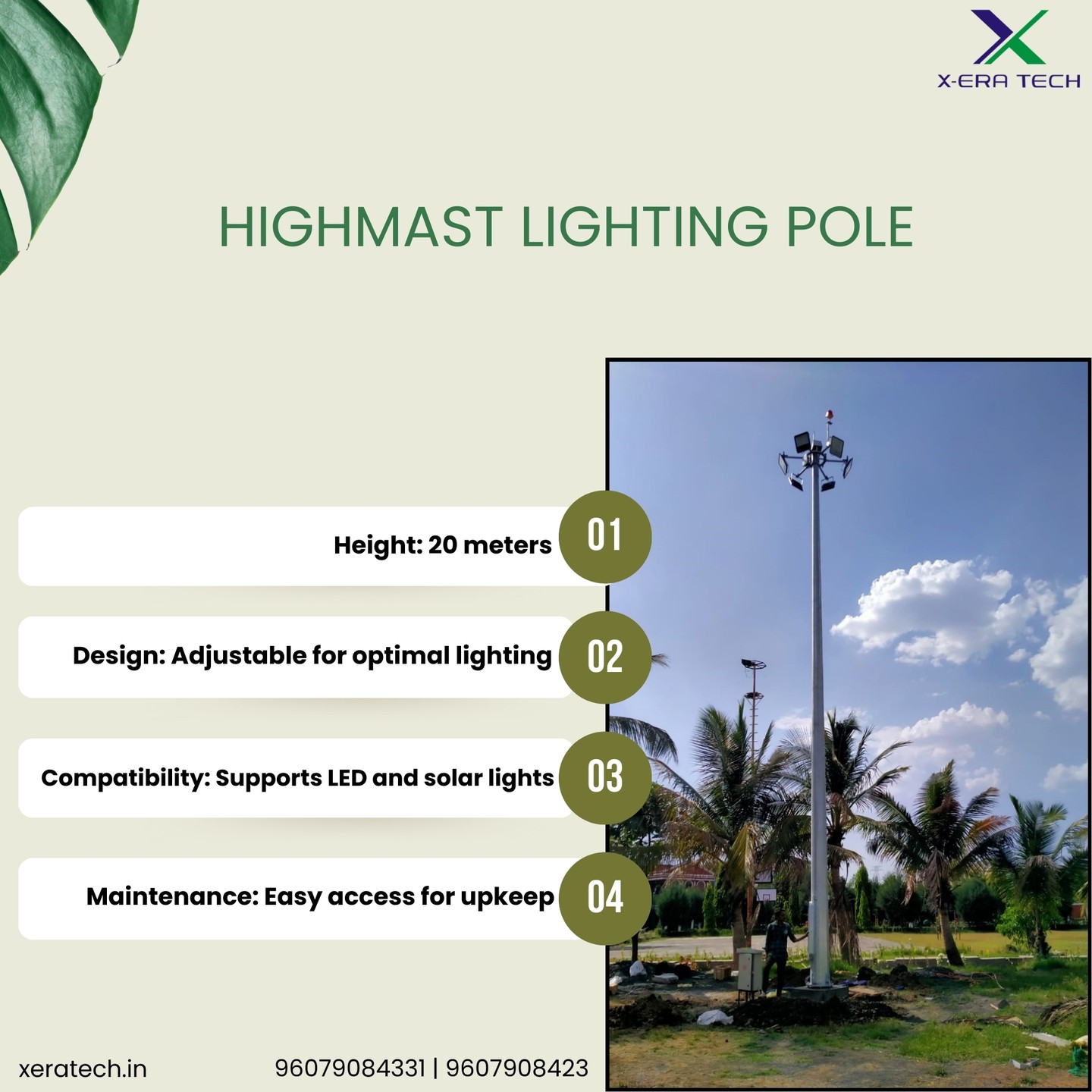
The pole is a tapered hot-dip galvanised steel shaft. Tapering — thicker at the base, narrower at the top — provides structural strength against wind load (a critical calculation for India's cyclone-prone coastal zones and high-wind corridor states) while minimising material weight and cost.
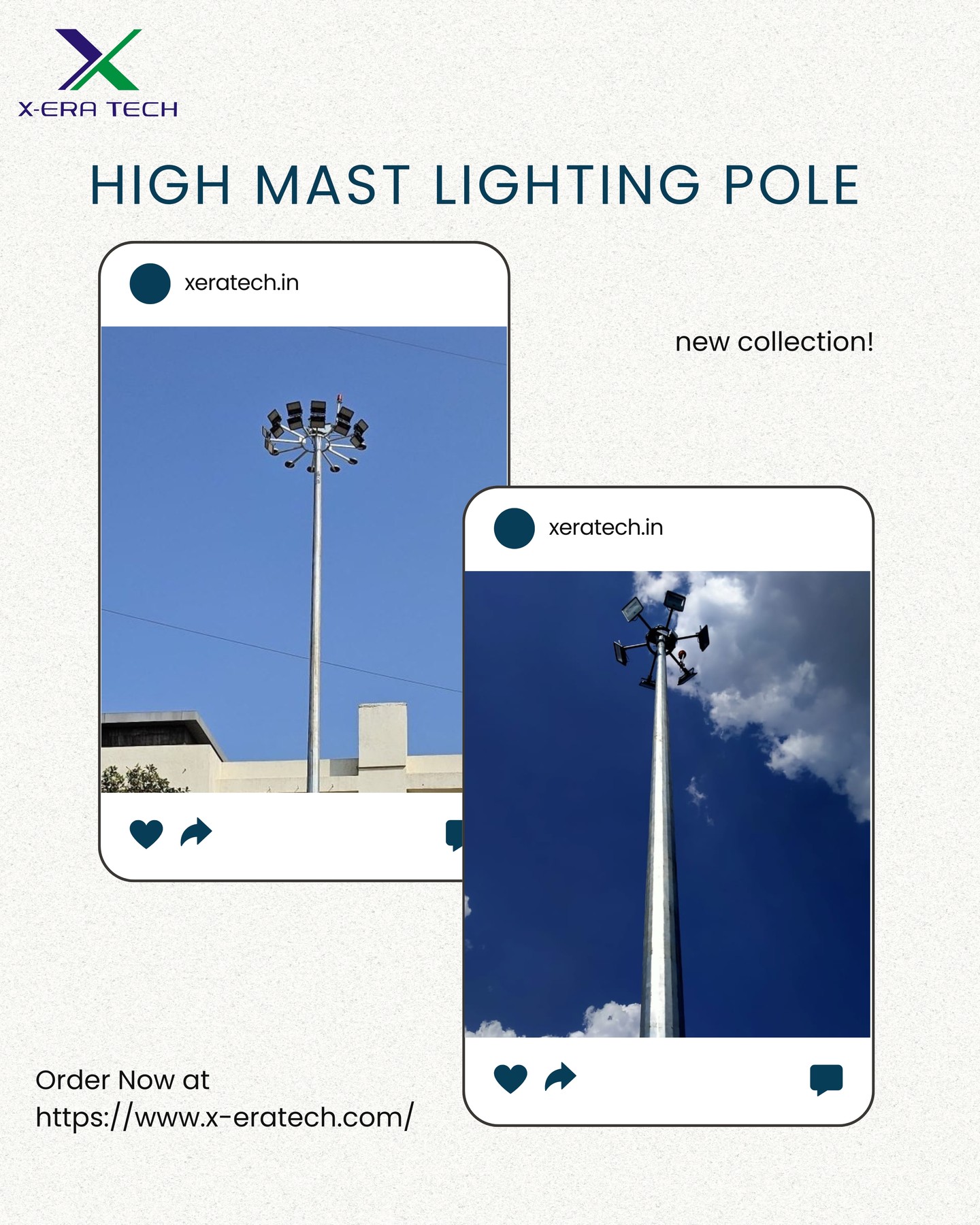
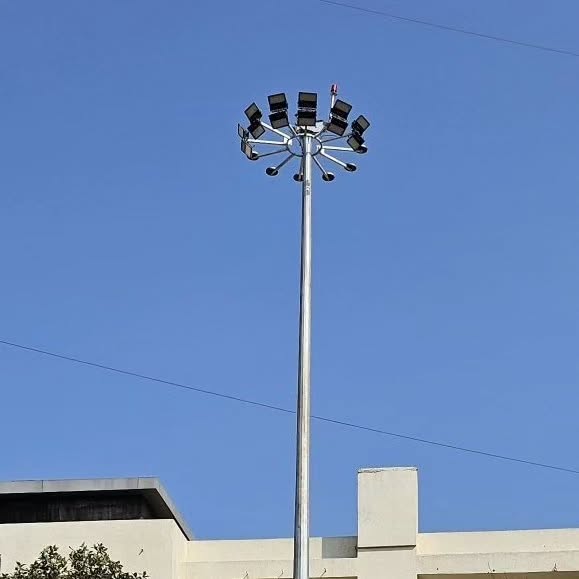
At the top of the pole sits the luminaire ring — a circular steel bracket to which the individual LED flood light heads are bolted at fixed angles. Most configurations point the luminaires outward and slightly downward, covering a circular ground area. The number of heads (4, 6, 8, 10, or 12) and their individual wattage determines the total light output and coverage radius. Xeratech high mast LED heads are individually adjustable — each can be aimed independently for asymmetric coverage when the illuminated area is not a perfect circle.
Xeratech high mast LED light product showcase. View in gallery →
Pole Height Selection Guide
Height determines coverage radius. As a rule: a high mast pole at height H illuminates a ground circle of radius approximately 0.8H to 1.2H depending on luminaire count and beam angles. The table below is a practical guide based on Xeratech's field specifications across 699+ completed projects.
| Pole Height | Coverage Radius | Luminaire Count | Typical Application | Wattage per Head |
|---|---|---|---|---|
| 9–12 m | 8–12 m | 4–6 | Parking lots, small industrial yards, bus stands | 100–150W |
| 15–18 m | 12–20 m | 4–8 | Large yards, sports grounds, market areas | 150–200W |
| 20–25 m | 18–28 m | 6–10 | Toll plazas, highway interchanges, railway yards | 200–300W |
| 25–30 m | 25–35 m | 8–12 | Port container yards, large industrial complexes | 200–400W |
| 35–45 m | 35–50 m | 10–16 | Airports, mega-ports, large stadiums | 300–400W+ |
Wattage and Lumen Selection
Wattage selection follows from two inputs: the target illuminance (lux) for the application, and the mounting height. Indian road and infrastructure lighting is governed by IS:1944 for roads and IS:2684 for industrial areas. Typical lux targets:
- Highways and major intersections: 30–50 lux average at ground level
- Toll plazas and service areas: 75–100 lux (high traffic, cash handling)
- Industrial yards and loading docks: 100–150 lux
- Ports and container handling: 150–200 lux (equipment operation at night)
- Sports arenas (training/practice): 200–300 lux
- Broadcast sports: 750–1000+ lux (requires specialist photometric design)
For formal tender submissions and photometric compliance reports, Xeratech provides IES files and DIALux lighting layout documentation. Request a lighting layout →
LED vs Sodium Vapour High Mast — 2026 Decision
| Parameter | LED High Mast | Sodium Vapour (HPS) |
|---|---|---|
| Efficacy (lm/W) | 120–150 lm/W | 80–100 lm/W |
| Colour rendering (CRI) | 70–90+ | 20–25 (poor) |
| Colour temperature | 3000K–6500K (selectable) | Fixed ~2000K (orange) |
| Rated lifespan | 50,000–80,000 hrs | 12,000–24,000 hrs |
| Warm-up time | Instant full brightness | 3–5 minutes to full output |
| Dimming capability | 0–100% (0–10V or DALI) | Not practical |
| Smart/IoT integration | Full (motion, remote, SCADA) | Not supported |
| Annual energy saving vs HPS | 45–60% less | Baseline |
| Maintenance cycles | 5–8 years between replacements | Every 1–2 years |
| Hazardous materials | None | Mercury, sodium |
| Payback period (over HPS) | 2–4 years | — |
The case for LED is definitive at the 2026 price point. LED technology has become the gold standard for high mast lighting — return on investment payback period is typically 2–4 years, and LED fixtures don't contain hazardous materials. Municipalities replacing 400W HPS high mast heads with 200W LED equivalents achieve equivalent or superior lumen output with 50% energy reduction. Read the complete LED vs traditional lighting comparison →
The Pulley Lowering System — Why It Is Non-Negotiable Above 15m
This is the most under-discussed specification decision in high mast purchasing — and the most consequential for long-term operating cost.
A fixed high mast pole has luminaires permanently bolted at height. Replacing a failed LED head at 25 metres requires a mobile crane — day hire rates in India range from ₹15,000 to ₹40,000 per crane deployment, plus road closure permissions, traffic management, and operator time. For a 50-pole highway installation, even one maintenance event per pole per year generates significant unplanned opex.
A pulley lowering system (also called a winch lowering system or LBS — Lowering and Raising System) uses a stainless steel wire rope threaded through the pole shaft to a motorised or manual winch at the base. The entire luminaire ring — all LED heads — is lowered on the wire rope to ground level, serviced, and winched back up. No crane. No road closure. Maintenance by a two-person ground crew in under two hours per pole.
Xeratech high mast pulley lowering system in action — the entire luminaire ring descends to ground level for maintenance, no crane required. View in gallery →
Rule of thumb: For poles at 9–12 metres, fixed installation is acceptable — ladders and scissor lifts are practical. For 15 metres and above, specify the pulley lowering system — the additional upfront cost (typically ₹15,000–₹40,000 per pole) is recovered from the first crane-avoided maintenance call.
Xeratech high mast poles above 15 metres are supplied with integrated hot-dip galvanised pulley housing as standard. The wire rope, winch unit, and ground-level maintenance bracket are all included. Ask about pulley system specifications →
Applications — Where High Mast Lights Are Specified in India
National Highways and Toll Plazas
Roads and highways account for 46.9% of the global high mast lighting market. In India, every NHAI toll plaza specification includes high mast poles at 20–30 metres with luminaire rings covering the full plaza footprint. The high vehicle speed, multiple lanes, and cash-handling activity at toll plazas require 75–100 lux — achievable only from high-mount poles that illuminate the full carriageway without glare at driver eye level.
Industrial Yards and Factories
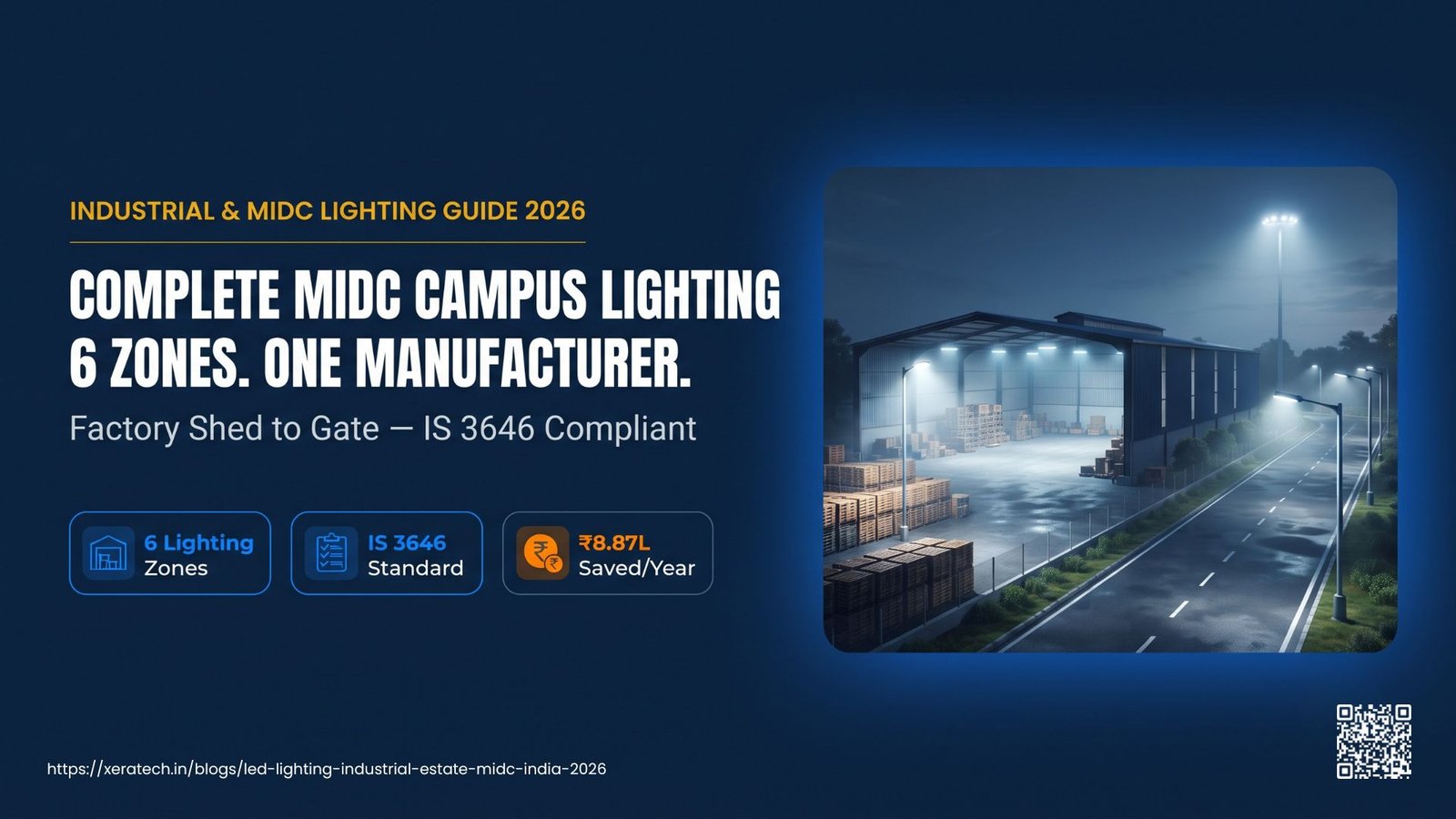
Outdoor factory yards, raw material stockyards, and logistics parks need robust, 24×7-reliable lighting at 100–150 lux for safe night operations — forklift movement, vehicle loading, and security. High mast poles at 15–20 metres with 6–8 LED heads cover large yard areas from fewer poles, reducing the number of vulnerable fixtures in a working industrial environment.
Xeratech industrial LED high mast light in a factory and industrial yard context. View in gallery →
For indoor factory and warehouse spaces, see our guide on LED highbay lights →
Sports Arenas and Stadiums
High mast poles at stadium perimeters (15–30 metres, 8–12 heads per pole) provide the mounting height needed for broadcast-quality lighting without spill into spectator eyes. The stadiums and sports complexes segment is expected to witness the fastest growth rate from 2026 to 2032, driven by rising investments in modern sports infrastructure, international event hosting, and recreational facilities.
For dedicated stadium lighting specifications including broadcast lux levels and uniformity ratios, see our guide: LED Stadium Lights — Power, Performance & Precision →
Ports, Container Yards and Logistics Hubs
Container handling cranes, reach stackers, and terminal trucks operate 24 hours at major Indian ports — JNPT, Mundra, Chennai, Visakhapatnam. Container yard lighting requires 150–200 lux for safe equipment operation at night, anti-theft visibility across deep-stacked container rows, and sufficient colour rendering (CRI 65+) for container label reading. High mast poles at 25–35 metres with LED heads providing asymmetric illumination across container rows are the standard. LED's instant-on capability (no warm-up) is a significant operational advantage over HPS in the frequent on/off port environment.
Solar High Mast Lights — The Off-Grid Revolution
Traditional high mast lighting has one expensive vulnerability: the grid cable. Running underground HT/LT cable to an isolated pole position — on a highway median, in a remote industrial area, at a border checkpoint — can cost ₹3–8 lakhs per pole in civil and electrical infrastructure. For 50 poles, the cable cost often exceeds the luminaire cost.
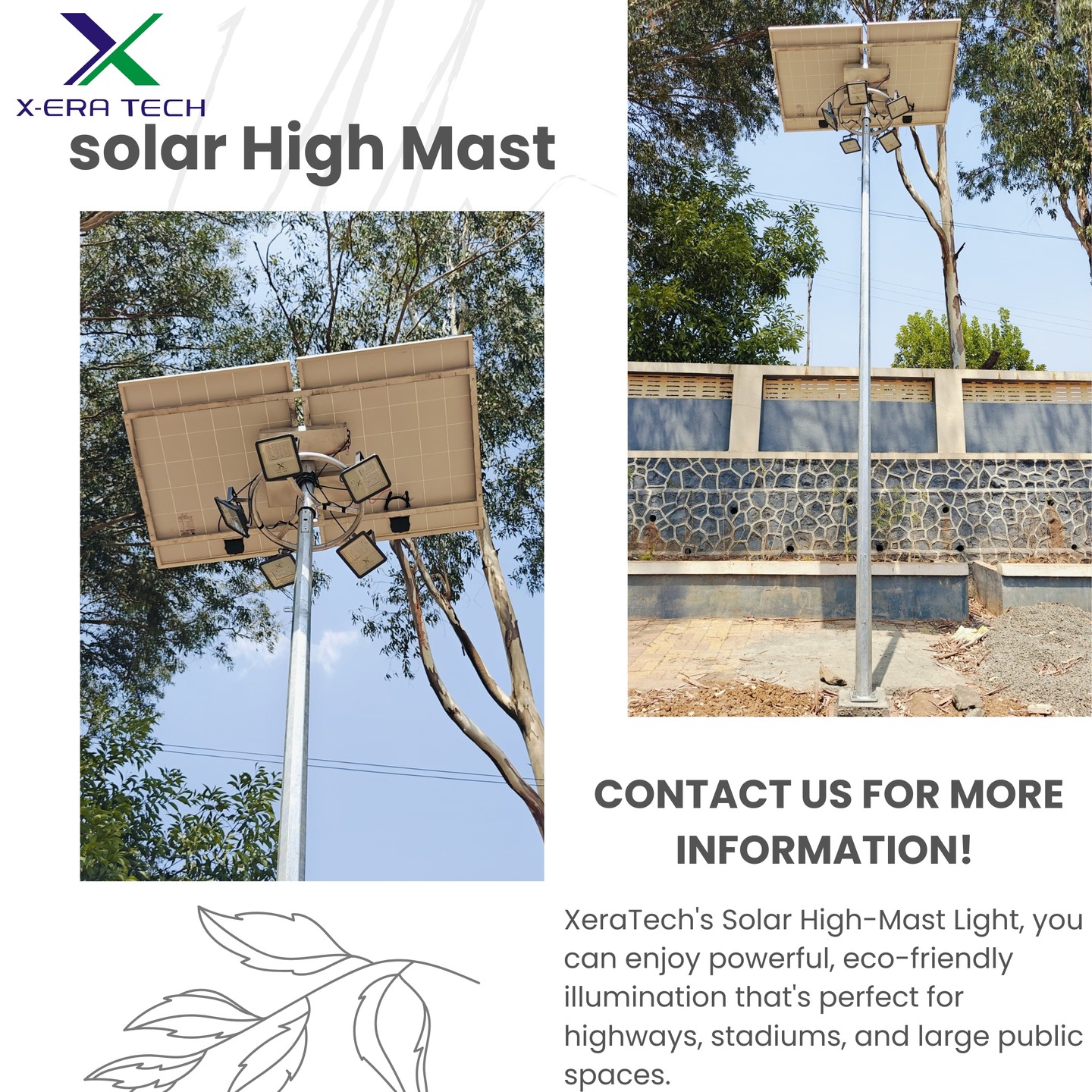
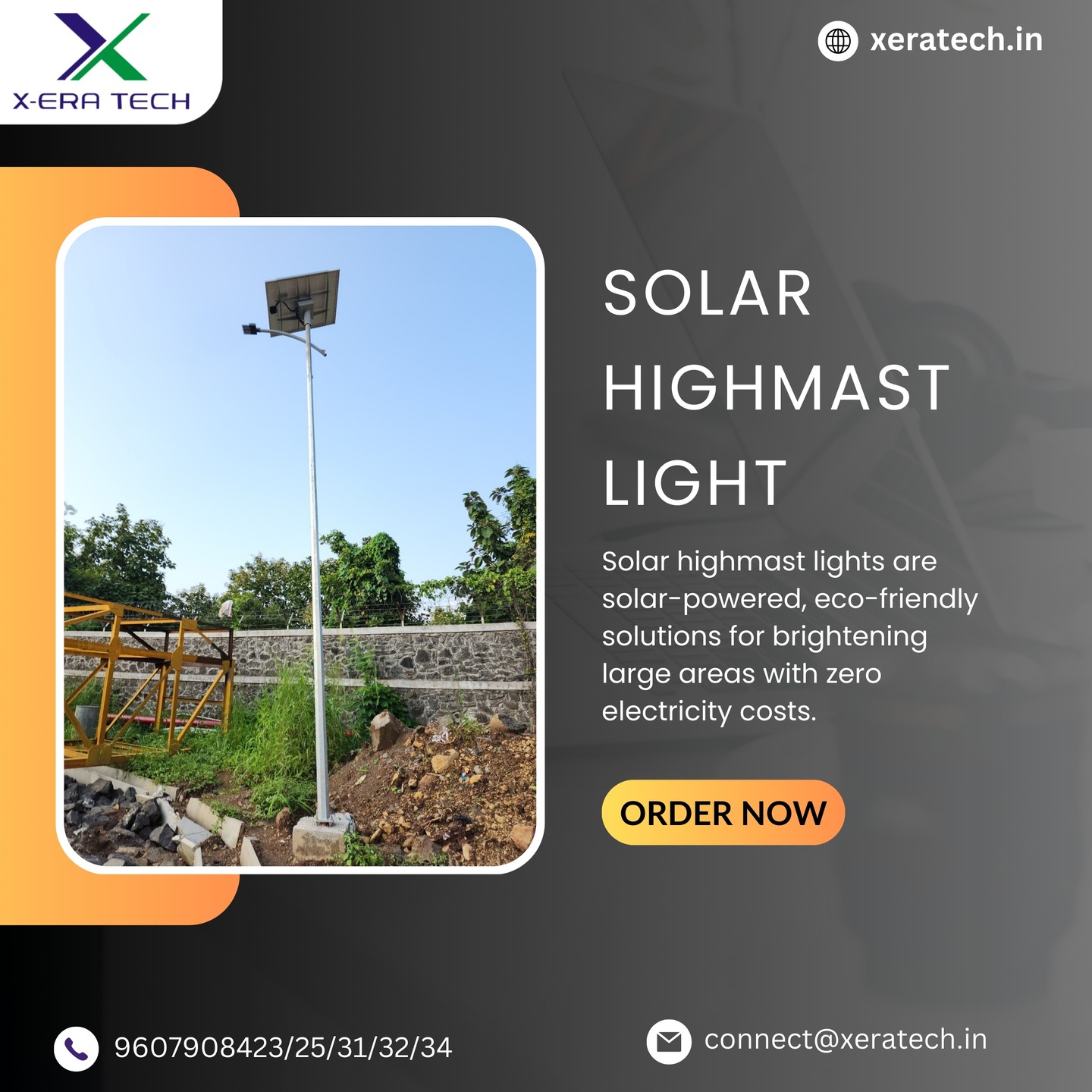
Solar high mast lights eliminate this entirely. A panel array (typically mounted on a separate bracket on the pole or on an adjacent support structure) charges a battery bank (LiFePO4 for India's temperatures) during the day. The LED luminaires run through the night on stored energy — fully autonomous, zero grid dependency, zero electricity bill.
India is exceptionally suited for solar high mast. Most Indian states receive 4.5 to 6.5 peak sun hours per day — significantly higher than Europe, North America, or East Asia. A monocrystalline panel on a solar high mast in Maharashtra generates more usable energy per day than the same panel in Germany. This means battery sizing requirements are lower, backup days are longer, and overall system economics are stronger.
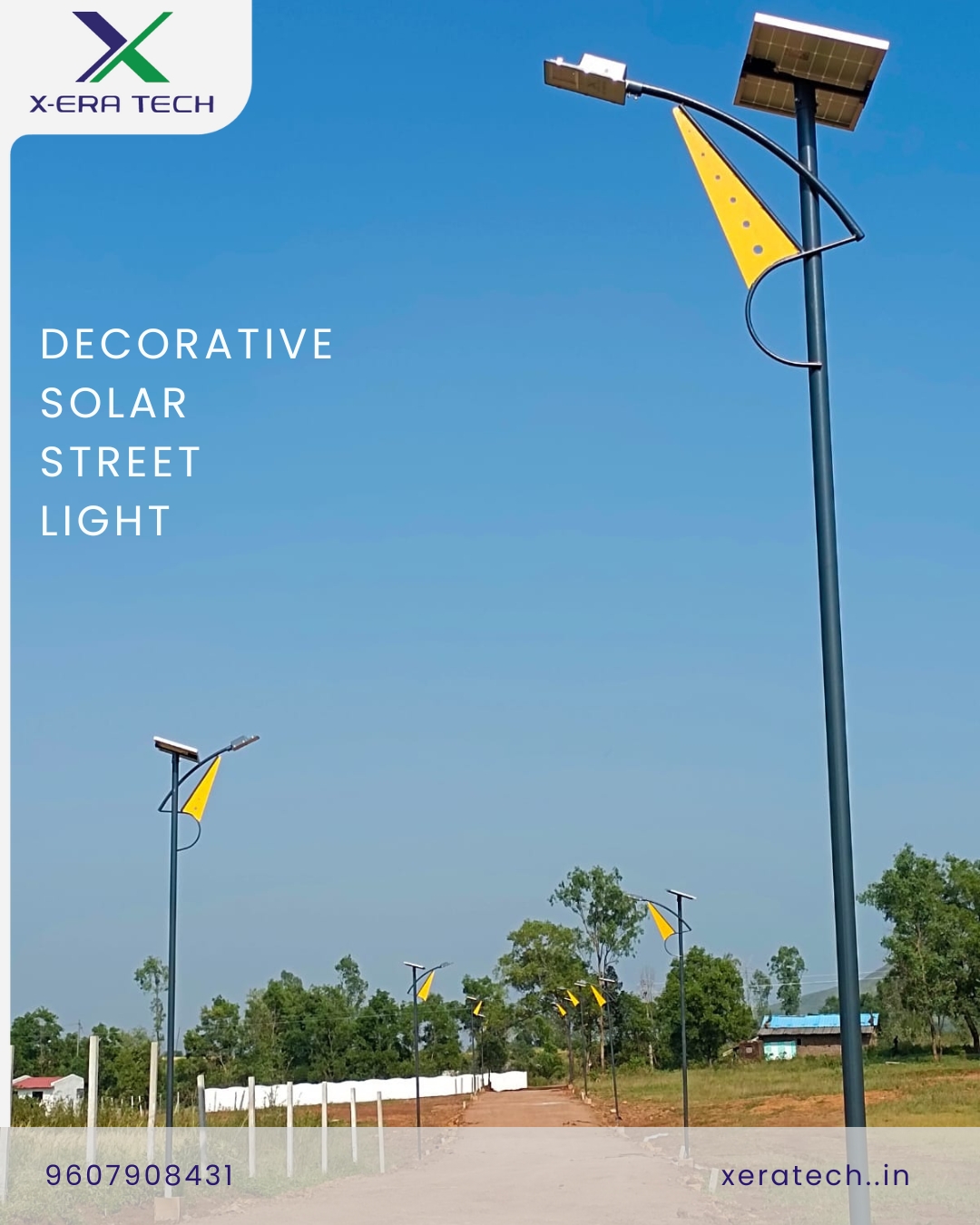
Solar High Mast Light — Industrial / Public Space
Full-height solar high mast for industrial yards, open public spaces, and highway rest areas. LiFePO4 battery bank, monocrystalline panel, dusk-to-dawn auto operation. 2–3 day cloudy-day backup.
Solar Mini High Mast — Parking / Community
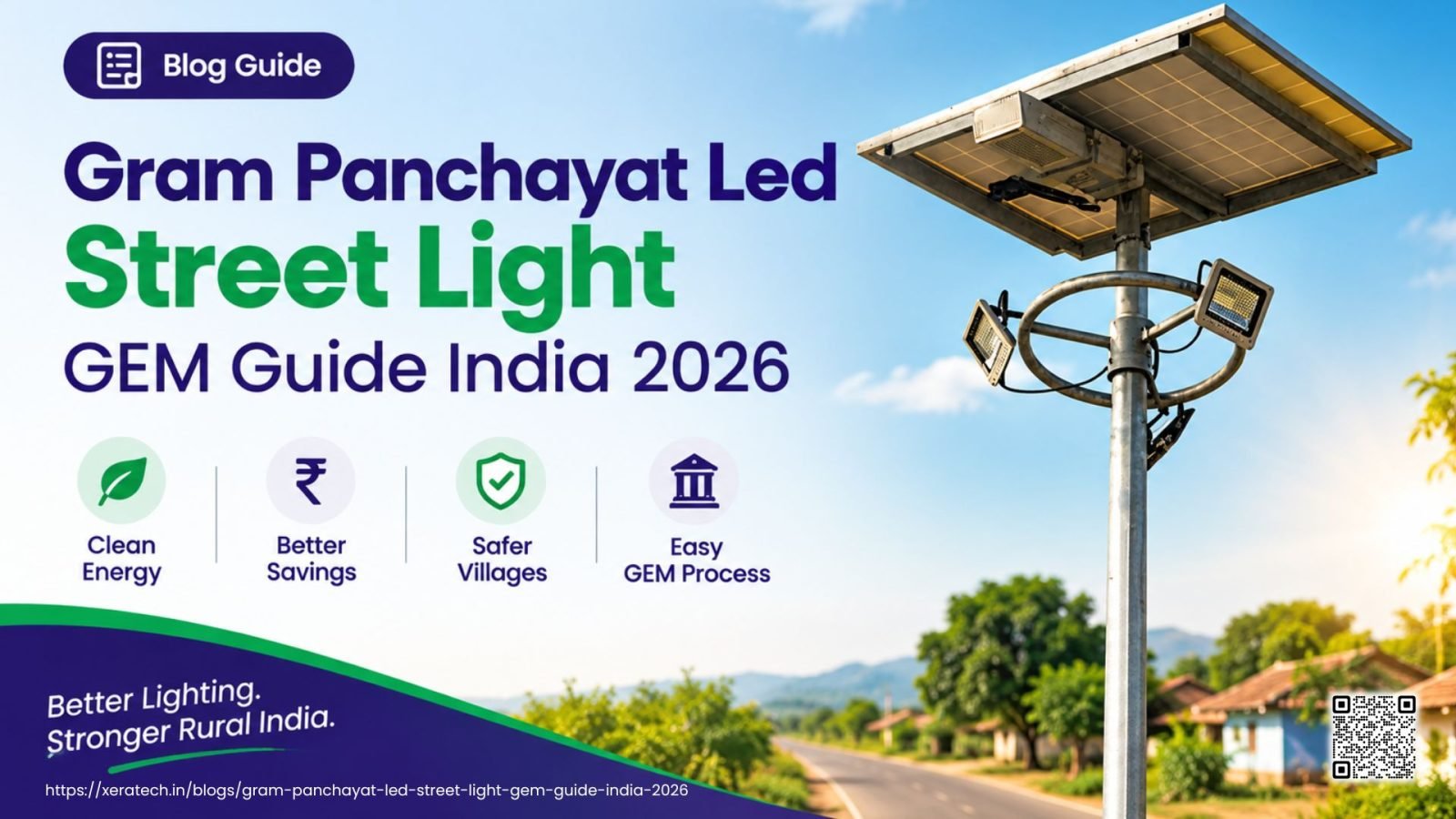
Compact solar high mast at 9–12 metres for parking lots, bus stands, community squares, and gram panchayat grounds. No underground cable. Quick installation. Complete autonomy.
Solar high mast also has a pulley lowering system for the panel array and luminaire ring — both can be lowered together for cleaning and maintenance. Full guide to solar high mast light benefits →
For battery technology: Why Xeratech uses LiFePO4 batteries in all solar products →
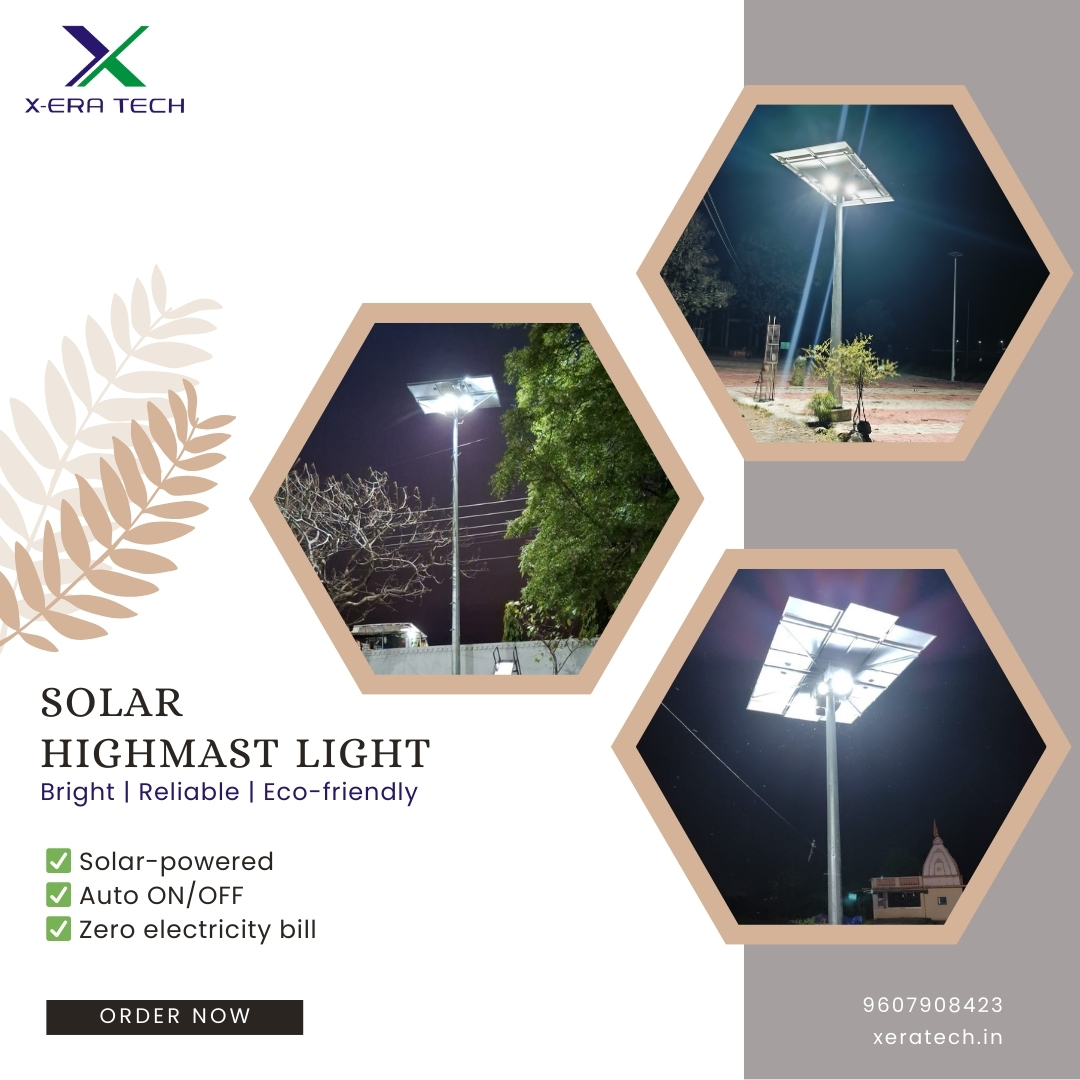
Xeratech solar high mast light — eco reel product showcase. View in gallery →
Xeratech High Mast Light Range
Xeratech manufactures its complete high mast range at Satpur MIDC, Nashik — hot-dip galvanised poles, IP65 LED luminaires, and integrated pulley systems for poles above 15 metres. All products are BIS certified, PWD approved, ERDA tested, and carry a 2-year warranty.
Grid-powered and solar high mast options available from 9 metres to 40+ metres, 4 to 16 luminaires per ring, 100W to 400W+ per head.
Browse LED High Mast Lights Browse Solar High Mast Lights WhatsApp for Quote Submit Project EnquiryAlso see:
- Solar High Mast Lighting — Full Benefits Guide
- LED Flood Lights — for perimeter and supplementary yard lighting
- LED Stadium Lights — broadcast-quality sports illumination
- Smart City LED Solutions — IoT and adaptive lighting
Frequently Asked Questions
What is a high mast light?
A high mast light is an outdoor lighting system mounted on a tall pole (typically 9–45 metres) with 4–16 LED luminaires in a ring at the top, designed to illuminate very large areas — highways, toll plazas, ports, stadiums, and industrial yards — uniformly from a single elevated position. LED high mast lights account for 67%+ of new installations globally in 2024.
What pole height do I need?
9–12 metres for parking lots and small yards; 15–20 metres for large industrial yards and sports grounds; 20–25 metres for toll plazas and highway interchanges; 25–35 metres for port container yards; 35–45 metres for airports and large stadiums. The right height depends on the coverage area required and the target lux level for your application.
What is a pulley lowering system and do I need it?
A pulley lowering system uses a wire rope through the pole shaft to lower the entire luminaire ring to ground level for maintenance — no crane or scaffolding required. For poles at 15 metres and above, it is strongly recommended: the upfront cost (₹15,000–₹40,000/pole) is recovered from the first crane-call avoided. Xeratech high mast poles above 15 metres are supplied with the pulley system as standard.
Are solar high mast lights practical for India?
Yes — India receives 4.5–6.5 peak sun hours per day, higher than most of the world. Solar high mast lights eliminate grid cable (which can cost ₹3–8 lakhs per isolated pole position), remove electricity bills, and work reliably in areas with unreliable grid supply. Xeratech solar high mast uses LiFePO4 batteries and monocrystalline panels. Full guide: https://xeratech.in/blogs/benefits-of-solar-high-mast-lighting
How much does a high mast light system cost in India?
Indicative pricing (pole + luminaires + installation): 9–12m system ₹1.2–2.5 lakhs; 15–20m system ₹2–4 lakhs; 20–25m with pulley system ₹4–8 lakhs; 30m+ systems ₹8–15 lakhs+. Solar systems add approximately 30–60% to grid-powered unit cost but eliminate ongoing electricity and cable infrastructure costs. Contact Xeratech for a project-specific quotation at https://wa.me/919607908430.
Are Xeratech high mast lights BIS and PWD certified?
Yes. Xeratech holds BIS certification, ISO 9001:2015, PWD approval, ERDA testing, NABL, NSIC, and ZED certification — making the full high mast range eligible for NHAI, state PWD, port authority, municipal, and industrial tenders across India. Xeratech has supplied high mast systems across 19+ Indian states and to Middle East markets.
How many LED heads do I need on a high mast ring?
4–6 heads for 9–15m poles lighting circular areas. 6–8 heads for 15–25m poles on highways and industrial yards. 8–12 heads for 25–35m poles at ports and interchanges. 10–16 heads for 35m+ poles at airports and major stadiums. Each head is individually adjustable — for non-circular coverage areas (long narrow yards, one-sided highway lighting), asymmetric aiming configurations are available.
Specify the right high mast system for your project
Xeratech's technical team has designed and supplied high mast lighting for national highways, toll plazas, industrial parks, sports grounds, and solar off-grid projects across 19+ Indian states. Tell us your area size, pole height, and lux requirement — we will send you a lighting layout and quotation.
WhatsApp for Free Specification Browse High Mast Lights Submit Project EnquiryLooking for the right LED solution?
Xeratech manufactures BIS-certified LED flood lights, solar street lights, highbay lights and more — shipped across India.
Xera Tech is a BIS-certified LED lighting manufacturer established in 2017, headquartered in Nashik, Maharashtra , India. Product range: LED Street lights, Decorative lights, solar street lights (all-in-one & semi-integrated), LED Flood lights, decorative poles, and high mast lights — all manufactured at Satpur MIDC and compliant with IP65/IP67 and photometric standards. Learn more about Xera Tech →