
Foundation Types
Anchor bolt foundation (most common): 3 or 4 anchor bolts set in concrete, with a base plate welded to the pole bottom. The pole is bolted to the anchor bolts after concrete curing. Advantages: precise plumbing adjustment possible, replaceable if concrete cures misaligned. Direct embedment foundation: the pole is set directly into the concrete without a base plate. Simpler but less adjustable. Used for rural low-budget projects and lower poles (up to 6m). Pre-cast foundation: a factory-made concrete block with embedded anchor bolts, delivered to site. Reduces curing time (pole can be erected same day on a pre-cast block). Premium cost but faster installation.
Foundation Depth and Size by Pole Height
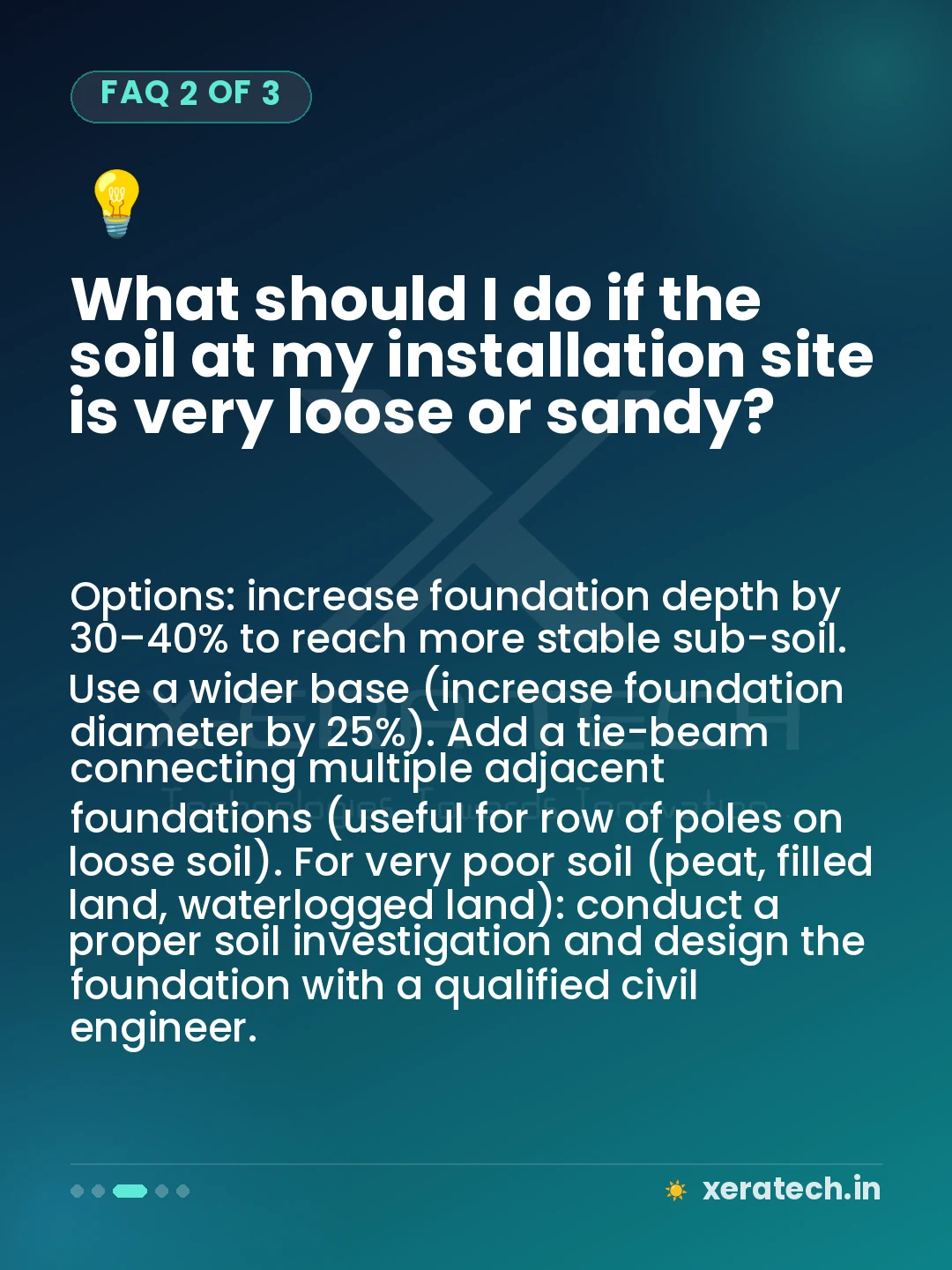
Rule of thumb: foundation depth = pole height ÷ 6 (minimum), and foundation diameter or side = pole height ÷ 10 (minimum). For 5m pole: depth 850mm, diameter 500mm. For 6m pole: depth 1,000mm, diameter 600mm. For 8m pole: depth 1,350mm, diameter 800mm. For 9m pole: depth 1,500mm, diameter 900mm. For 10m pole: depth 1,700mm, diameter 1,000mm. These are minimums for standard soil (bearing capacity 100 kPa or more). For loose sandy soil, waterlogged areas, or coastal areas: increase depth by 20–30% and consider a wider base. Always get a soil test (bore log) for pole heights above 9m - structural safety is non-negotiable.
Concrete Mix and Curing
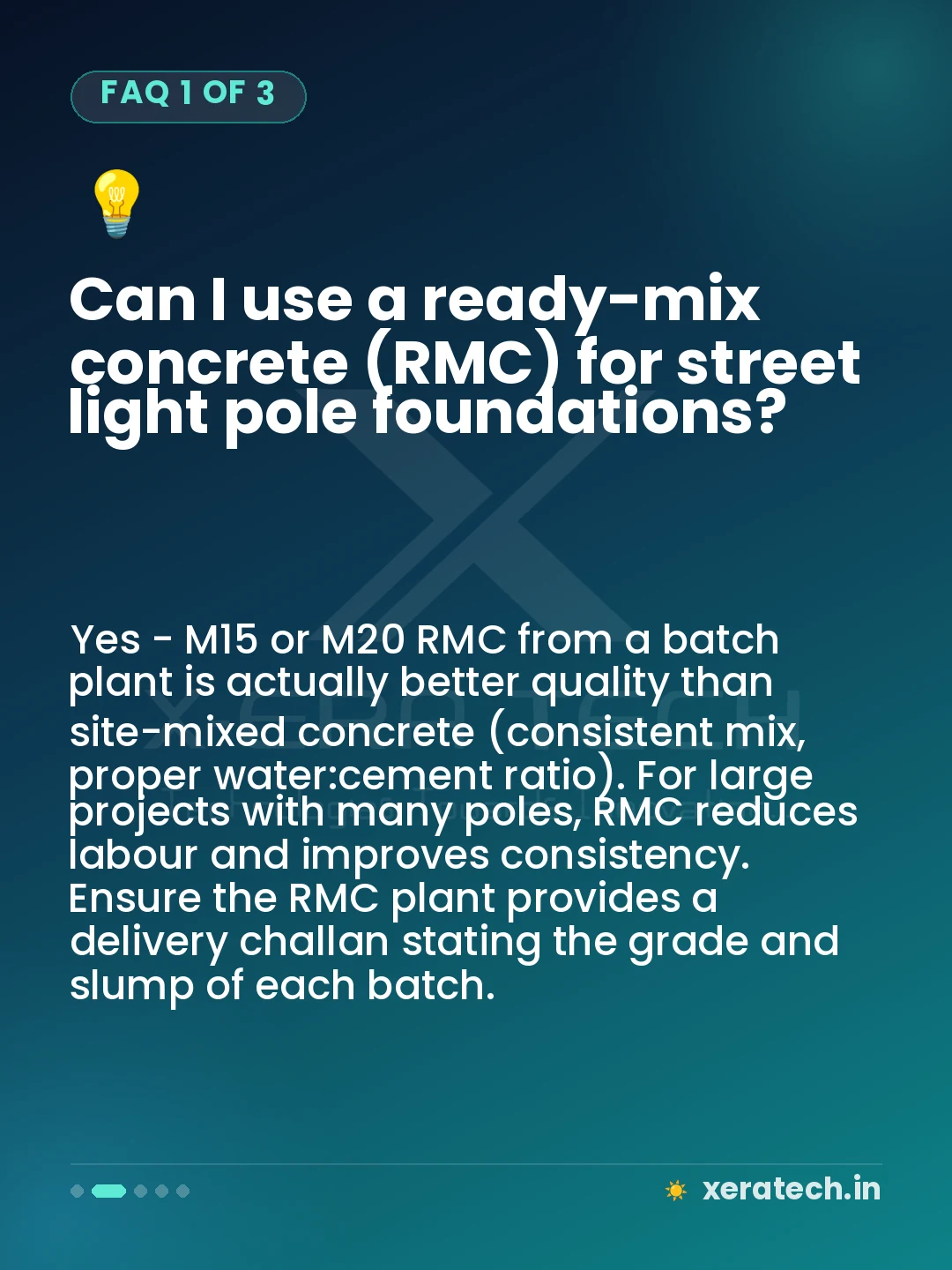
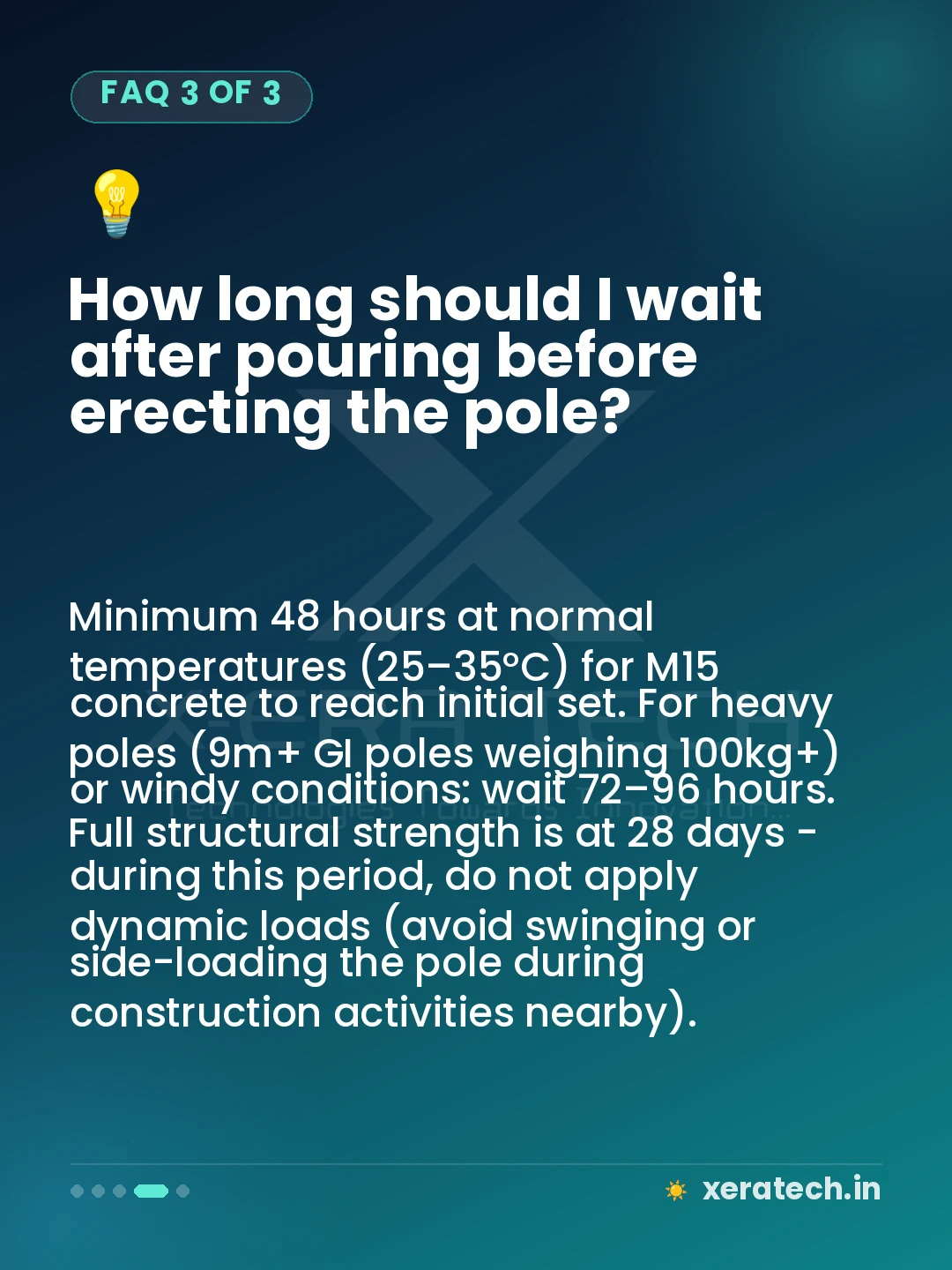
Minimum concrete grade: M15 (1:2:4 mix - 1 part cement: 2 parts coarse sand: 4 parts 20mm aggregate). For highway poles and coastal areas: M20 minimum. Mixing: use a proper mixer - hand mixing of foundation concrete produces inconsistent quality. Water:cement ratio: maximum 0.5 (do not add extra water to make mixing easier - it weakens the concrete). Curing: cover with hessian or polythene and keep moist for minimum 7 days. Do not erect the pole or apply load until 48 hours minimum (for M15 at normal Indian temperatures). Full design strength is achieved at 28 days. In hot weather (above 35°C): cure with shade and extra water - high temperatures accelerate drying but not strength gain.
Earthing at the Foundation
Every pole foundation must include a proper earth electrode: drive a 2.5m × 16mm GI earth pipe vertically into the earth pit adjacent to the foundation. Connect to the pole body with 8 SWG GI earth wire and a proper mechanical clamp (not just a screw). Fill the earth pit with common salt and charcoal layers around the GI pipe - this improves soil conductivity and maintains moisture. Measure earth resistance: maximum 5 ohms per IS 3043. In rocky soil (common in Nashik, Pune, and Deccan areas): use chemical earthing electrodes with bentonite compound - achieves 1–2 ohm in difficult soil.