
What a Gel Battery Is
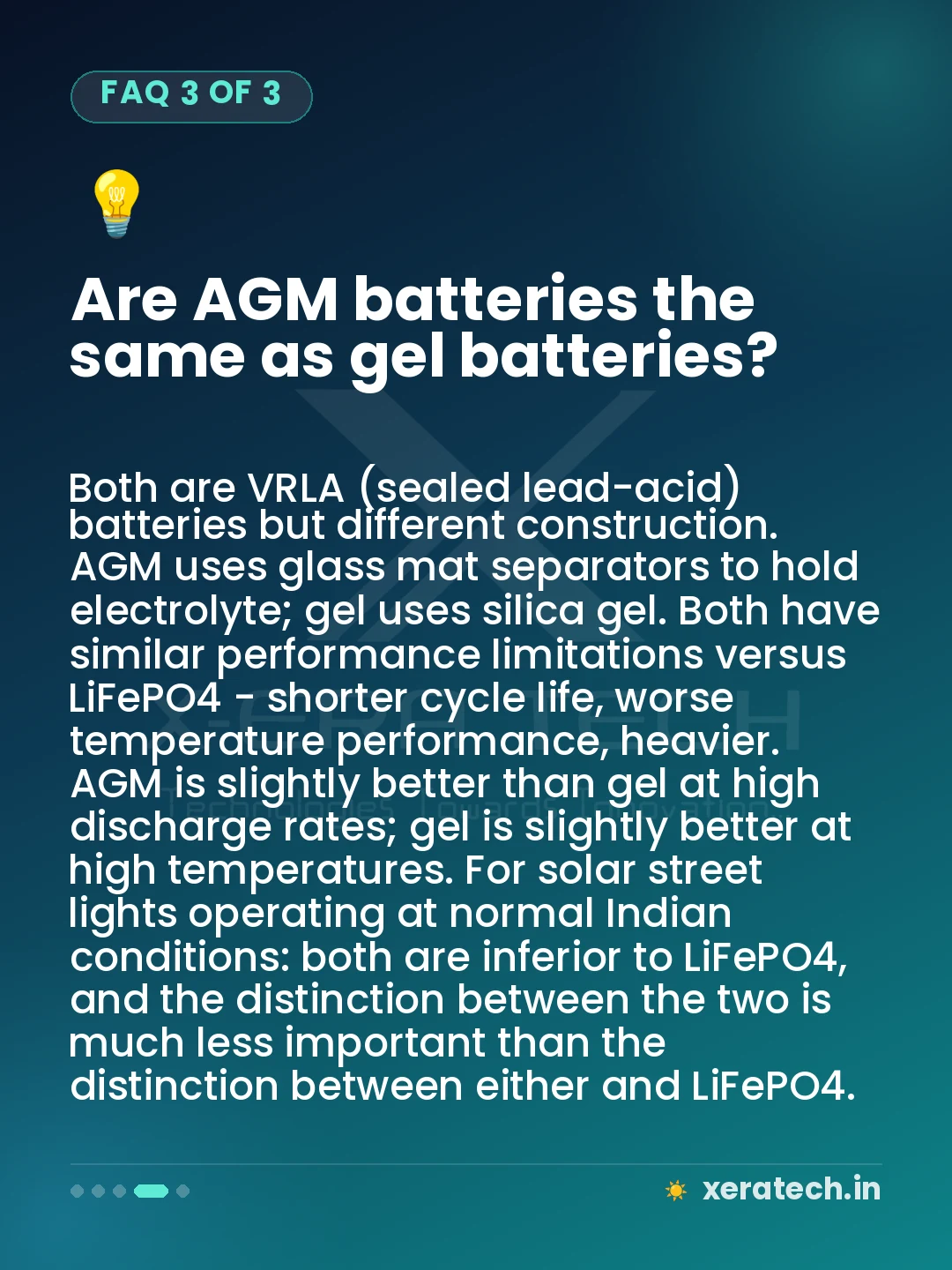
A gel battery is a type of VRLA (Valve Regulated Lead-Acid) battery where the electrolyte is immobilised as a gel (silica-thickened sulphuric acid) rather than liquid. This makes the battery sealed and spill-proof (unlike flooded lead-acid). Gel batteries are a type of lead-acid battery - they use the same lead plates and sulphuric acid chemistry as a car battery, just in a different form. Other VRLA types include AGM (Absorbent Glass Mat) - similar concept, different electrolyte immobilisation method.
Gel vs LiFePO4 - The Honest Comparison
Cycle life: Gel/AGM: 300–500 cycles at 50% DoD, 200–300 cycles at 80% DoD. LiFePO4: 2,000–3,000 cycles at 80% DoD. At one cycle/day: gel lasts 0.8–1.4 years to 80% DoD; LiFePO4 lasts 5.5–8.2 years. Temperature performance: Gel batteries lose 30–40% capacity at 45°C ambient - catastrophic in Indian summers. LiFePO4 loses only 5–10% at 45°C. Energy density: Gel: 30–50 Wh/kg. LiFePO4: 90–120 Wh/kg. A LiFePO4 battery weighs less than 1/3 of a gel battery of equal capacity. Safety: Gel batteries can release hydrogen gas if overcharged - a fire/explosion risk. LiFePO4 cannot produce hydrogen. Verdict: Gel batteries are better than flooded lead-acid but significantly inferior to LiFePO4 in every parameter relevant to Indian solar street lights.
When Gel Batteries May Be Acceptable
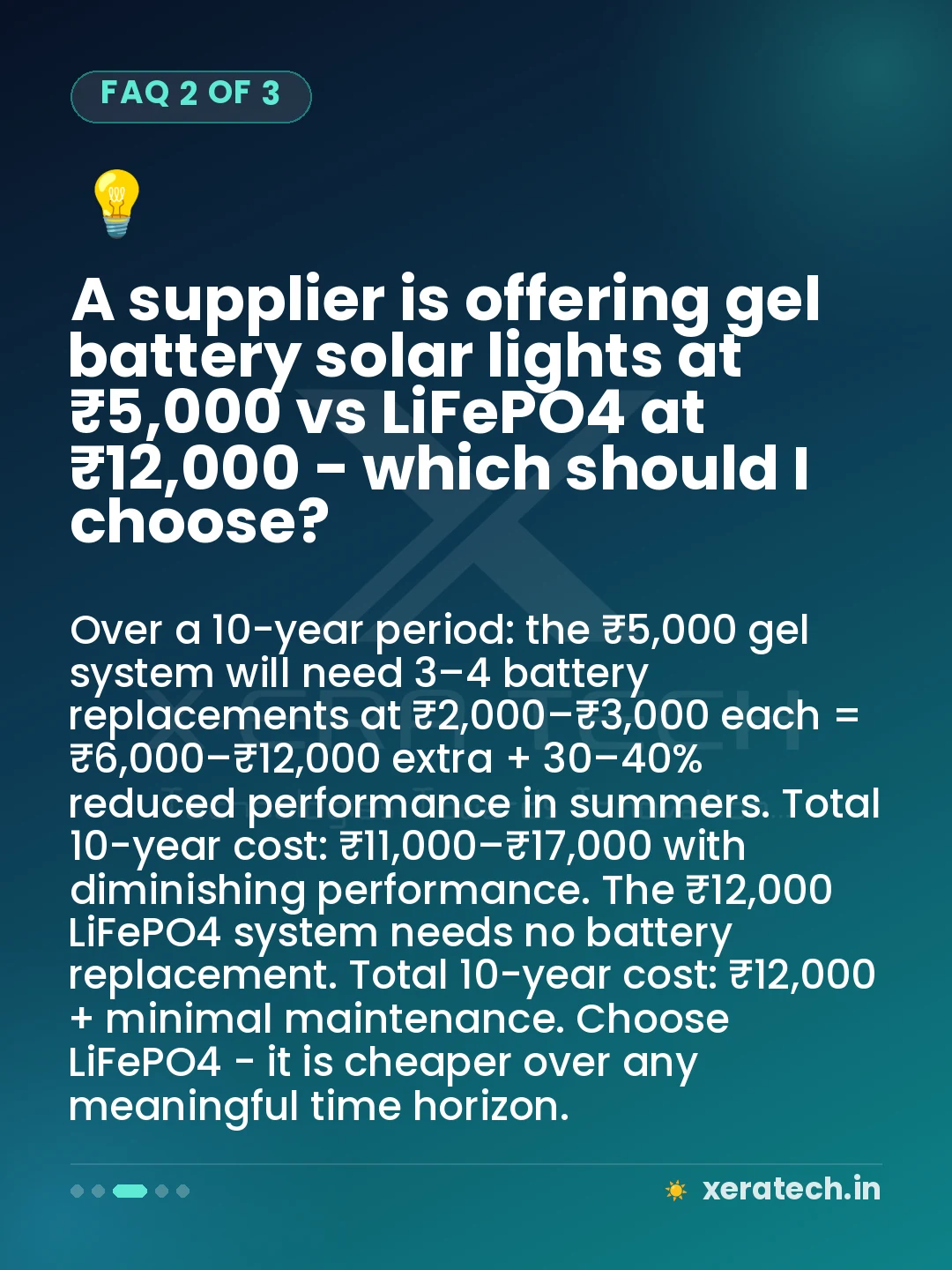
Gel batteries may be acceptable only when: budget is extremely constrained and there is a clear plan to replace batteries every 2 years. The climate is temperate (below 35°C ambient - northern India winters, high altitudes). The solar light is for low-priority temporary use (construction site, event, agricultural season). In all permanent public infrastructure (village roads, municipal streets, industrial perimeters): LiFePO4 is the correct specification. A gel battery solar light on a public road will require battery replacement 3–4 times over 10 years - effectively costing more than LiFePO4 while delivering lower performance throughout.