Step 1 - Define Your Requirements
Before approaching any vendor: identify road type and width, required lux level (IS 1944 standard), number of poles and spacing, mounting height, power source (grid or solar), area climate (coastal? dusty? industrial?), budget per point installed, and timeline. Having these details in writing prevents vendors from substituting specifications.
Step 2 - Mandatory Certifications to Check
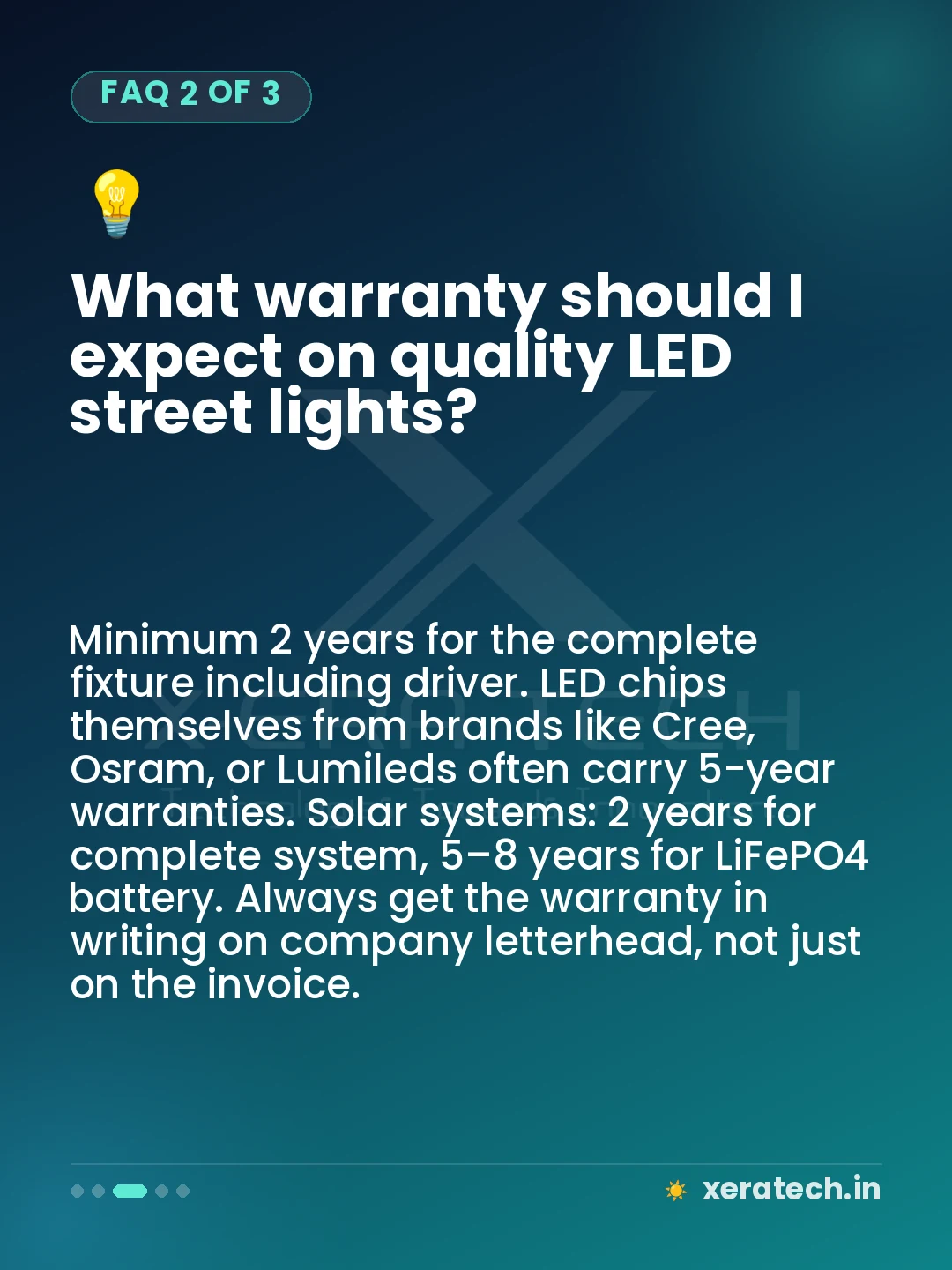
BIS (Bureau of Indian Standards) certification under IS 16905: mandatory for LED luminaires sold in India. Every unit must have the BIS mark - ask for the license number and verify on bis.gov.in. ERDA (Electrical Research and Development Association) approval: important for government procurement. IP65 rating: verified by a NABL-accredited lab, not self-declaration. LM80 and TM-21 data: these international test standards verify LED lumen maintenance over time. ISO 9001:2015 factory certification: confirms quality management. Xera Tech holds all of the above certifications.
Step 3 - Specification Comparison Framework
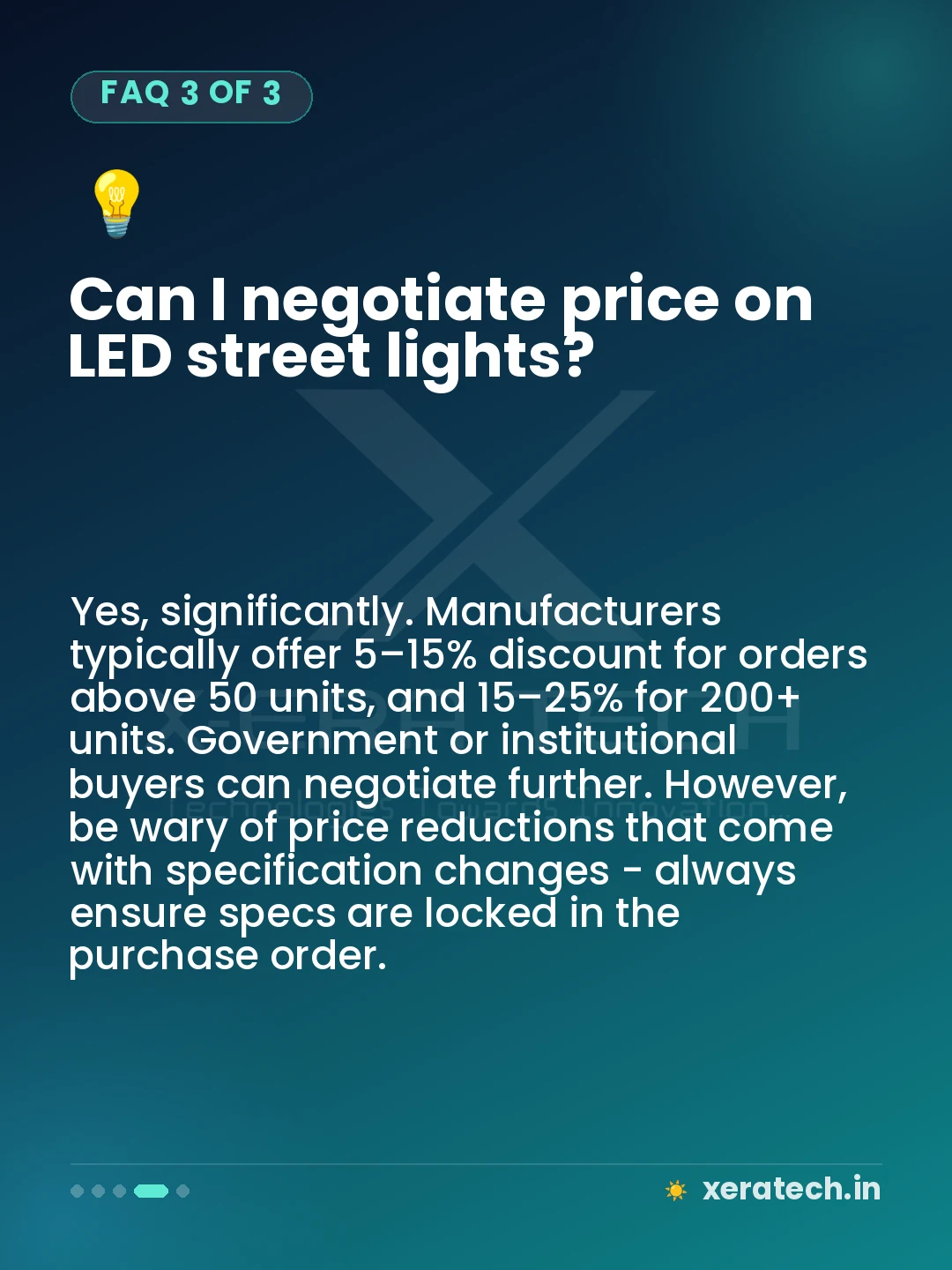
Create a comparison table with: wattage, lumen output (not just lumens - also lm/W efficacy), colour temperature (K), colour rendering index (CRI, minimum 70 for roads), power factor (PF, minimum 0.95 for grid lights), total harmonic distortion (THD, below 10%), operating temperature range, driver brand, warranty period, and after-sales service location. Never compare on price alone - a light with 100 lm/W needs 30% more units than one with 140 lm/W for the same road brightness.
Step 4 - Vendor Evaluation
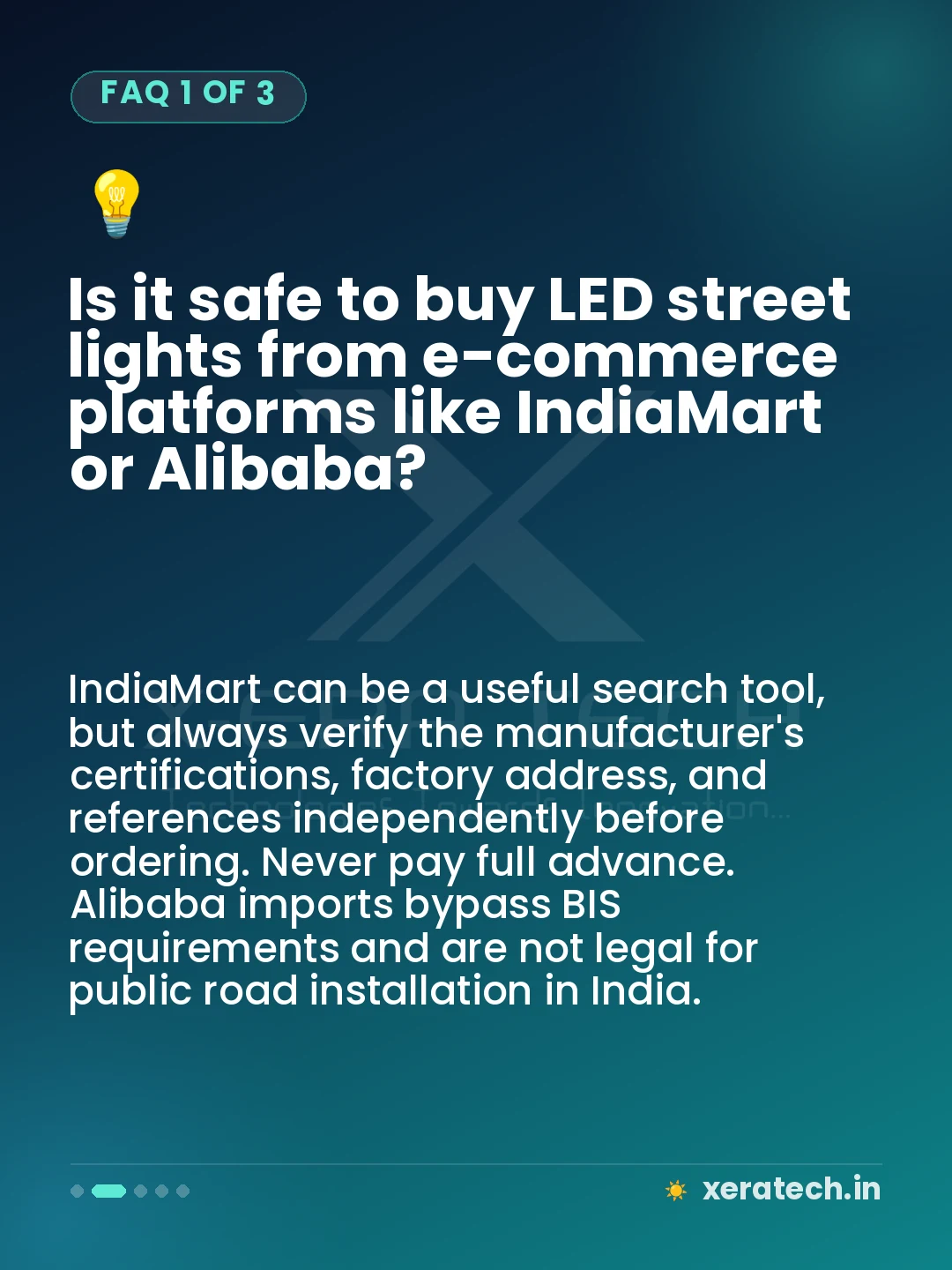
Visit the factory if possible - or request a factory audit report. Check Google Maps for physical address. Look for project references - ask for the name, location, and contact of 3–5 completed projects you can verify independently. Check if the company is on the GeM portal (Government e-Marketplace) - this requires formal verification. Ask about service infrastructure: where is the nearest service technician? What is the response time for warranty claims? Xera Tech has a physical factory at Satpur MIDC, Nashik, with 10+ years of verifiable project history.
Red Flags That Should Disqualify a Vendor
No physical factory address. Cannot produce original BIS test certificates (not photocopies). Specifications that seem too good (e.g., 200 lm/W efficacy, or 10-year warranty on solar batteries - both physically unlikely). Warranty is offered by the trader, not the manufacturer. Price is 40%+ below the market median. No completed project references in your state. Cannot provide photometric data (IES files) for lux calculation. Offers 'equivalent' certifications instead of BIS.