Unique Lighting Needs of Religious Sites
Temple lighting must achieve: Safety - pilgrims walk on uneven stone surfaces, ghat steps, and crowded paths in darkness. Safety lighting at 15–20 lux is essential on all walking routes. Devotional atmosphere - harsh blue-white industrial lights are inappropriate near a mandir. 3000–4000K warm white creates a lamp-lit spiritual ambience. Continuous reliability - religious sites operate 365 days, often from 4am (Brahma Muhurta) through 10pm. Solar lights must be designed for 18-hour operation periods during festivals. Aesthetic harmony - poles and fixtures should complement the temple architecture, not look like highway streetlights beside a medieval structure.
Heritage Solar Poles for Temple Roads
Xera Tech's Heritage Solar series combines decorative pole designs with integrated solar systems - purpose-built for this application. Available designs for temple environments: Shiva Series (trident and Damru motifs): for Shiva temples, Jyotirlinga routes, and Kashi corridor. Vitthal Series (Pandharpur Vithoba design): for Wari pilgrimage routes and Vaishnav temples. Lotus Series: for general Hindu temples and government complexes. Classical Lantern Post: for older stone temples and heritage mandirs. These poles are manufactured at the Nashik factory with customisable finishes: gold, bronze, ivory, or temple copper colour. The solar panel is fitted on a discreet adjustable arm at the top; the battery is concealed in the pole body.
Funding Sources for Temple Solar Lighting
Temple Trust funds: registered temple trusts (Devasthan Inams, Shri Mandir trusts) can use operational funds for lighting improvements - pass a trust committee resolution. Government schemes: pilgrim circuits under PRASHAD (Pilgrimage Rejuvenation and Spiritual Augmentation Drive) scheme fund infrastructure at notified pilgrim sites. MNRE rural solar lighting funds temples as community infrastructure. State tourism development schemes: Maharashtra Tourism, Uttar Pradesh Tourism, and Karnataka Tourism fund solar lighting on recognized pilgrimage routes. CSR: nearby industries can sponsor temple road lighting under 'rural development' or 'cultural heritage preservation' CSR heads - a socially visible CSR project.
Technical Specifications for Temple Sites
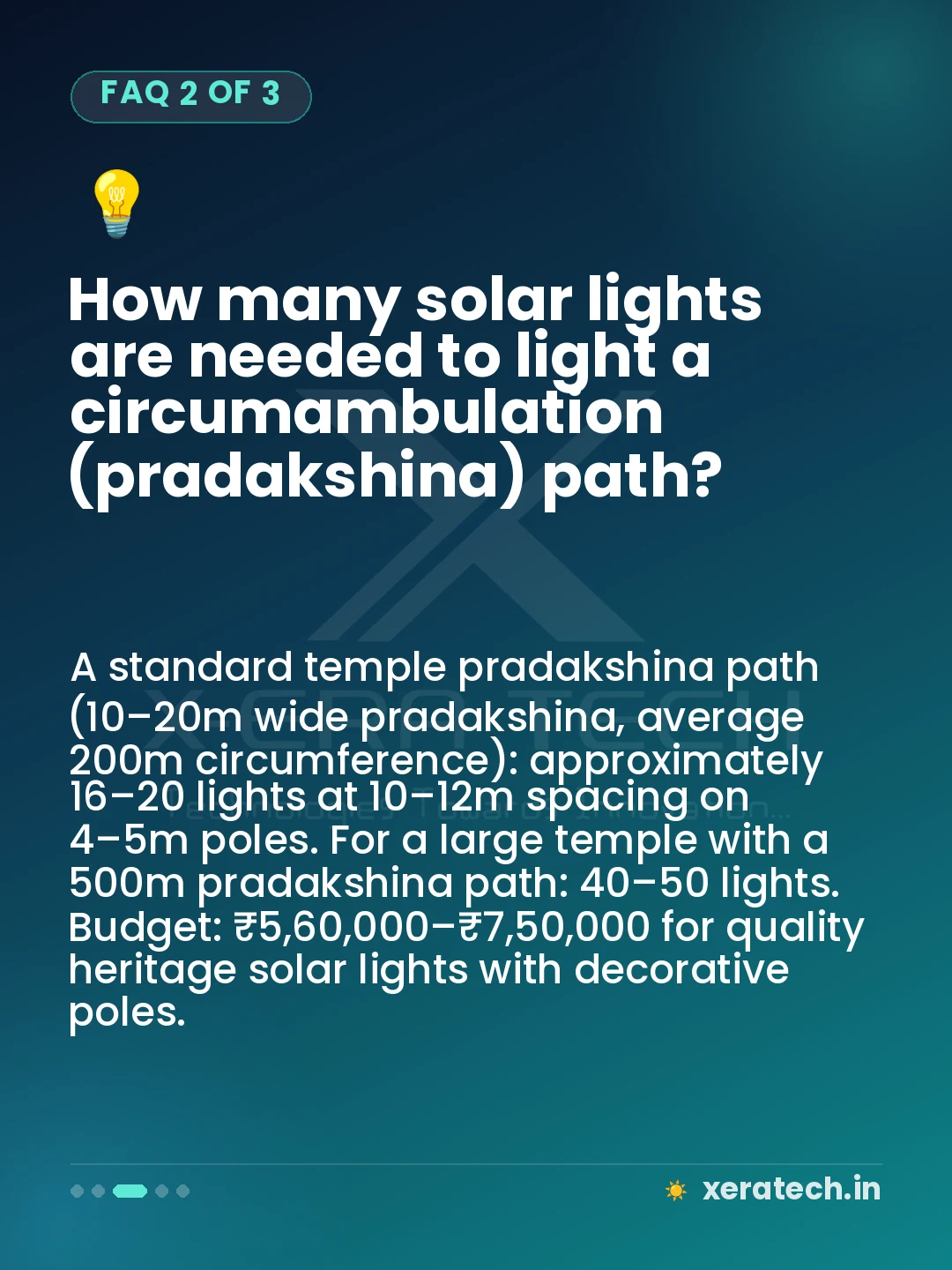
Ghat and step areas: IP66 minimum due to proximity to water bodies (rivers, temple tanks). Stainless steel hardware - constant spray from religious ablutions causes rapid corrosion of zinc hardware. Outdoor temple compound: IP65 minimum. IK09 - festival crowds can inadvertently bump or stress poles. Colour temperature: 3000K for inner sanctum vicinity, 4000K for outer compound roads. Mounting height: 4–5m for narrow pradakshina paths (less glare in intimate spaces). 5–6m for wider approach roads. Lux: 10–15 lux for inner compound paths (walking pace, paved surface). 20–25 lux for vehicle approach road.