Where Solar is Appropriate on a Petrol Pump
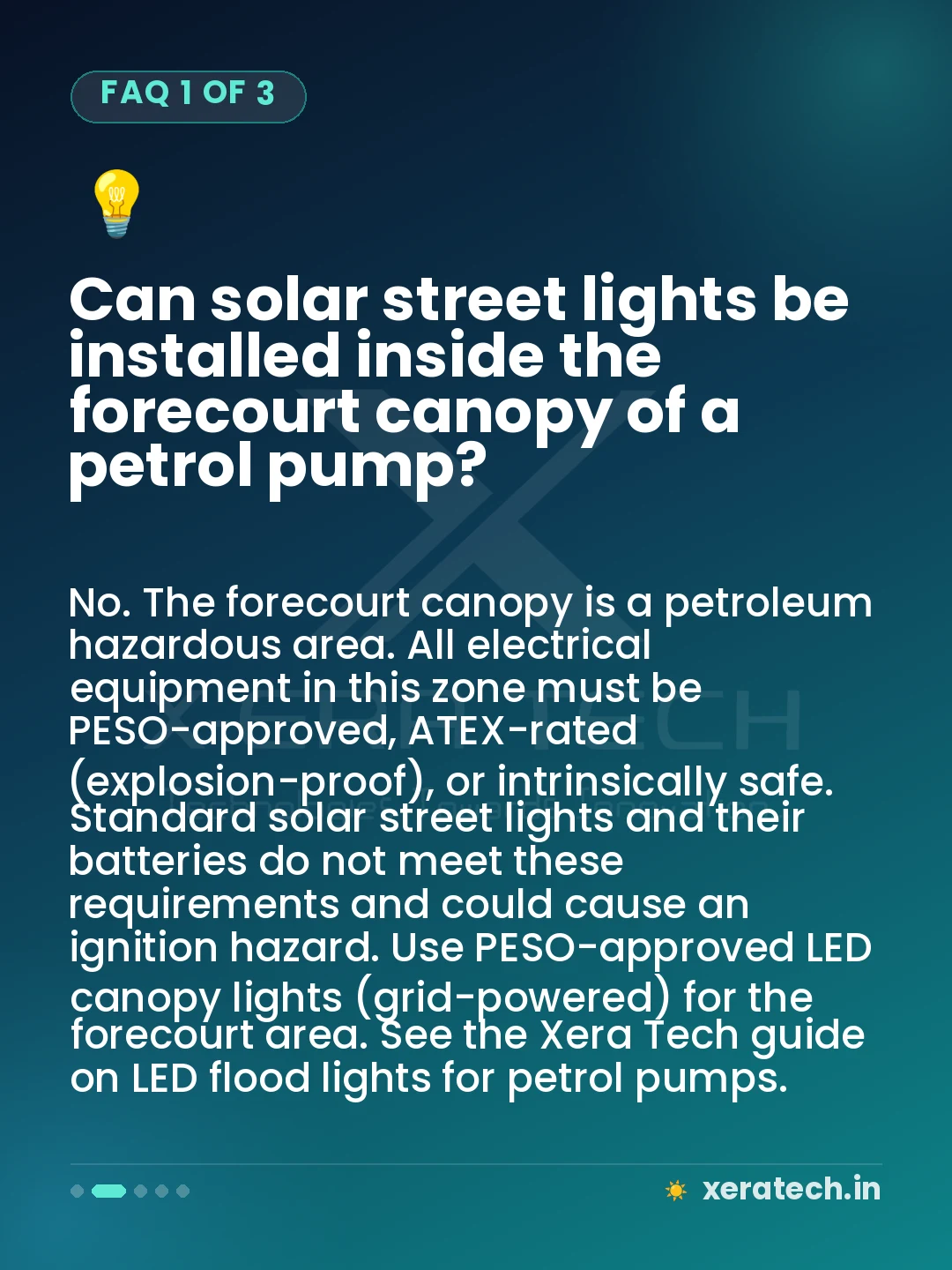
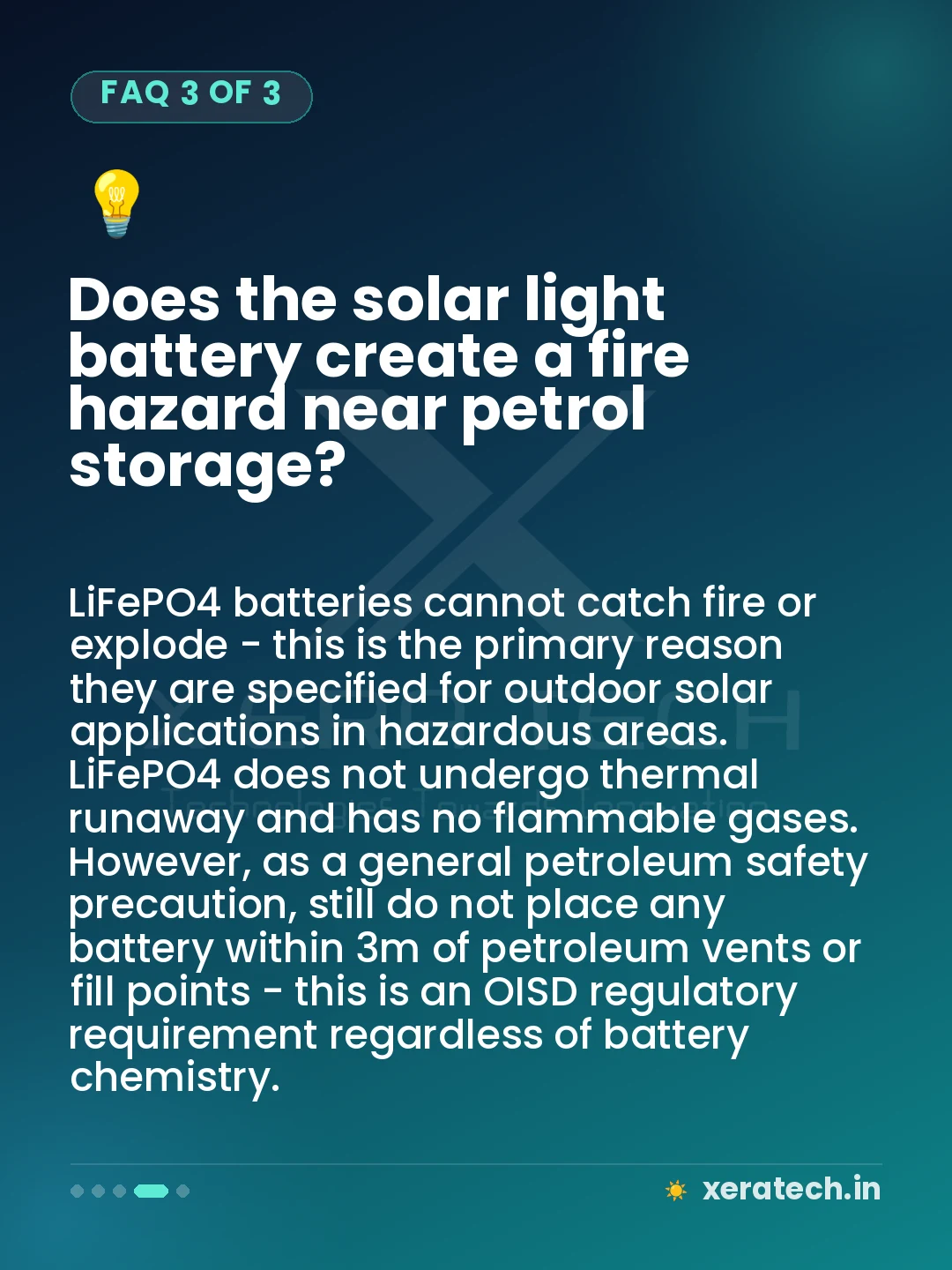
Solar street lights are appropriate for: approach road lighting (50m–200m road leading to the petrol pump forecourt) - not within the forecourt. Compound perimeter and boundary wall lighting. Office building exterior lighting. Vehicle queue/waiting area lighting. Staff accommodation or service area lighting. Solar is NOT appropriate for: the forecourt canopy area - this is a petroleum hazardous zone requiring PESO-approved fixtures. The dispenser area - requires intrinsically safe or explosion-proof fittings. Areas within 1m of dispenser nozzles - ATEX Zone 1. Solar equipment (battery, controller, wiring) must also never be located within 3m of any petroleum storage vent or fill point.
Solar Advantages for Petrol Pump Operators
Petrol pumps operate 24/7 - approach road lighting is required from dusk to dawn every night. Grid electricity at commercial rates (₹8–12/unit for fuel retail) makes continuous lighting expensive. A solar street light with LiFePO4 battery eliminates this cost entirely on the approach road. Grid independence: during power cuts, solar lights continue operating - maintaining visibility and safety for approaching vehicles even when the grid fails. Since petrol pumps often run diesel generators for the pumping equipment, the solar street lights mean one less load on the DG, reducing generator fuel cost. Xera Tech completed a complete outdoor lighting project at Oryx Al MAHA Gas Station in Muscat, Oman - demonstrating fuel station solar lighting capability.
Technical Specifications for Fuel Station Environment
IP rating: IP66 minimum for all outdoor fixtures on a petrol pump - high-pressure hosing of forecourt and compound areas is routine. Surge protection: 6kV/3kA - petrol pump electrical systems are susceptible to surges from generator start/stop. No battery or controller within 3m of any petroleum vent, fill point, or dispenser - comply with OISD-118 guidelines on electrical installations in petroleum premises. Battery housing: all-in-one designs with battery sealed inside the pole body are preferred - no exposed battery box near fuel areas. Earth continuity: all metallic pole bodies must be bonded to the petrol pump's main earth electrode - IS 5572 (Code of Practice for Electrical Installations at Petroleum Storage and Dispensing Sites).
Approach Road Lighting Specification
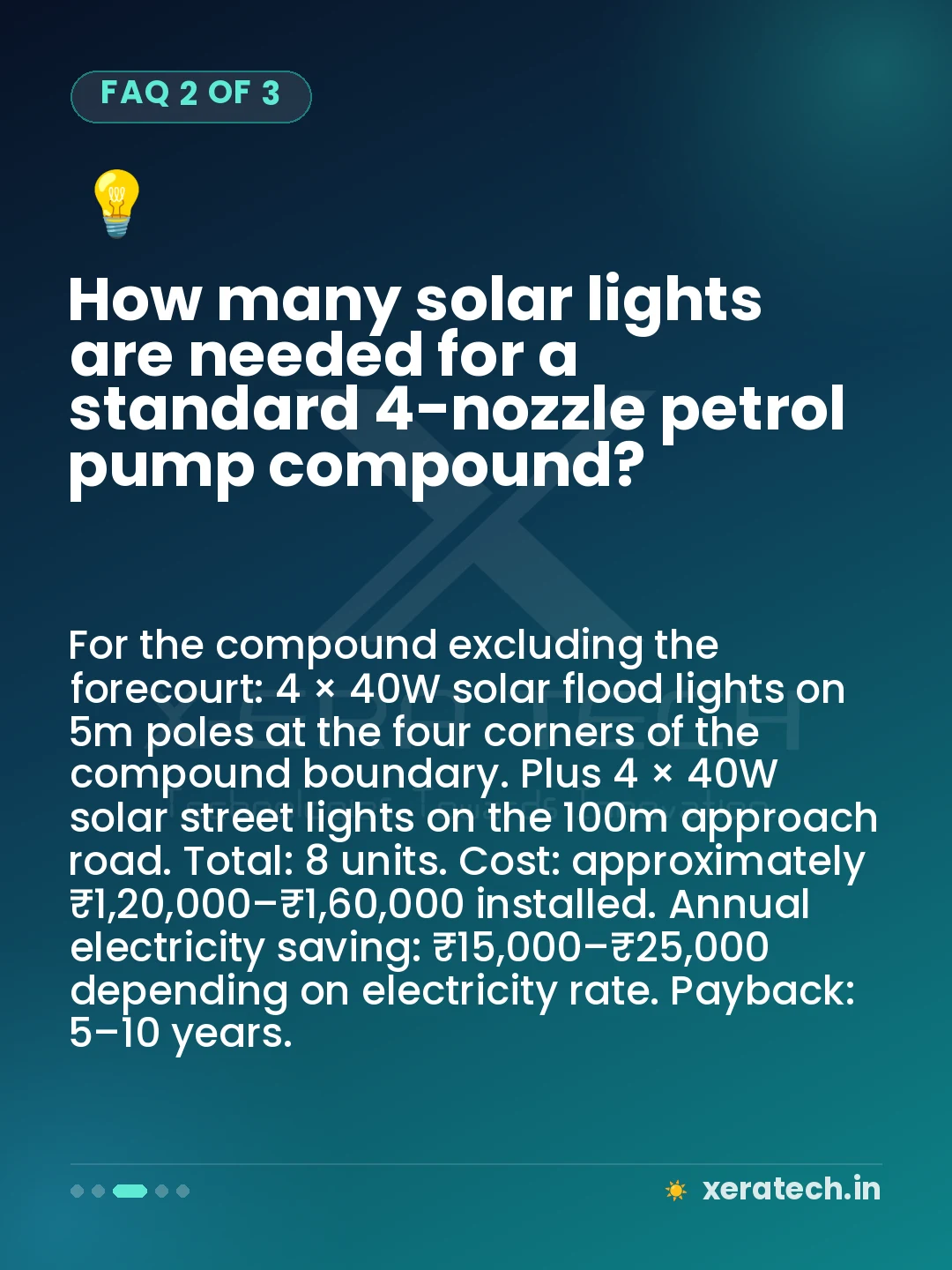
For a 100m approach road to a petrol pump: 4 × 40W solar street lights on 6m poles at 25m spacing. 5000–6500K colour temperature for maximum driver visibility. 20–30 lux maintained average at road surface (IS 1944 Category M3 arterial road standard). For a high-traffic pump on a national highway: use 60–80W solar lights on 8m poles for higher lux - vehicle approach speeds are higher and visibility window is shorter. For the pump's main signage pylon: use a dedicated 100–200W LED flood light (grid-powered) for the tall illuminated sign - solar is adequate for road lighting but not for the high-luminance advertising pylon.