
Hazardous Area Classification
Not all mine/quarry lighting is in hazardous areas. Surface quarries for building stone (granite, basalt, marble): generally non-hazardous for explosion purposes. Standard IP66, IK10 LED flood lights are appropriate. Coal mines and certain underground operations: classified as hazardous atmosphere (methane gas) - require CMRS (Central Mine Research Station) approved, flame-proof (Ex-d) or intrinsically safe (Ex-ia) luminaires. Crusher and screening areas: heavy dust - IP66 minimum, IK10 for impact resistance. Explosive storage and blasting areas: standby lighting must use intrinsically safe fixtures. Always conduct a formal hazardous area classification study (ATEX zone drawing) before specifying luminaires for any mining operation.
Lux Requirements for Mining Operations
IS 3646 and DGMS (Directorate General of Mines Safety) guidelines specify: Open cast mine face (drill and blast area): 50–100 lux. Haul road within mine boundary: 30–50 lux (higher than standard road - heavy vehicle density). Crusher platform and screening area: 200–300 lux. Workshop and maintenance bay: 300–500 lux. Control room: 500 lux. Loading and weighbridge area: 100–200 lux. The entire mine site perimeter should be lit to 20 lux minimum - both for security and to prevent vehicle accidents near the mine boundary.
Dust-Proof Specification for Quarry Lighting
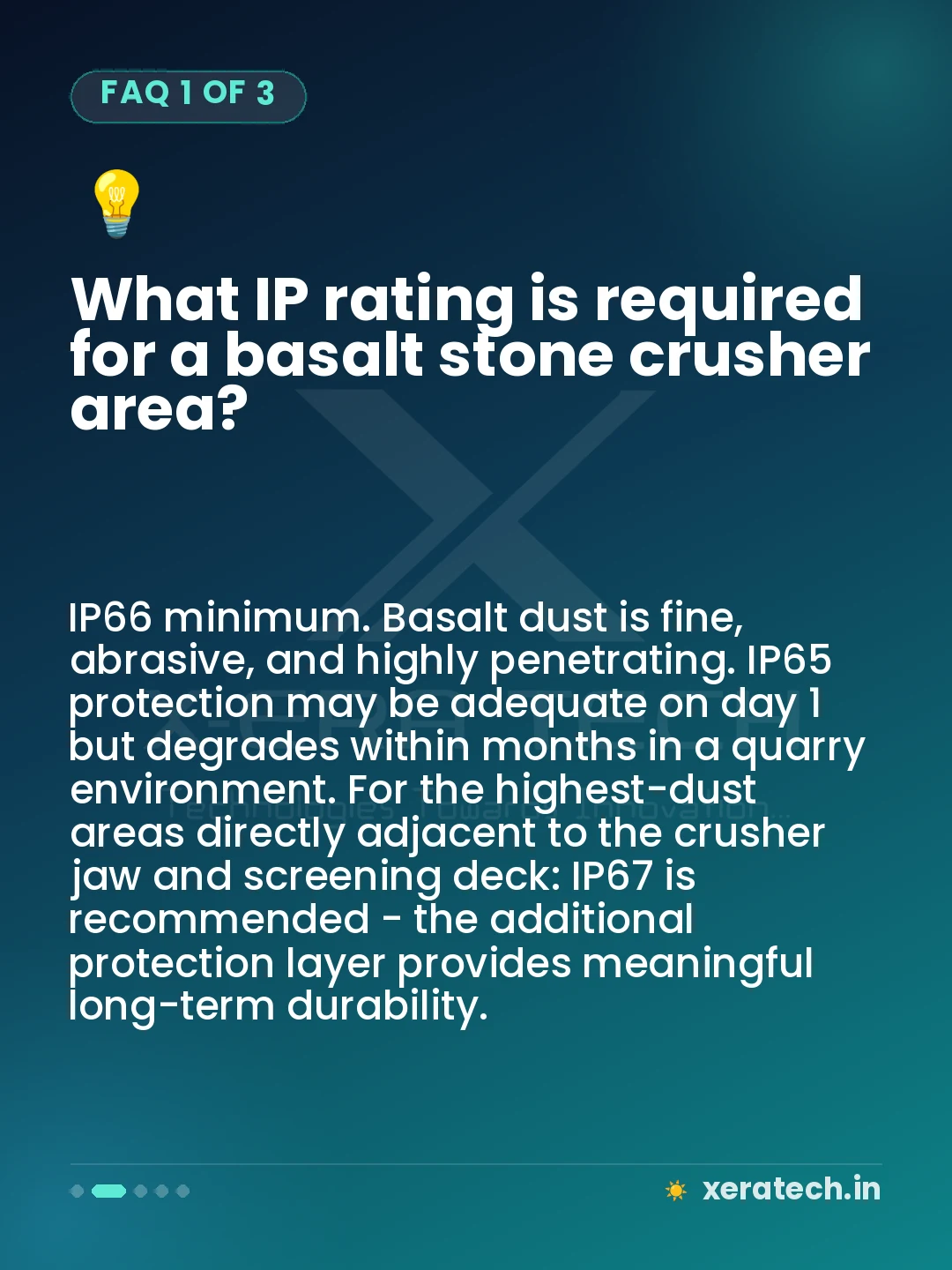
Stone quarry environments generate extreme levels of stone dust - fine silica particles that penetrate IP65 seals over time. Specification for quarry flood lights: IP66 minimum (the additional gasket compression of IP66 versus IP65 provides meaningful long-term dust protection). Polycarbonate or tempered glass cover - glass is more resistant to abrasion from airborne rock particles. Vibration-resistant mounting: use anti-vibration brackets to protect LED chips and driver solder joints from continuous heavy equipment vibration. IK10 rating: for areas where flying rock chips are possible. Regular cleaning: weekly cleaning of fixtures in active quarry areas - dust accumulation on covers reduces output by 30–40% within weeks.
Solar Lighting for Remote Mine Sites
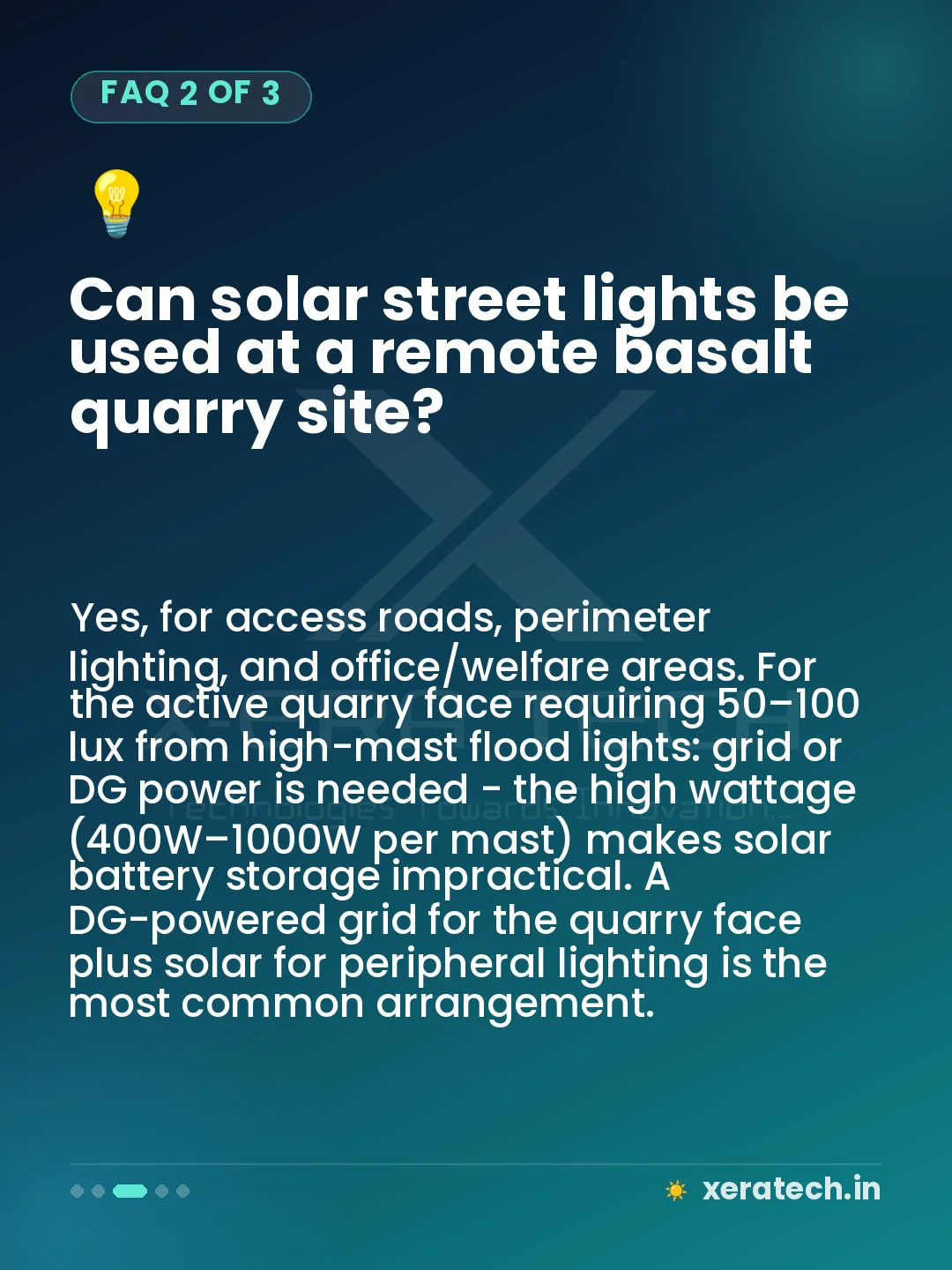
Many stone quarries and small mines in Maharashtra, Rajasthan, and MP are in remote locations where grid connection is expensive. Solar flood lights are practical for: site boundary and perimeter lighting (all night, low-to-medium lux). Security guard posts. Access road lighting. Scale and weighbridge area. For the active mining face: grid-powered high-intensity LED is preferred for reliability and high lux. A hybrid approach - solar for perimeter/access roads, grid for active operations - is common and cost-effective. All solar equipment must comply with the mine's electrical safety regulations and DGMS guidelines for the specific mine classification.