Lux Requirements by Sports Level
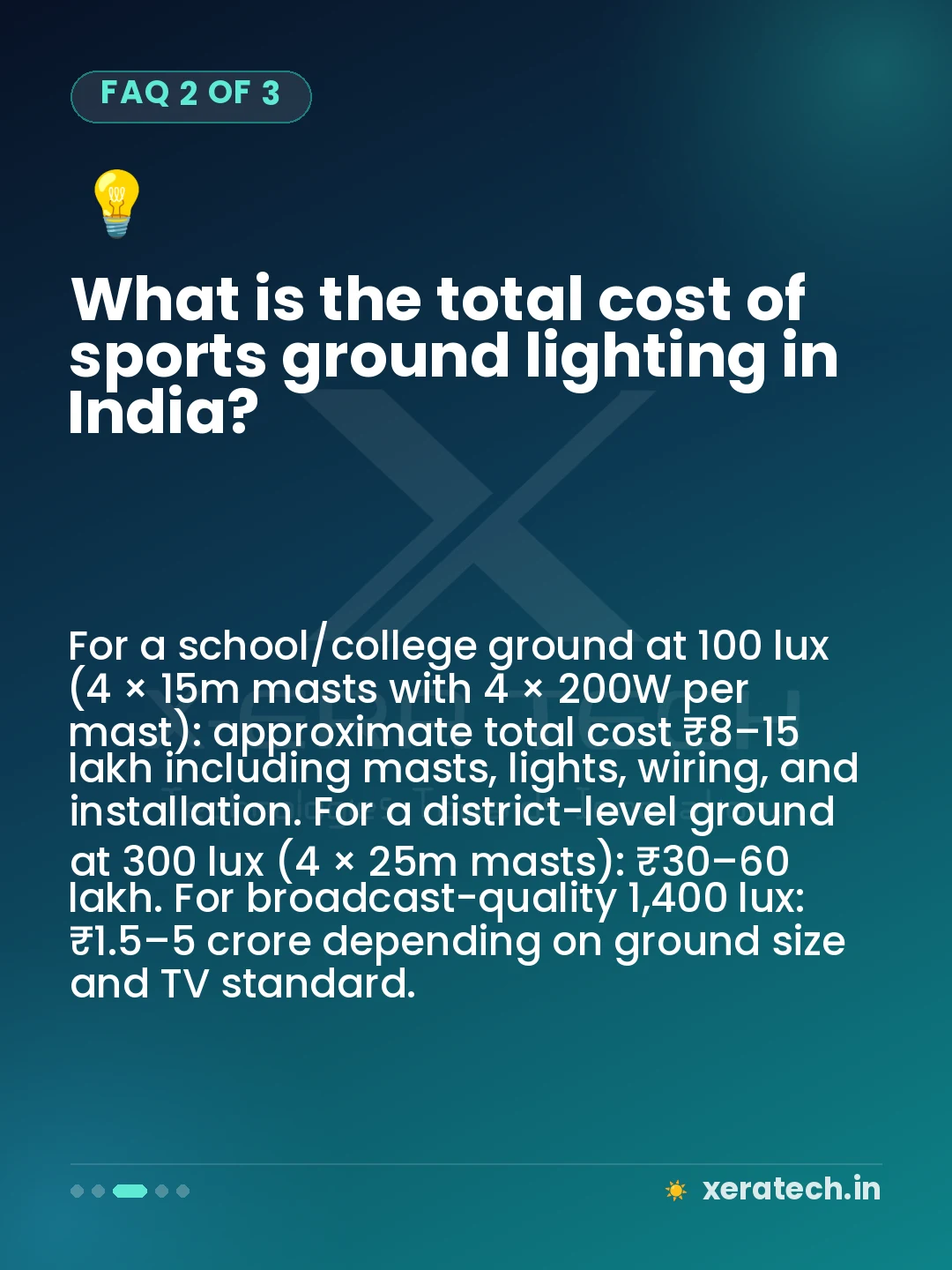
School/college practice ground: 75–100 lux (players can see the ball clearly, no broadcast). Club-level cricket/football: 100–200 lux (evening matches for club members). District/state-level competition: 200–300 lux (official matches, local broadcast). National level / IPL-quality: 1,000–2,000 lux (broadcast HD cameras need 1,400+ lux at ball level). FIFA/ICC broadcast standard: 1,400–2,000 lux (horizontal) + specific vertical illuminance requirements. Most Indian municipal and school grounds fall in the 100–300 lux range. The Xera Tech APJ Abdul Kalam Stadium project in Mira Road targeted 300–500 lux for district-level use.
Mast Height and Placement
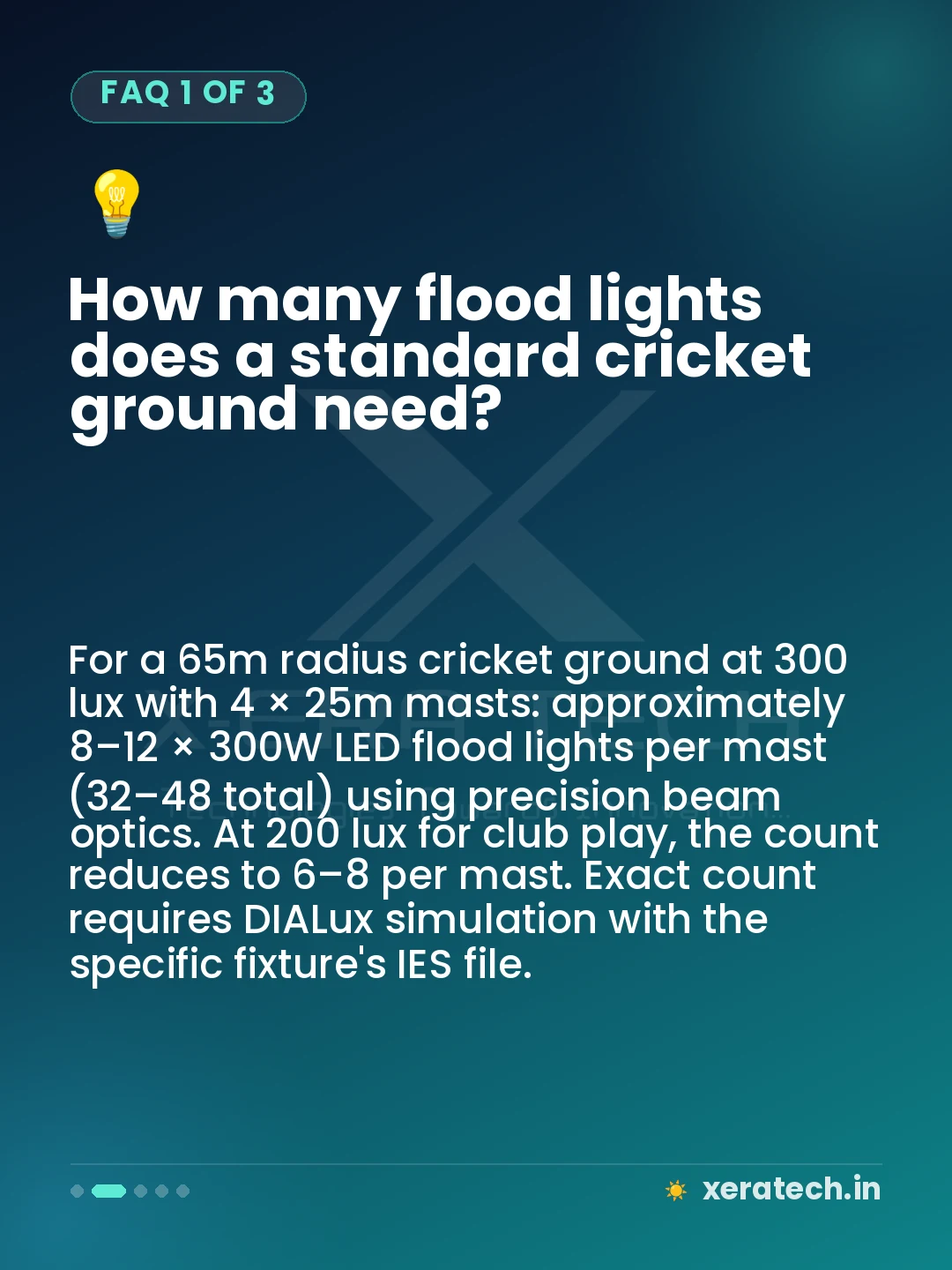
Mast placement critically affects glare to players and ball visibility. General rule: masts at four corners of the playing field, minimum distance from boundary = 5m. Mast height should create an elevation angle to the playing area centre of at least 25° (ideally 30°+) to keep glare out of players' and goalkeepers' lines of sight. For a standard cricket ground (radius 65m): 4 masts at 25m height, placed at cardinal corners. For a football pitch (105×68m): 4 masts at 20m height at corners, or 6 masts at 18m for better uniformity. Flood lights on each mast are aimed precisely - this is not point-and-hope; it requires a photometric design.
Uniformity Ratio for Sports
Uniformity ratio (Emin ÷ Eavg) must be 0.50+ for club play and 0.60+ for broadcast sports. A uniformity ratio below 0.40 means players move between bright and dark zones - dangerously disorienting in a fast sport. Achieving good uniformity requires: careful mast positioning, precise aim angles for each flood light head, and multiple lower-wattage fixtures rather than fewer high-wattage ones. For broadcast sports, vertical illuminance uniformity (light on vertical plane at player eye level) is also specified - typically Ev ≥ 0.5 × Eh.
LED vs Metal Halide for Sports
Until 2018, most Indian stadiums used 1,000W or 2,000W metal halide flood lights on high masts. LED has now completely overtaken metal halide for new sports installations because: LED is instant-on (metal halide takes 5 minutes to warm up and re-strike after power interruption - catastrophic during a TV broadcast). LED saves 50–60% electricity. LED lasts 50,000 hours versus 6,000 hours for metal halide (MH replacement on a 25m mast requires a crane - very expensive). LED maintains consistent colour temperature throughout its life (MH shifts from white to pink as it ages). Retrofit of existing MH sports lights to LED is increasingly common - Xera Tech supplies retrofit LED modules for standard mast fixtures.