Lux Requirements for Highways
IRC (Indian Roads Congress) SP-72 specifies road lighting standards for Indian highways. Category M1 (high volume arterial, NH/SH): maintained average horizontal illuminance 15–20 lux, uniformity ratio (Emin/Eavg) ≥ 0.40. Category M2 (secondary roads, MDR): 10–15 lux, uniformity ≥ 0.35. Category M3 (local roads): 7.5–10 lux. For comparison, village roads (Category P5) require only 3–7 lux. Highway solar lights must achieve 15–20 lux consistently - this requires higher wattage (60–100W) and more battery capacity than a typical village road light.
Technical Specifications for Highway Solar Lights
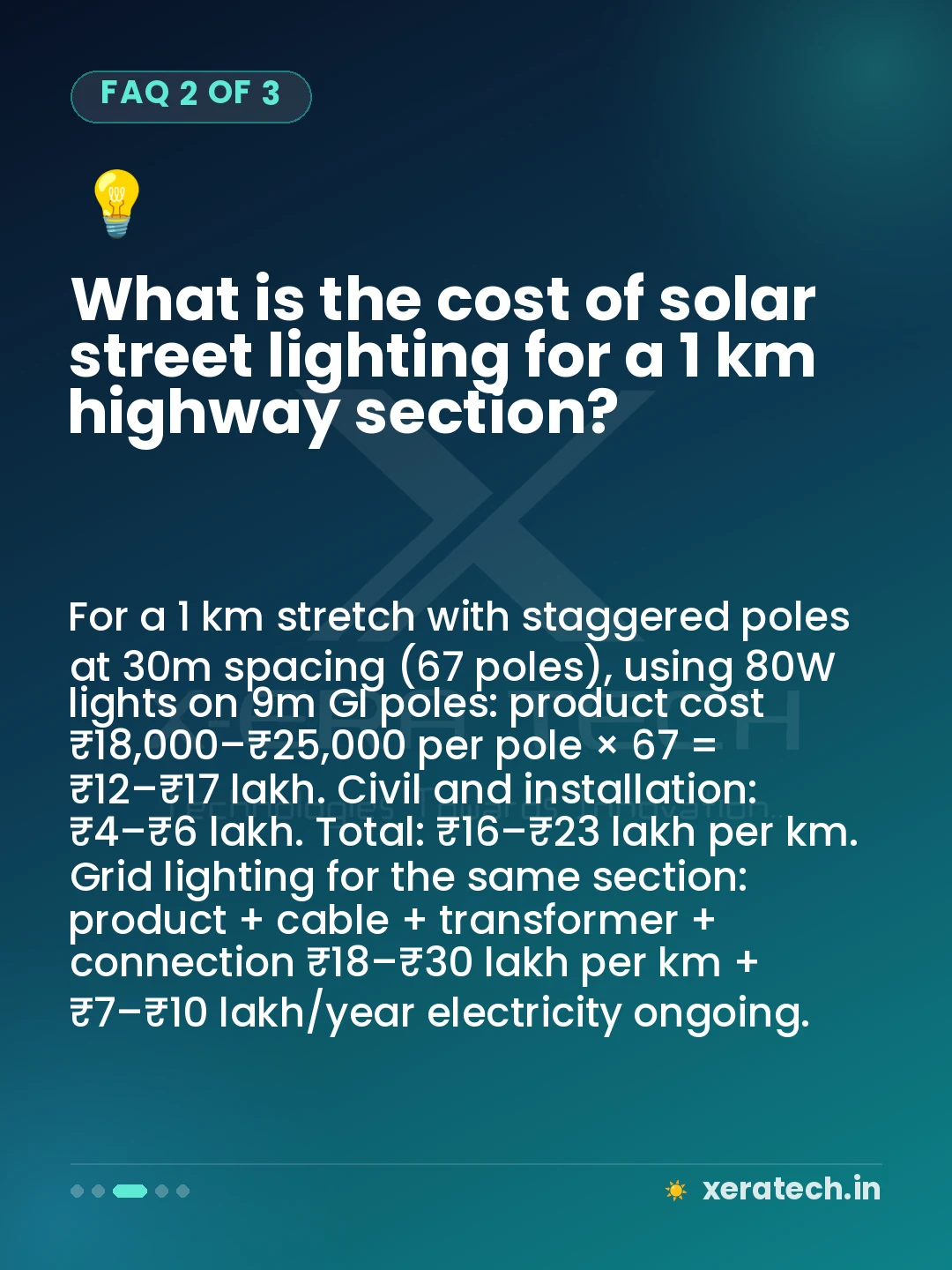
Wattage: minimum 60W LED, recommend 80–100W for 9–10m poles. Pole height: 9–10m for single-side or staggered installation on a 7m carriageway. Spacing: 30–35m for staggered arrangement on 9m poles with 80W lights. Battery: minimum 600–800 Wh LiFePO4 for 10-hour backup. Panel: minimum 120W monocrystalline for 80W LED (1.5× panel-to-LED ratio). Controller: MPPT mandatory. IP rating: IP66 minimum (highway locations experience high-speed vehicle wash, heavy rain, and spray). Wind load: must be designed for wind zone applicable to the highway corridor - coastal NHs need Zone IV or V wind load rating.
Where Highway Solar Lighting Works Best
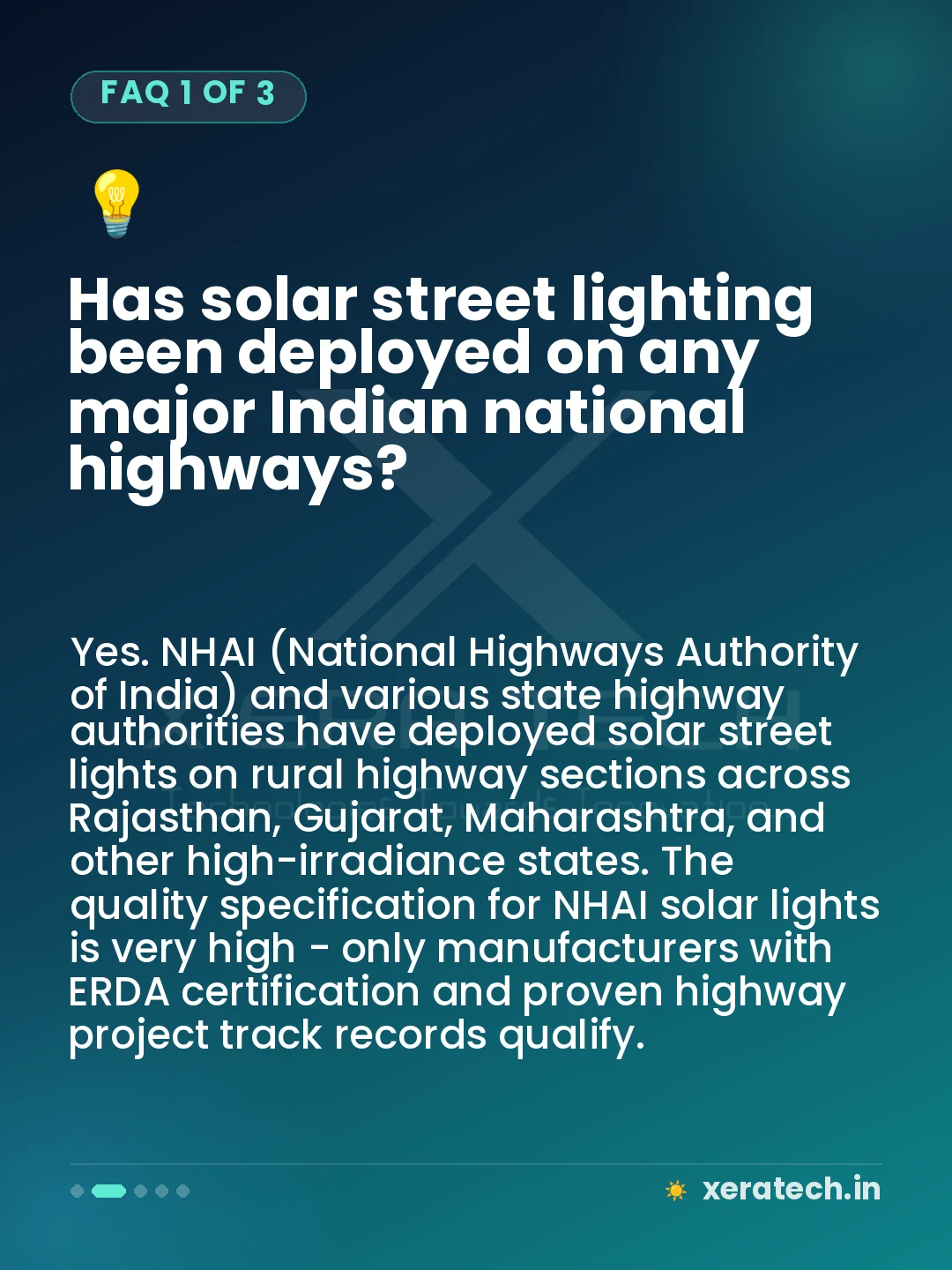
Highway solar lights work best on: rural highway sections far from grid substations (where grid connection cost is ₹5–15 lakh per km). Bypass roads around towns (often ungridded despite being SH/MDR classification). State highway sections in tribal and forest areas. Highway intersections and junction areas (limited number of lights, high-priority safety need). Toll plazas and rest areas (often remote, and the plaza generates revenue to fund premium lighting). Sections through high solar irradiance zones (Rajasthan, Gujarat, Vidarbha Maharashtra, Andhra Pradesh - 5.5–6.5 peak sun hours).
Limitations of Solar on Busy Highways
Solar is not the best choice for: major highway sections near urban areas where grid connection is cost-effective. Tunnels and underpasses (no sunlight). Areas with heavy tree canopy along the highway. Sections requiring >20 lux maintained average with very high uniformity (e.g., NHAI expressway standards require consistent 500 lux at toll plazas - only grid lights can deliver this). For most Indian national highways in rural areas, a hybrid approach makes sense: solar lights for the open rural sections + grid lights at toll plazas, grade separators, and populated sections.