
Indian Road Classification and Lux Requirements
IS 1944 (Indian Standard for Road Lighting) classifies roads and specifies minimum maintained illuminance: Village lanes and internal roads: 5–10 lux. Residential colony roads: 10–15 lux. Urban distributor roads: 15–20 lux. Arterial roads and highways: 20–30 lux. Industrial road areas: 20–25 lux. Intersections and pedestrian crossings: 30–50 lux. Parking areas: 10–15 lux. Always design for the maintained lux level (average over the lighting period), not just initial lux.
Wattage Selection Table by Road Type
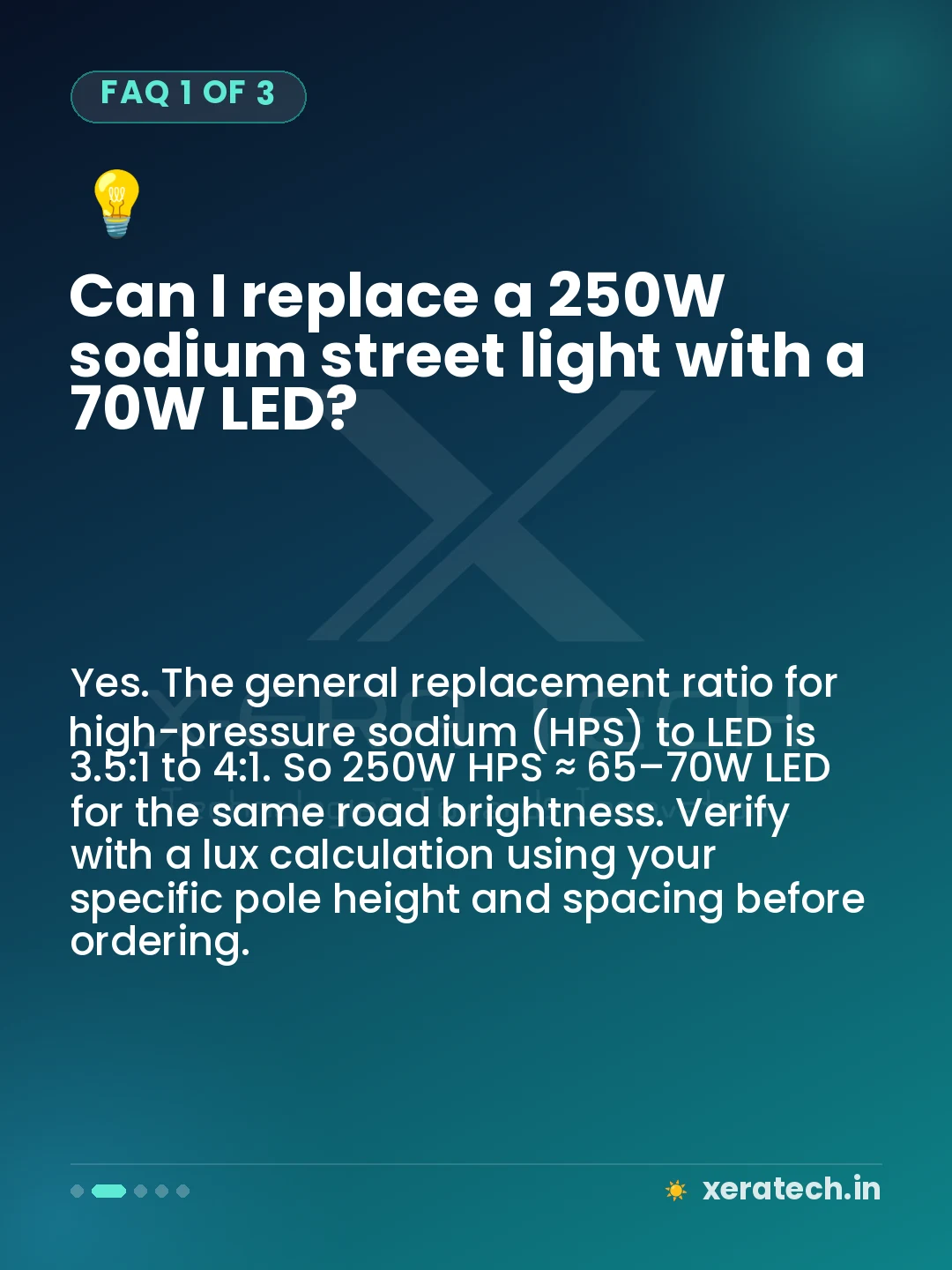
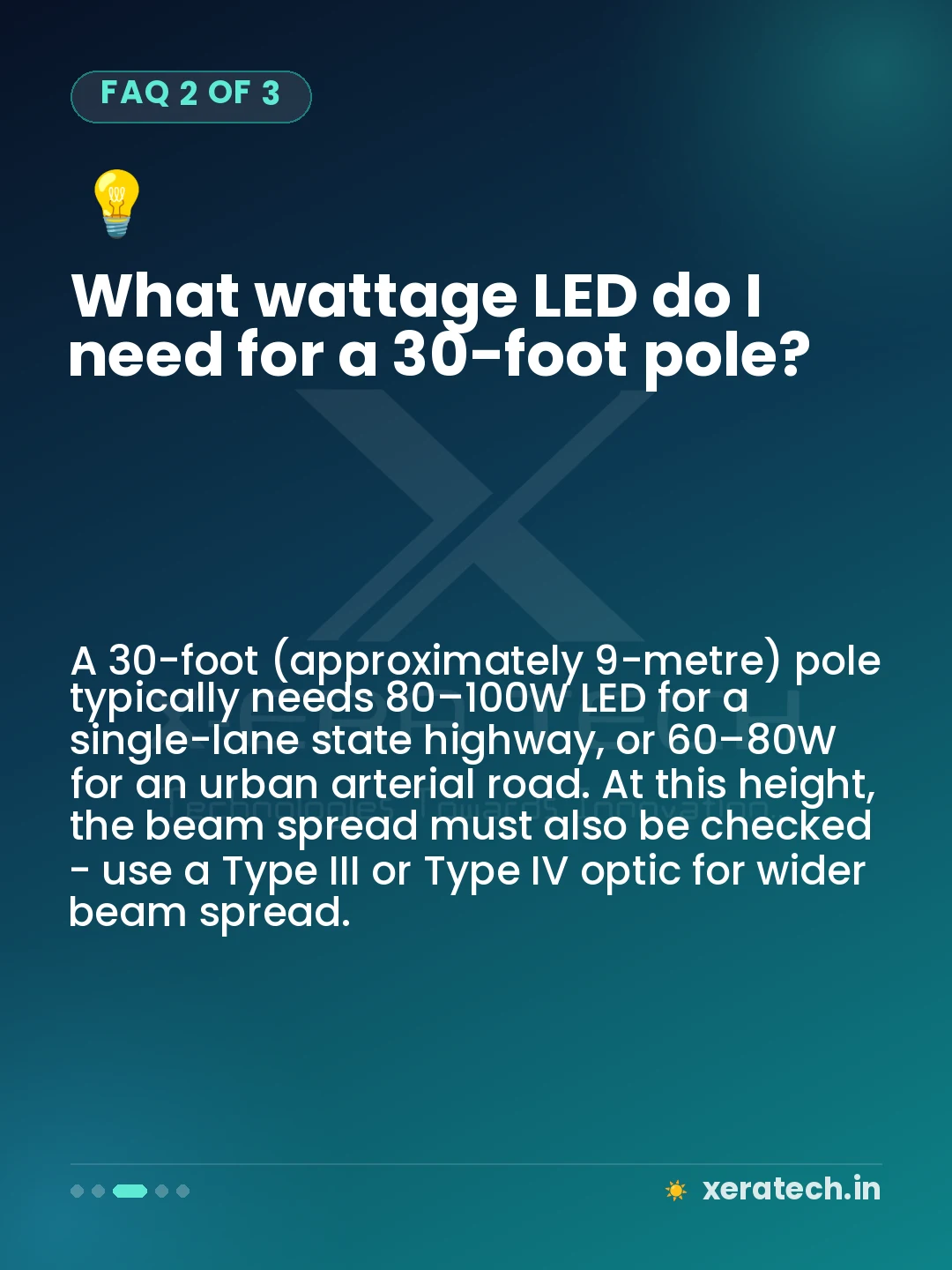
Village lane (3–4m wide, 5m pole, 20m spacing): 20–24W. Colony road (5–6m wide, 6m pole, 25m spacing): 30–36W. Single-carriageway road (7m wide, 7m pole, 30m spacing): 40–45W. Dual carriageway (10m wide, 8m pole, 35m spacing): 60–72W. State highway (12–14m wide, 9m pole, 35m spacing): 80–100W. National highway (14m+ wide, 10m pole, 35m spacing): 100–150W per point or dual-arm arrangements. Industrial road (6–8m, 7m pole): 45–60W.
The Pole Height Formula
The mounting height directly affects road uniformity ratio. General rule: pole height should be 0.6–0.8× the road width. For a 7m wide road: pole height = 7 × 0.7 = ~5m. For a 10m road: 7m pole. Too low a pole creates bright spots directly under each light with dark patches in between. Too high a pole requires much higher wattage to achieve the same lux at ground level. Spacing between poles should be 3–4× the mounting height for uniform lighting.
Efficacy - Why Lumens Matter More Than Watts
A 40W street light can produce anywhere from 3,200 lumens (80 lm/W efficacy - poor quality) to 5,600 lumens (140 lm/W - high quality). A better quality 30W light can outperform a poor quality 40W light. Always check: lumens output, not just wattage. Minimum acceptable efficacy for Indian street light tenders is 130 lm/W. Xera Tech lights achieve 140–160 lm/W, allowing you to use a lower wattage for the same road brightness - saving electricity.