Rural Road Classification and Lux Targets
IRC SP-72 classifies rural roads: Village roads (VR): 3–5 lux maintained average - the minimum for safe pedestrian use. Other District Roads (ODR): 7–10 lux - for mixed traffic including cycles, two-wheelers, and occasional HCVs. Major District Roads (MDR): 10–15 lux - significant vehicle traffic. PMGSY roads are typically ODR or MDR classification requiring 7–15 lux. For most gram panchayat internal roads (Category P4/P5): 5–10 lux is the practical target - achievable with 20–40W solar or grid LED lights on 5–6m poles.
Recommended Specification for PMGSY Roads
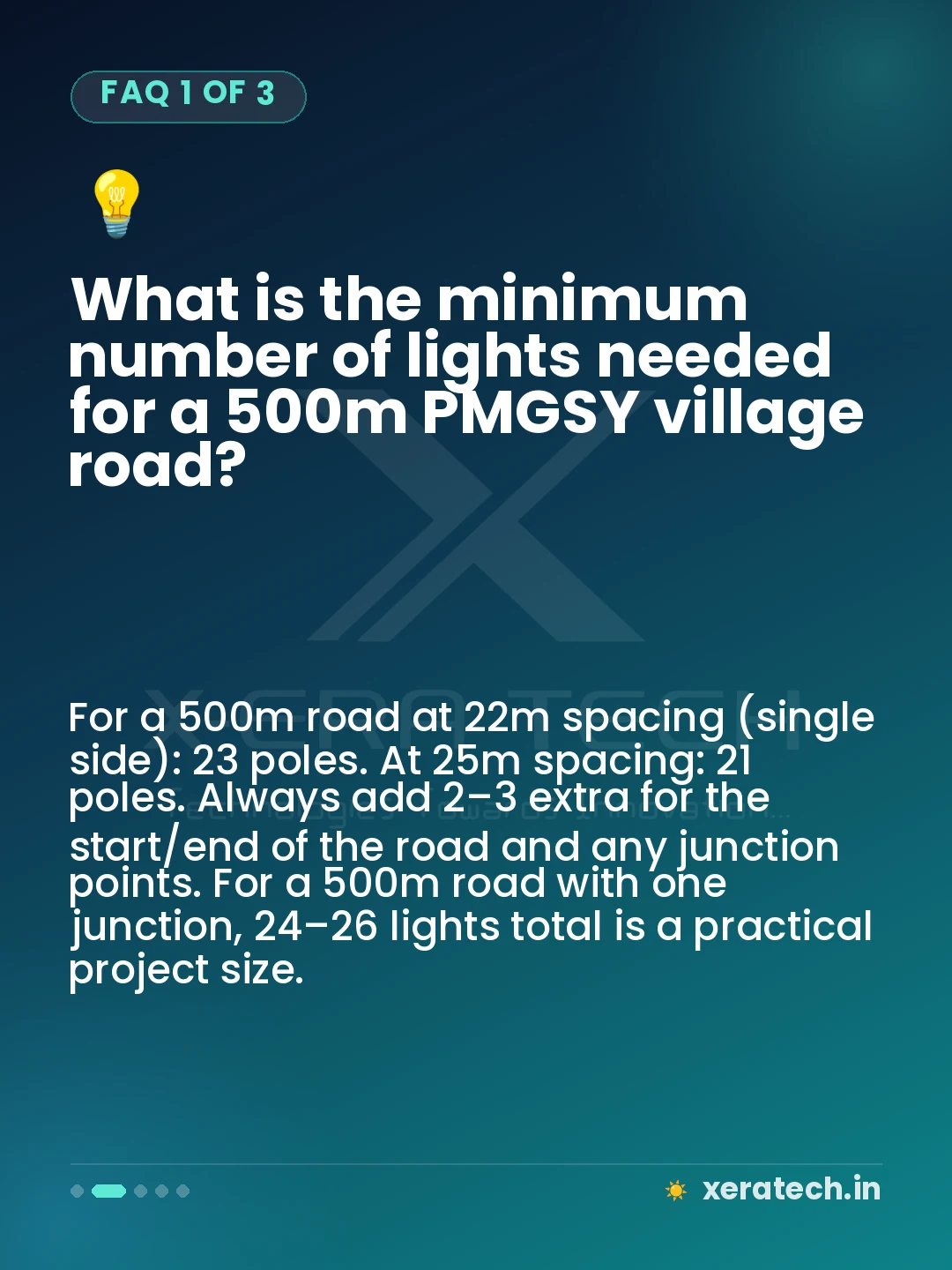
A 30W LED street light on a 5m pole at 22m single-side spacing achieves 7–12 lux on a 5m wide PMGSY road - meeting ODR requirements. For 6m wide PMGSY roads: use 40W on 6m pole at 25m spacing. Key specifications: BIS certified (IS 16905), minimum 130 lm/W efficacy, 5000–6500K colour temperature, IP65 minimum, IK08 minimum, CRI ≥ 70, PF ≥ 0.95. For solar: LiFePO4 battery, MPPT controller, 3-day minimum backup. Pole: hot-dip galvanised GI, 3mm wall thickness minimum, with anchor bolt foundation.
Solar vs Grid for Rural Roads
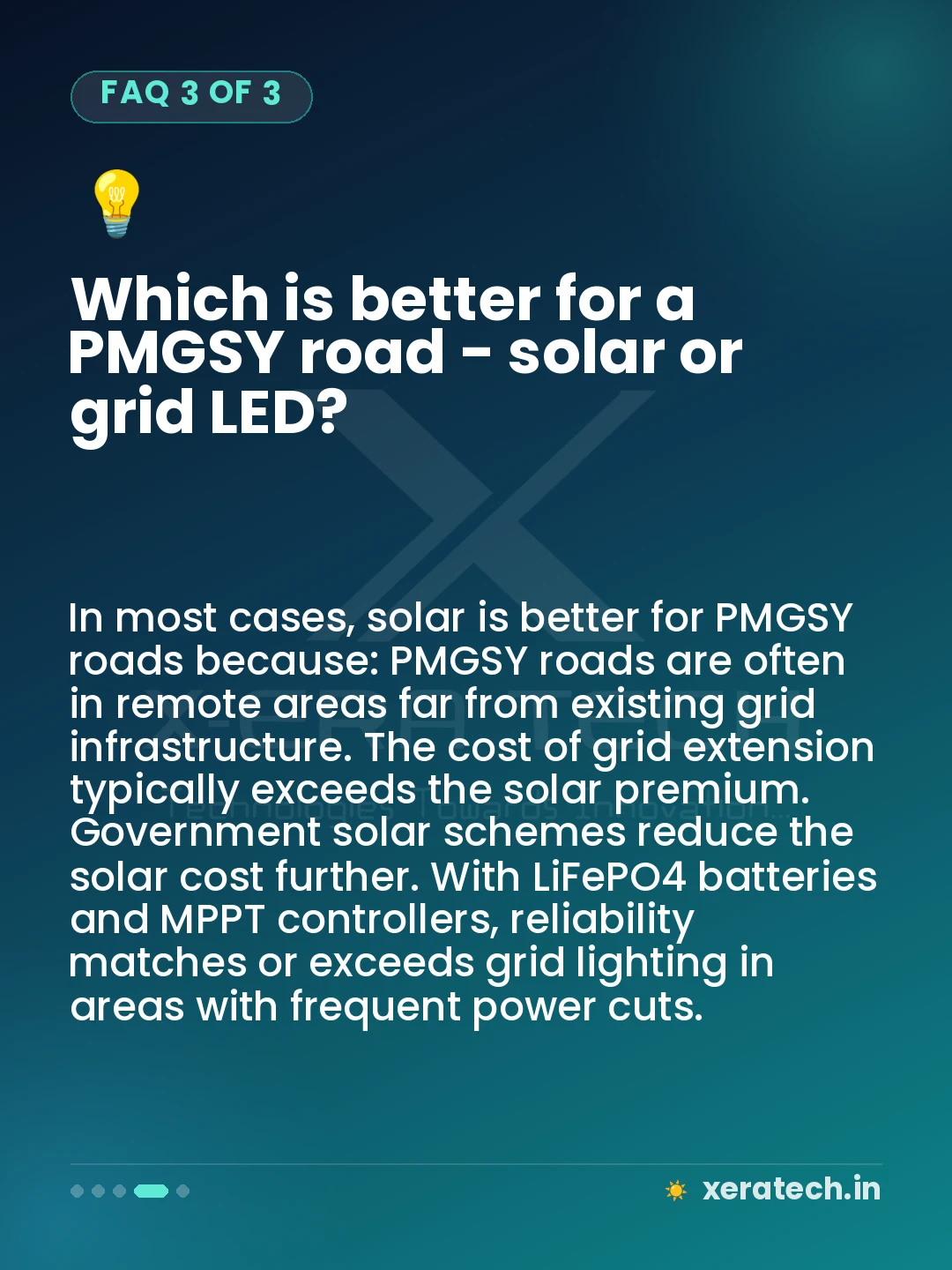
Most PMGSY and rural roads are the strongest candidates for solar street lights because: grid extension to rural road outskirts costs ₹1.5–₹5 lakh per km in cabling and transformer. Rural areas face 6–12 hours of load shedding daily in many states - grid lights are useless during outages. Solar lights operate independently of grid availability. Maintenance is simpler - no cable network to maintain. The only counter-argument: rural areas may have limited technical capacity for solar maintenance - this is solved with proper training and an AMC (Annual Maintenance Contract) with the supplier.
Procurement Under PMGSY
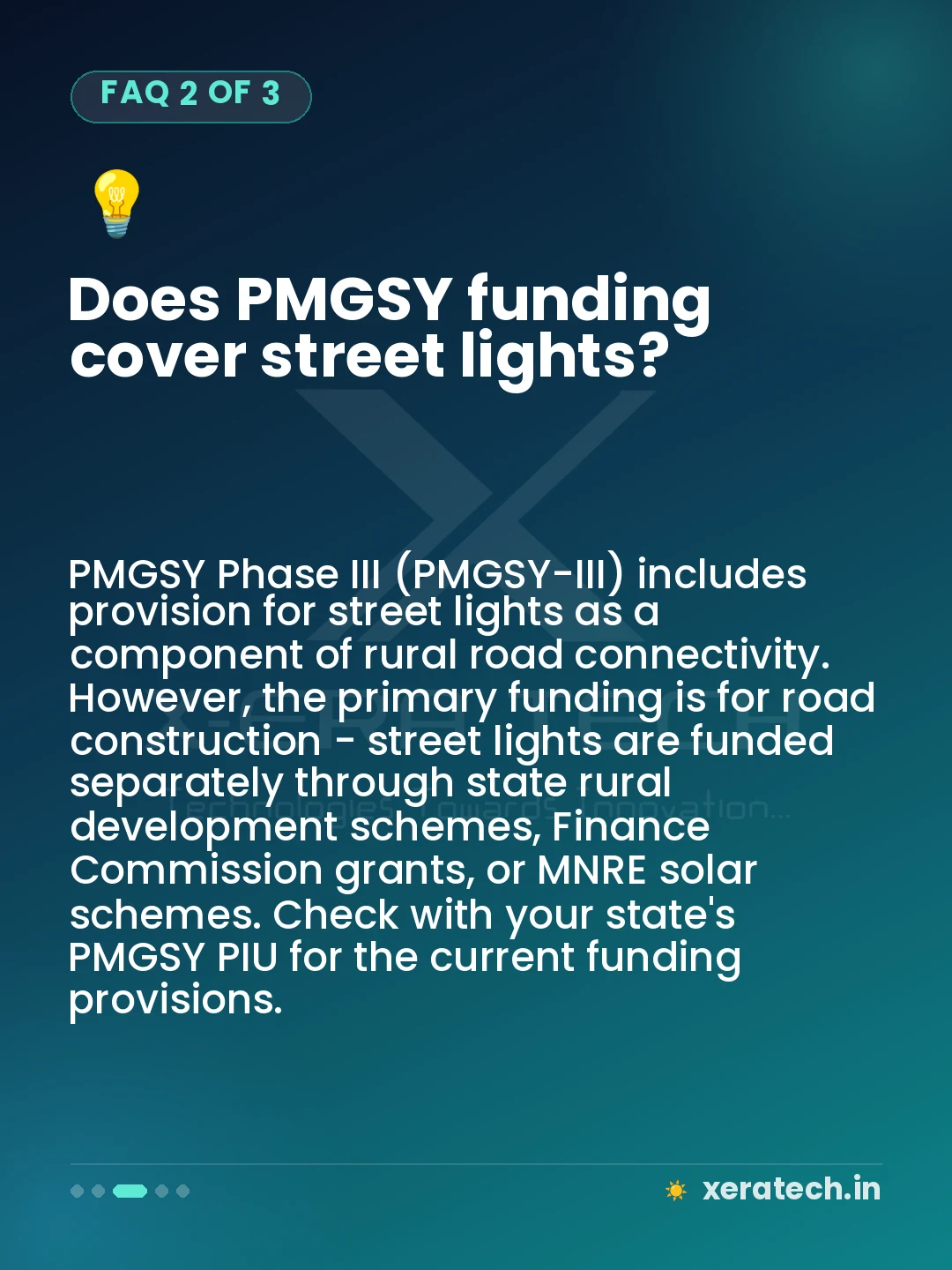
PMGSY projects are executed by state PWD or Rural Development departments. Street lighting is included as a separate component in the DPR (Detailed Project Report) for new PMGSY roads. Products must meet the state PWD's approved vendor list requirements. For state PMGSY projects: the state PIU (Project Implementation Unit) issues tenders with technical specifications. BIS certification is mandatory. For village-level gram panchayat roads (not PMGSY): procurement is by gram panchayat directly under their annual plan budget, typically without formal tendering below ₹2–5 lakh (state threshold).