Lux Requirements by Sport
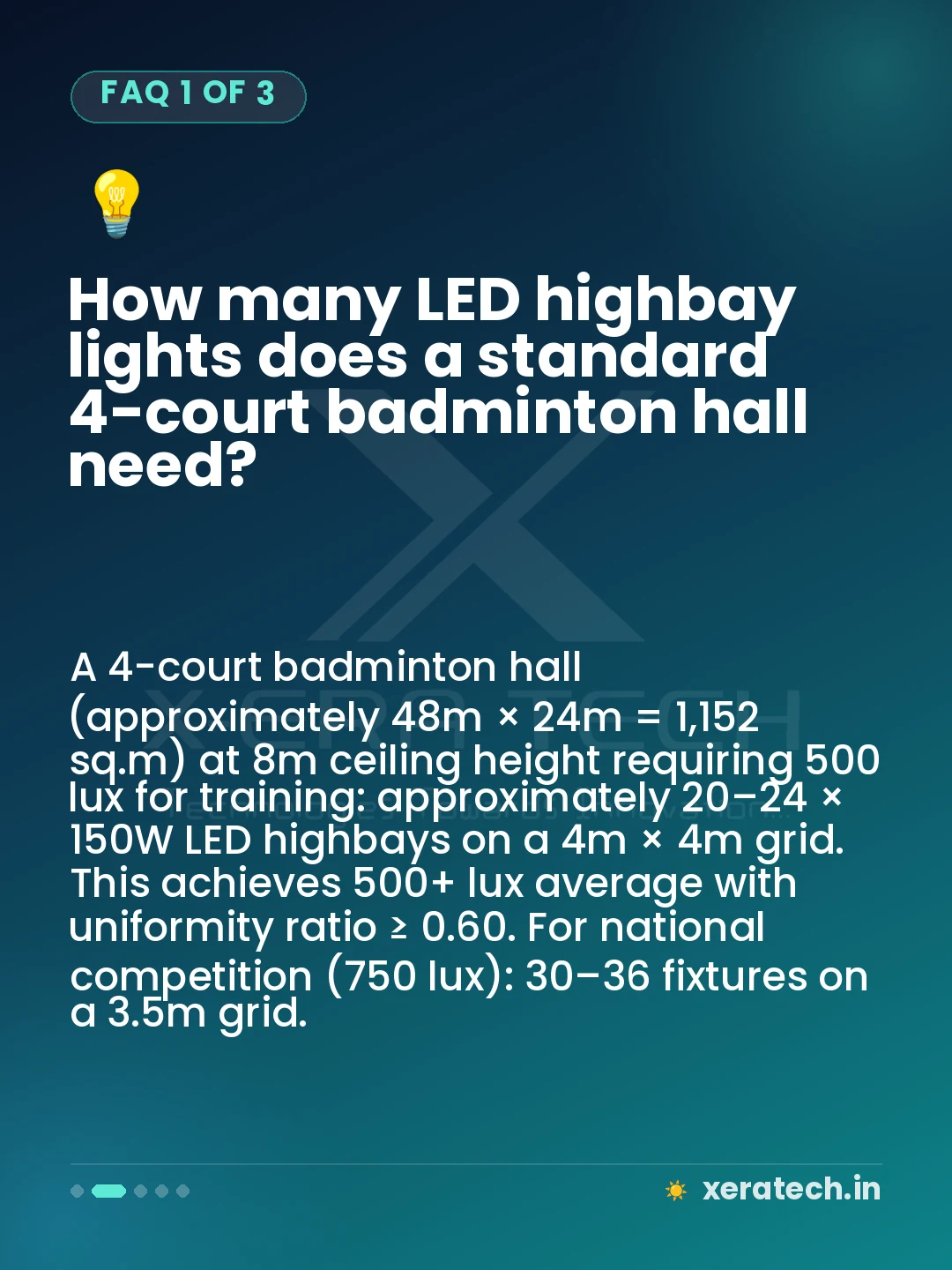
IS 3646 Part 2 and international sports federation guidelines specify: badminton (BWF): training 300 lux, national competition 750 lux, international broadcast 1,000 lux. Basketball (FIBA): training 300 lux, national competition 1,000 lux, international 1,500 lux. Volleyball: training 300 lux, competition 750 lux. Indoor football/futsal: 300–500 lux for training and club play. Table tennis: 500–750 lux (requires very high uniformity - Emin/Eavg ≥ 0.7). Gymnasium (weights, fitness): 300–500 lux. Multipurpose community hall: 200–300 lux. Higher uniformity ratios are required for indoor sports than outdoor - players' eyes adapt to the indoor average and any bright/dark variation is very visible.
Glare Control in Sports Halls
Glare is more critical indoors than outdoors because: the background is darker (no ambient skylight to dilute fixture brightness). Athletes look upward frequently (badminton, basketball, volleyball - all involve looking up). Ceiling-mounted fixtures are in the direct line of vision. Controls: avoid bare LED chips facing downward - use deep-reflector or prismatic diffuser fittings. Mount lights perpendicular to the court's long axis (at the sides, not at the ends where players look up toward the backwall). Use frosted or prismatic lenses that reduce luminance without reducing luminous flux. For badminton: avoid fixtures directly above the net area. Unified Glare Rating (UGR) should be ≤ 22 for sports halls per CIE 117.
LED Selection for Sports Halls
Ceiling height 6–8m (most Indian municipal sports halls): 100–150W LED highbay, 90°–120° beam, UGR ≤ 22, CRI ≥ 80. Ceiling height 8–12m (university and state-level sports halls): 150–200W LED highbay or linear LED with precision optics. For badminton specifically: 5700–6500K cool white improves shuttle visibility. Use 2-level switch-able lighting (50% for training, 100% for matches) to save energy. Colour temperature: 5700–6500K for all ball and shuttle sports - cool white improves visual acuity and reaction time. CRI 80 minimum - colour recognition is important for team sports (jersey colours). Anti-flicker: LED driver must have less than 5% flicker at full brightness - high-speed cameras and broadcast equipment require flicker-free light.