



LED street lights have transformed outdoor lighting by offering superior energy efficiency, long lifespan, and enhanced illumination quality compared to traditional sodium or mercury vapor lamps. These lights work using semiconductor technology, providing high-lumen output with minimal power consumption.
How Do LED Street Lights Work?
Power Supply and LED Driver
- The LED street light receives AC power from the main electrical grid or a solar panel.
- A LED driver converts AC power to DC power, ensuring stable and efficient operation.
- Modern LED drivers include surge protection and voltage regulation to prevent power fluctuations.
LED Chips and Light Emission
- Light Emitting Diodes (LEDs) are semiconductor devices that emit light when an electric current passes through them.
- The process is called electroluminescence, where electrons recombine with holes in the semiconductor material, releasing energy in the form of visible light.
- Unlike traditional bulbs, LEDs do not generate excess heat, making them highly energy-efficient.
Optics and Beam Control
- LED street lights use optical lenses to focus and distribute light evenly across roads, pathways, and highways.
- Optical control reduces glare, light pollution, and unwanted light dispersion.
- Various beam angles are available depending on the area being illuminated.
Heat Dissipation Mechanism
- LEDs generate some heat during operation, which must be dissipated efficiently to maintain performance and lifespan.
- High-quality aluminum heat sinks absorb and disperse heat, preventing LED degradation over time.
Smart Control and Sensors
- Many modern LED street lights feature motion sensors and dimming technology, adjusting brightness levels based on real-time needs.
- Smart lighting systems allow remote monitoring and scheduling, optimizing energy use and reducing maintenance costs.
Components of an LED Street Light
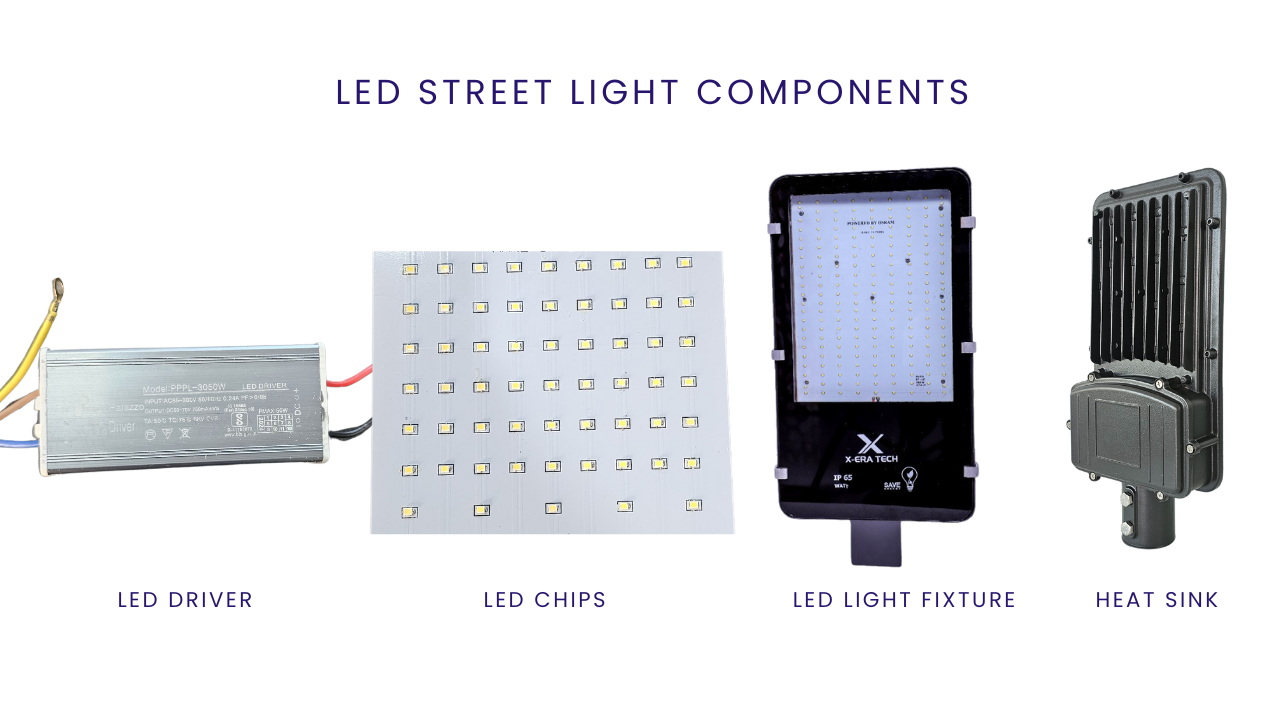
| Component | Function |
|---|---|
| LED Chips | Light source producing high-lumen output |
| LED Driver | Converts AC power to DC and regulates voltage |
| Optical Lens | Focuses and directs light efficiently |
| Heat Sink | Dissipates heat to prolong lifespan |
| Motion Sensors | Adjust brightness based on movement detection |
| Housing & Casing | Protects internal components from weather conditions |
| Surge Protector | Prevents damage from voltage fluctuations |
| Solar Panel (if applicable) | Generates electricity for off-grid LED street lights |
Advantages of LED Street Lights
- Consumes up to 70% less energy compared to high-pressure sodium lamps.
- Lasts between 50,000 to 100,000 hours, reducing maintenance costs.
- Produces bright, white light with a color temperature of 4000K–6000K, improving road visibility.
- Integrates with smart city technologies for adaptive lighting.
- No hazardous materials like mercury or lead.
Applications of LED Street Lights
- Urban and Residential Streets
- Highways and Expressways
- Parking Lots and Commercial Spaces
- Parks and Pathways
- Industrial and Warehousing Areas
Comparison: LED vs. Traditional Street Lights
| Feature | LED Street Lights | Traditional Street Lights |
|---|---|---|
| Energy Efficiency | High | Low |
| Lifespan | 50,000+ hours | 15,000-24,000 hours |
| Maintenance | Minimal | Frequent replacements needed |
| Light Output | High lumen per watt | Lower efficiency |
| Environmental Impact | No toxic materials, low CO2 emissions | Contains mercury, high carbon footprint |
| Smart Control Compatibility | Yes | No |
FAQs
Conclusion
LED street lights are the most advanced and efficient outdoor lighting solution available today. They provide energy savings, long lifespan, and superior lighting quality, making them ideal for roads, highways, and commercial areas. With smart controls and solar compatibility, LED street lights are shaping the future of sustainable urban lighting.
For high-quality LED street lights, XeraTech offers a range of solutions designed for maximum performance and energy efficiency.