



Regular Solar Street Lights
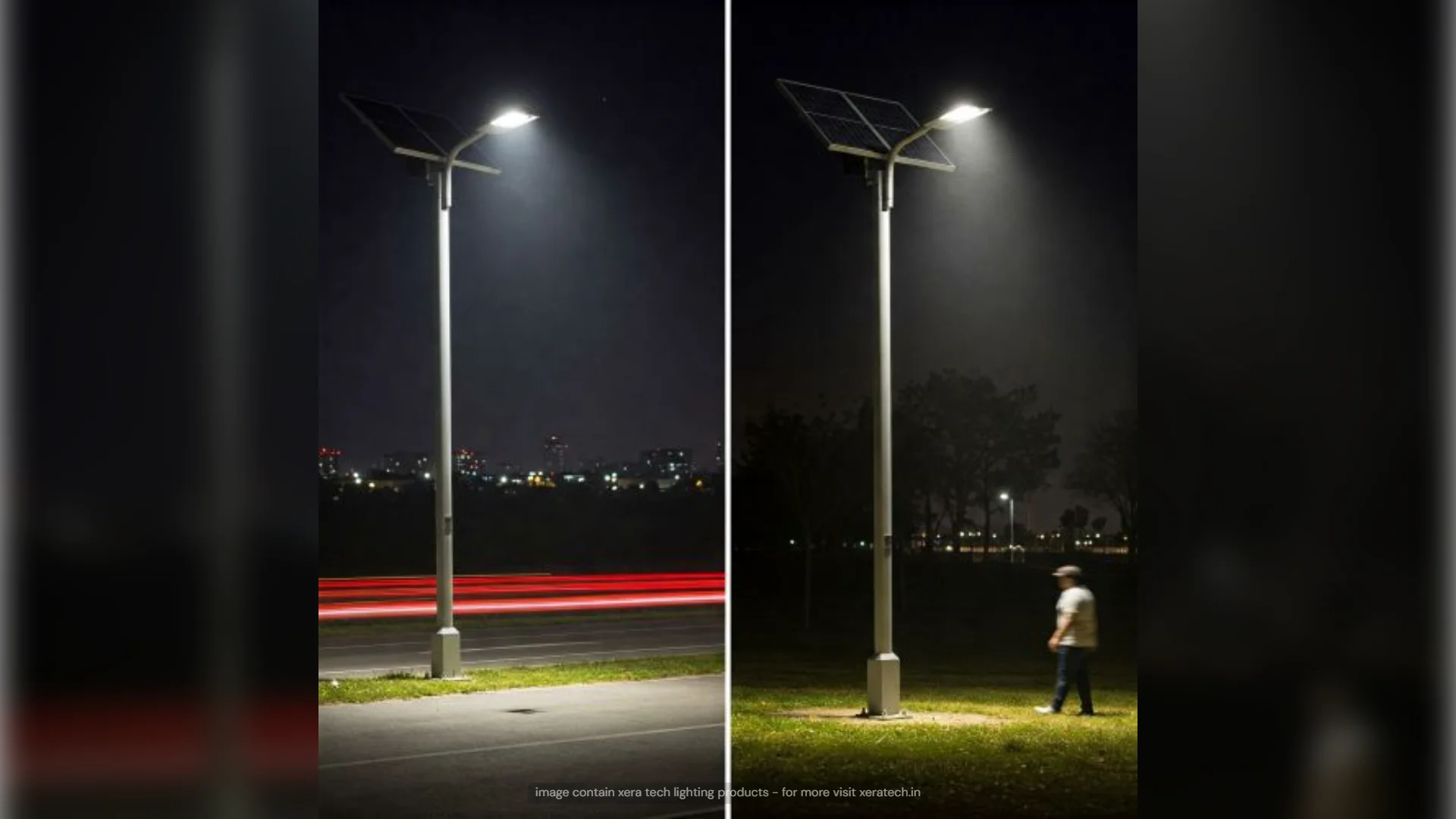
Regular solar street lights operate at a constant brightness level throughout the night. These lights are best suited for locations requiring continuous illumination, such as highways, main roads, and commercial areas.
- Continuous Operation: Lights stay on at full brightness all night.
- Higher Energy Consumption: Uses more battery power as there is no dimming or power-saving mode.
- Ideal for High-Traffic Areas: Perfect for places where constant lighting is needed, like highways, public streets, and security-sensitive zones.
- Increased Battery Drainage: Since it operates at full capacity, the battery discharges more quickly compared to motion sensor-based models.
- Frequent Maintenance: Due to higher power consumption, components such as the battery and LED chips may wear out faster.
Motion Sensor Solar Street Lights
Motion sensor-based solar street lights are designed to conserve energy by adjusting brightness based on movement detection. These lights remain dim when no activity is detected and switch to full brightness when motion is sensed.
- Smart Brightness Control: Lights remain dim in inactive periods and brighten only when motion is detected.
- Energy Efficiency: Reduces energy consumption by operating at full brightness only when needed.
- Best for Residential & Public Spaces: Ideal for parks, pathways, gardens, and low-traffic streets.
- Extended Battery Life: Since the light is not always running at full power, battery life is significantly prolonged.
- Low Maintenance: Requires fewer battery replacements and LED component maintenance.
Key Differences Between Regular and Motion Sensor Solar Street Lights
| Feature | Regular Solar Street Lights | Motion Sensor Solar Street Lights |
|---|---|---|
| Brightness Control | Full brightness throughout the night | Adjusts brightness based on movement |
| Energy Consumption | Higher due to continuous operation | Lower due to adaptive brightness control |
| Ideal Locations | Highways, public roads, security areas | Residential streets, parks, pathways |
| Battery Life | Shorter due to continuous drain | Longer as it uses energy only when needed |
| Maintenance | Frequent due to higher power usage | Less maintenance due to energy efficiency |
Conclusion
Both regular and motion sensor solar street lights have their unique advantages. Regular solar street lights provide continuous illumination, making them ideal for highways and security-sensitive areas. On the other hand, motion sensor solar street lights are more energy-efficient, reducing power consumption and extending battery life, making them perfect for residential streets, parks, and pathways.
Choosing the right type of solar street light depends on your specific needs. If you require constant lighting, go for regular models. If energy efficiency and smart functionality are priorities, motion sensor lights are the better choice.