Winter Challenges by Region
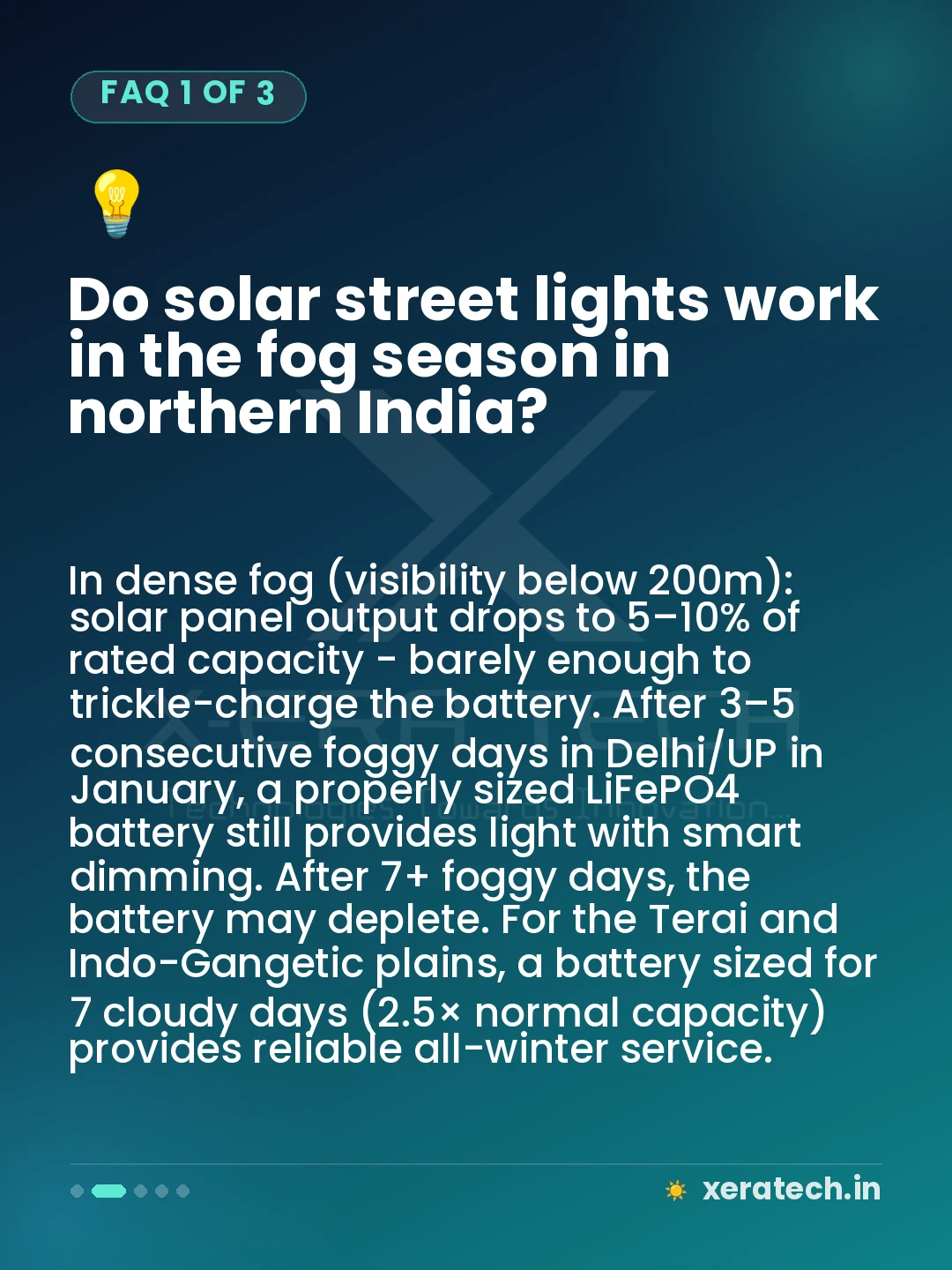
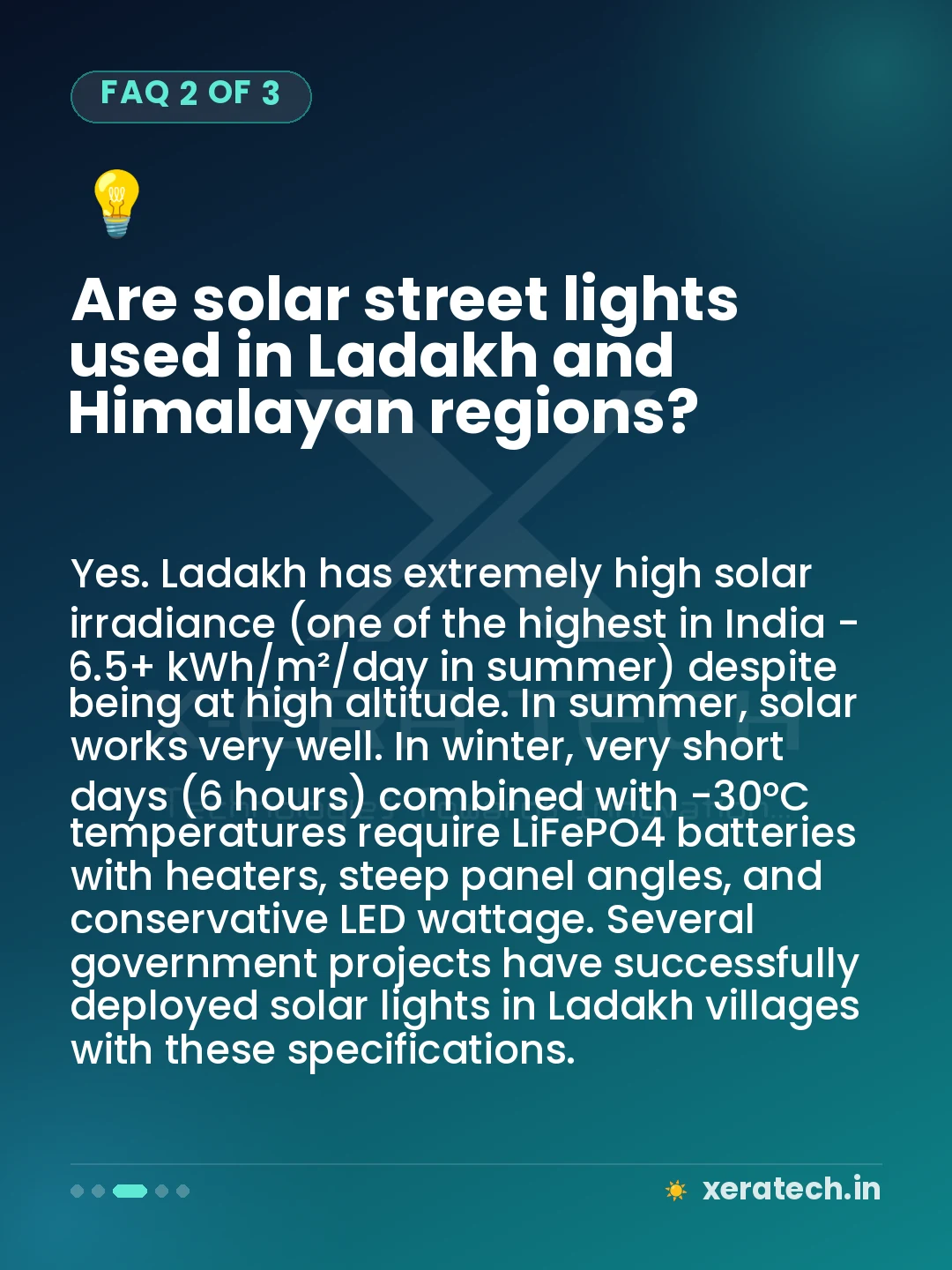
Maharashtra (Nashik, Pune, Aurangabad): minimal impact. Winter days are still 10+ hours, solar irradiance is actually excellent (clear skies), and temperatures rarely drop below 10°C at night. Battery performance is normal. Delhi, Rajasthan, UP, Bihar (plains): shorter days (9–10 hours) but good irradiance. Cold nights (-2° to -5°C minimum). LiFePO4 batteries discharge fine at these temperatures. Charging slows slightly below 0°C but this is rarely an issue for plains areas. Himachal Pradesh, Uttarakhand, J&K (mountains): 8–9 hour days, snow cover on panels (critical issue), temperatures dropping to -15° to -25°C. Lead-acid batteries fail at these temperatures. LiFePO4 with heated battery box is needed. Northeast India (Assam, Meghalaya): short winter days + heavy fog significantly reduces solar irradiance.
How Short Days Affect Battery Charge
A solar street light needs: LED consumption × operating hours = panel harvest. In winter at 28°N (Delhi): 9 hours of daylight, of which effective charging time (sun above 20° elevation) ≈ 7 hours. A 40W panel harvests: 7h × 40W × 0.85 (system efficiency) = 238 Wh. A 20W LED running 12 hours needs: 20W × 12h = 240 Wh. This is tight - the system just barely balances. With smart dimming (50% from midnight to 5am): 20W × 5h + 10W × 7h = 170 Wh. Now there is comfortable margin. In summer at the same location: 10+ effective hours, harvesting 340+ Wh - comfortable surplus for battery health.
Design Tips for Northern and High-Altitude Projects
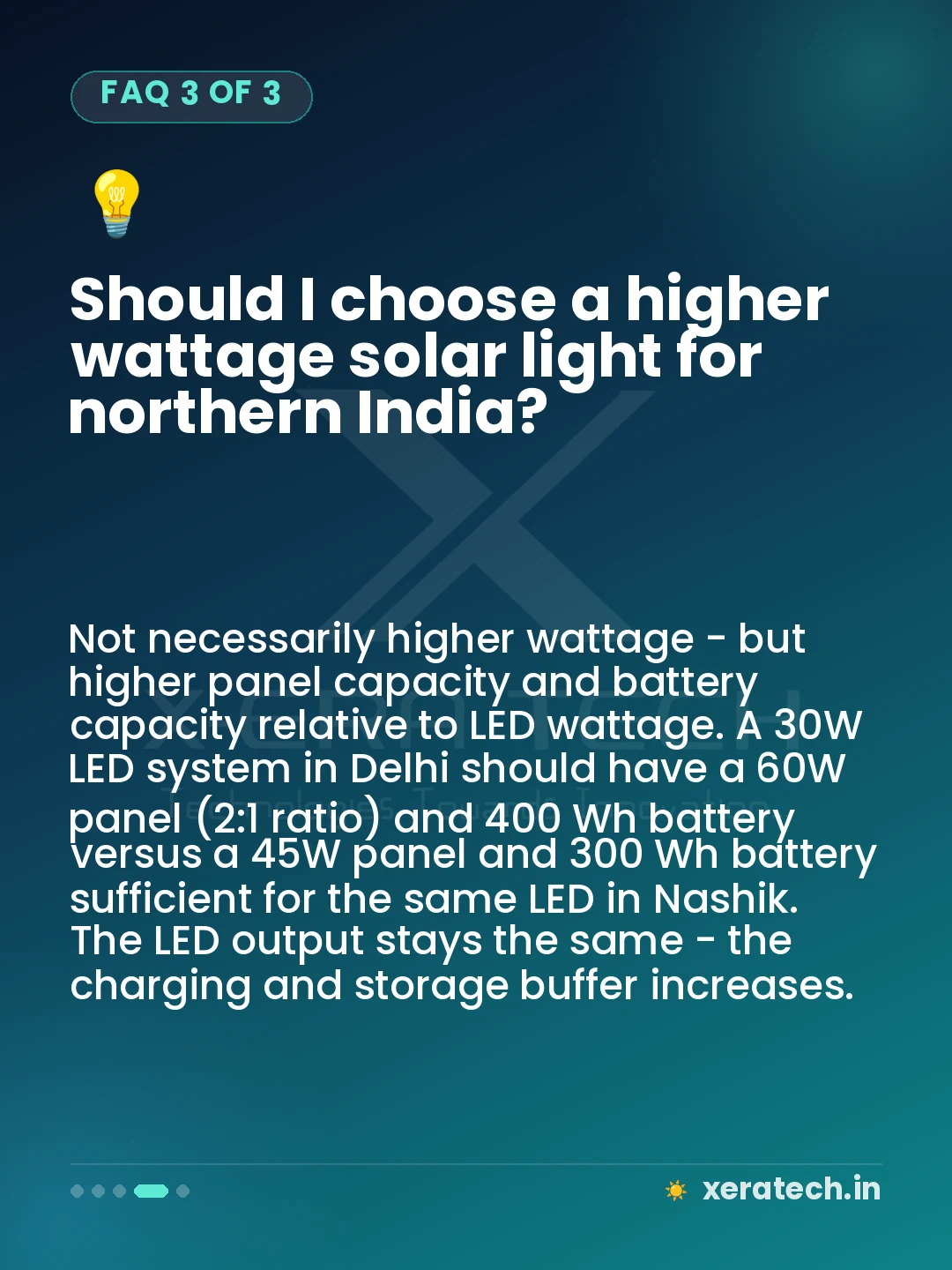
Increase panel-to-LED ratio: use 60W panel for 30W LED (2:1 ratio) instead of the usual 1.5:1. This provides more charging buffer on short winter days. Increase battery capacity by 30%: a 360 Wh battery instead of 280 Wh provides more storage for consecutive short-day periods. Steeper panel tilt: at Delhi (28°N), a winter tilt of 43° (latitude + 15°) significantly improves winter output. For fixed installations, 35° is a good compromise. For high altitude (above 2,000m): specify LiFePO4 battery with built-in heater circuit - batteries do not charge efficiently below 0°C. Heated battery systems draw a small amount of stored energy for self-warming before accepting charge.
Snow on Solar Panels
For Himachal Pradesh, Uttarakhand, and J&K projects: snow accumulation on the panel completely blocks generation. Design solutions: steep panel tilt (45°+) allows snow to slide off naturally. Hydrophobic panel surface coatings repel snow adhesion. Regular manual cleaning after snowfall (include this in maintenance contract). Alternatively: use semi-integrated design with the panel mounted at a very steep angle on a separate arm, ensuring self-shedding. In extreme snowfall areas (Rohtang Pass, Zoji La): grid-tied hybrid systems are more practical than pure solar - solar supplements in summer, grid provides in winter.