
Why Developers Choose Solar
No electricity bill for maintenance: housing societies taking over a plotted development with solar street lights have zero common area lighting cost - a powerful selling point in a market where society maintenance charges are a buyer concern. No DISCOM connection required for internal roads: eliminates the DG application, metering, and connection delays that hold up projects. Faster possession handover: solar lights can be installed and handed over independently of grid connection status. Sustainability certification: solar street lights contribute to IGBC Green Township or GRIHA 4-star rating points. RERA compliance: solar street lighting is explicitly acceptable as a common amenity for RERA project registration.
Specification Recommendations for Residential Projects
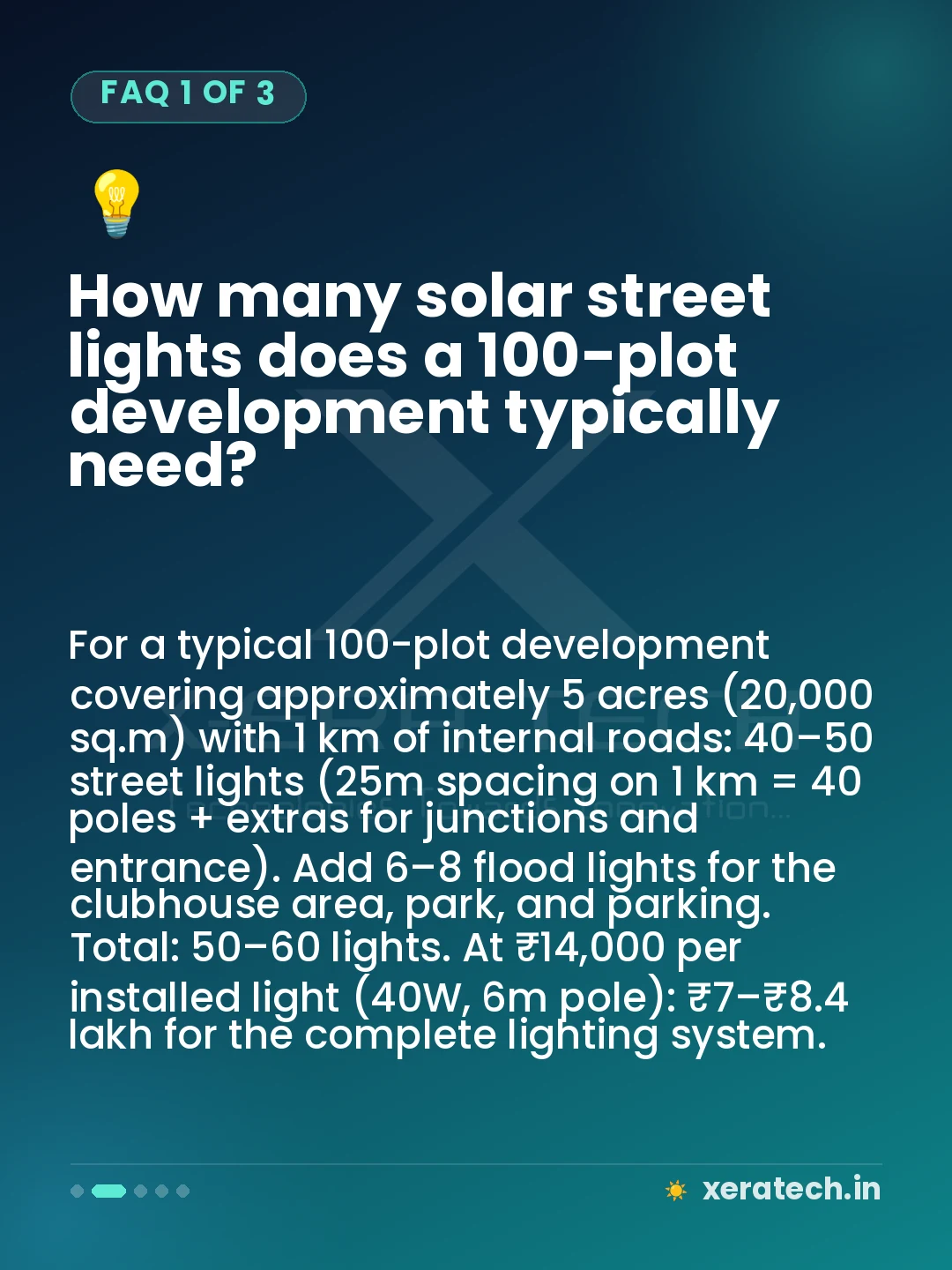
Main entrance road (10m+ wide): 60W LED on 7m decorative pole, 30m spacing, staggered. Internal colony roads (6–8m): 40W LED on 6m pole, 25m spacing. Amenity areas (clubhouse, park, parking): 40–60W solar flood lights on wall or dedicated pole. Footpaths and garden paths: 10–20W bollard lights, 4m spacing. Corner plots and T-junctions: additional point over and above the regular spacing. Heritage or themed development: use Xera Tech's designer pole range - swan neck, modern geometric, or colonial lantern styles as appropriate for the project theme.
Lifespan and Handover Considerations
A common developer concern: what is the maintenance responsibility after handover? Answer: with LiFePO4 batteries, no battery replacement for 7–10 years. With quality LED chips, no lamp replacement for 15 years. The only ongoing maintenance is annual cleaning (by the society's maintenance staff) and visual inspection. At handover: provide the society with: commissioning report for each pole, warranty certificates in the society's name, controller user manuals, and basic maintenance training for the maintenance staff. Include an optional AMC from Xera Tech for the first 3 years - buyers and societies appreciate knowing a manufacturer-backed service is available.
RERA and GRIHA Compliance
Under RERA (Real Estate Regulation and Development Act): solar street lights are an acceptable electrical common amenity. Declare them in the project brochure, agreement for sale, and RERA registration. The specification (wattage, pole height, spacing, brand) declared in the RERA registration must match what is installed - non-compliance is a RERA violation. GRIHA (Green Rating for Integrated Habitat Assessment) and IGBC Green Township: both give points for renewable energy use in common area infrastructure. Solar street lights covering 100% of the project's common area lighting typically earn 3–5 GRIHA points, which contribute to the overall rating.