Myth 1–3: Performance Myths
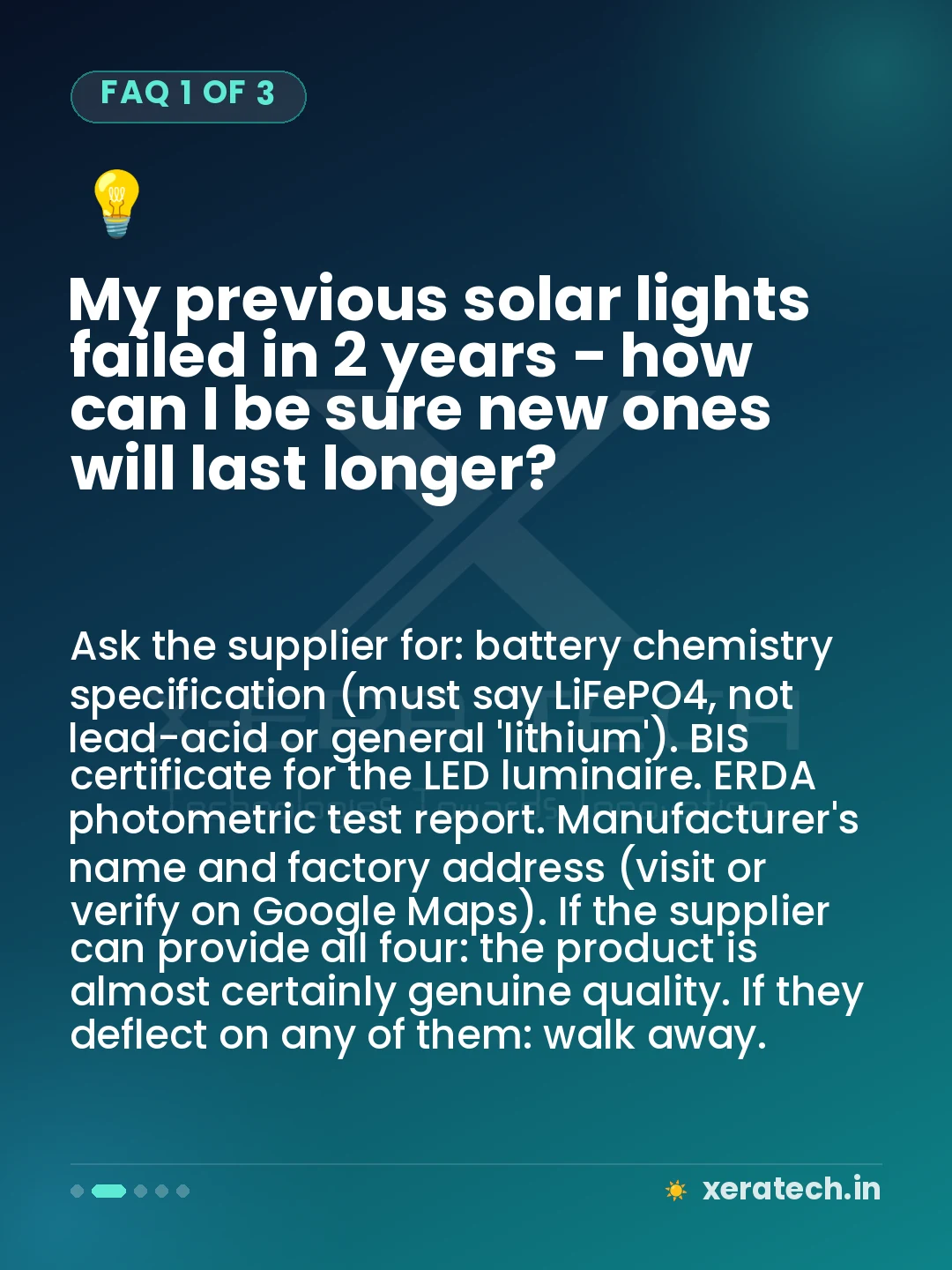
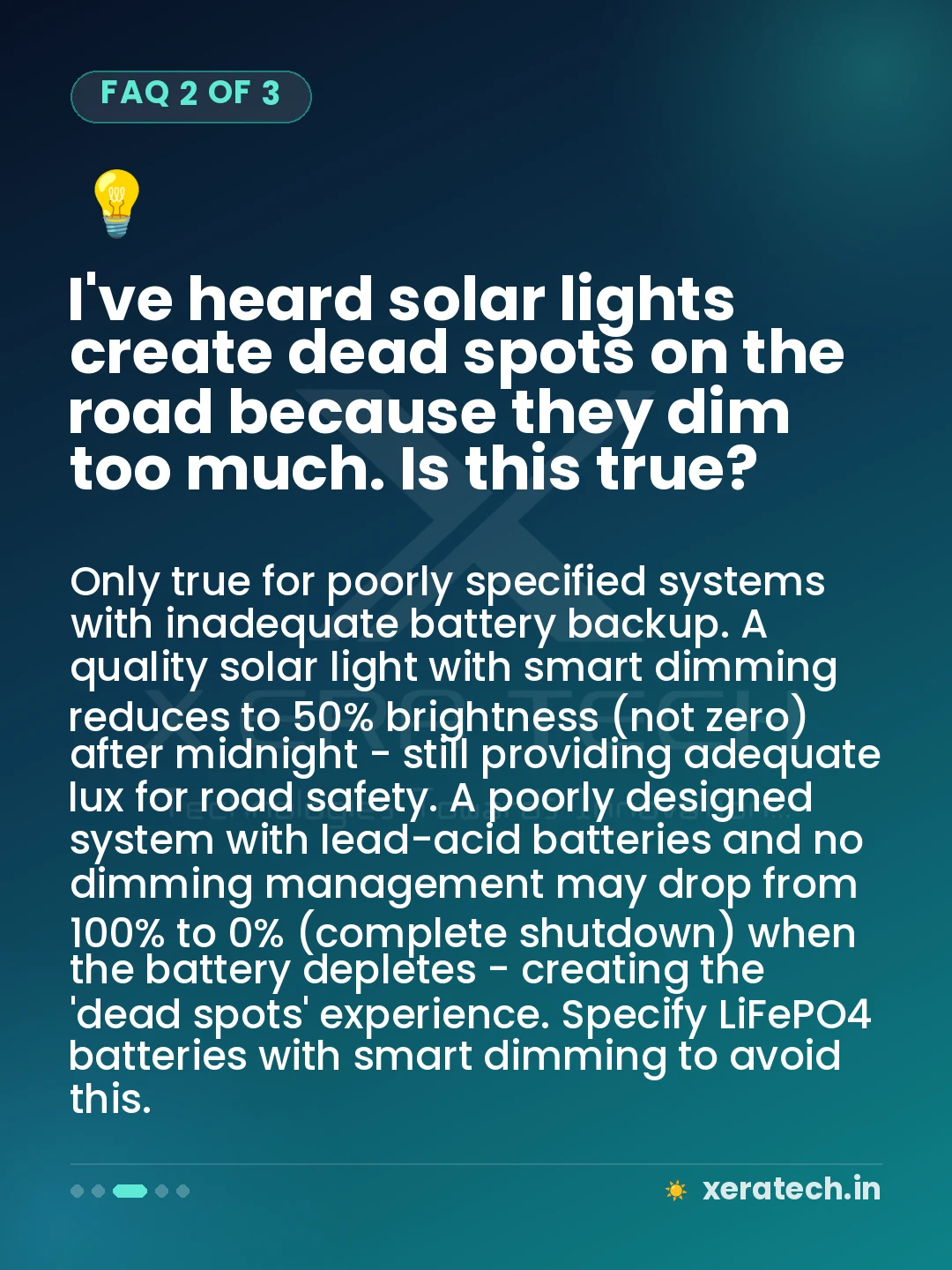
Myth 1 - 'Solar lights don't work in monsoon': FALSE. Modern LiFePO4 batteries store 3–5 days of backup. Smart dimming extends this to 7+ days. A properly designed solar light works through the entire Maharashtra monsoon. What IS true: cheap lead-acid battery solar lights fail in monsoon - and this experience gave solar street lights a bad reputation. Myth 2 - 'Solar lights are dim compared to grid lights': FALSE for quality products. A quality 40W solar LED produces 5,200+ lumens - identical to a 40W grid LED. What IS true: cheap solar lights use underpowered LEDs (20W falsely marketed as 40W) that are indeed dim. Myth 3 - 'Solar lights only last 2–3 years': FALSE for quality products. LED chips last 50,000+ hours. LiFePO4 batteries last 7–10 years. What IS true: lead-acid battery solar lights typically fail in 2–3 years - and this experience is widespread in India.
Myth 4–6: Safety and Technology Myths
Myth 4 - 'Solar light batteries catch fire': FALSE for LiFePO4 chemistry. Lithium Iron Phosphate batteries are the most thermally stable lithium chemistry - they cannot catch fire or explode even in severe abuse conditions. What IS true: standard lithium-ion (NCM/NCA) batteries found in phones and laptops CAN catch fire - this is a different chemistry from LiFePO4. Always verify your solar light uses LiFePO4. Myth 5 - 'The solar panel will blow off in a storm': FALSE if correctly installed. A properly anchored panel on a structurally calculated pole handles IS 875 design wind speeds. What IS true: incorrectly installed panels (loose bolts, wrong orientation) can fail in storms - reinforcing the need for professional installation. Myth 6 - 'Solar lights attract lightning': FALSE. Solar panels are no more lightning-attractive than any other metal structure. The earthing system of a properly installed pole protects against lightning strikes.
Myth 7–10: Cost and Policy Myths
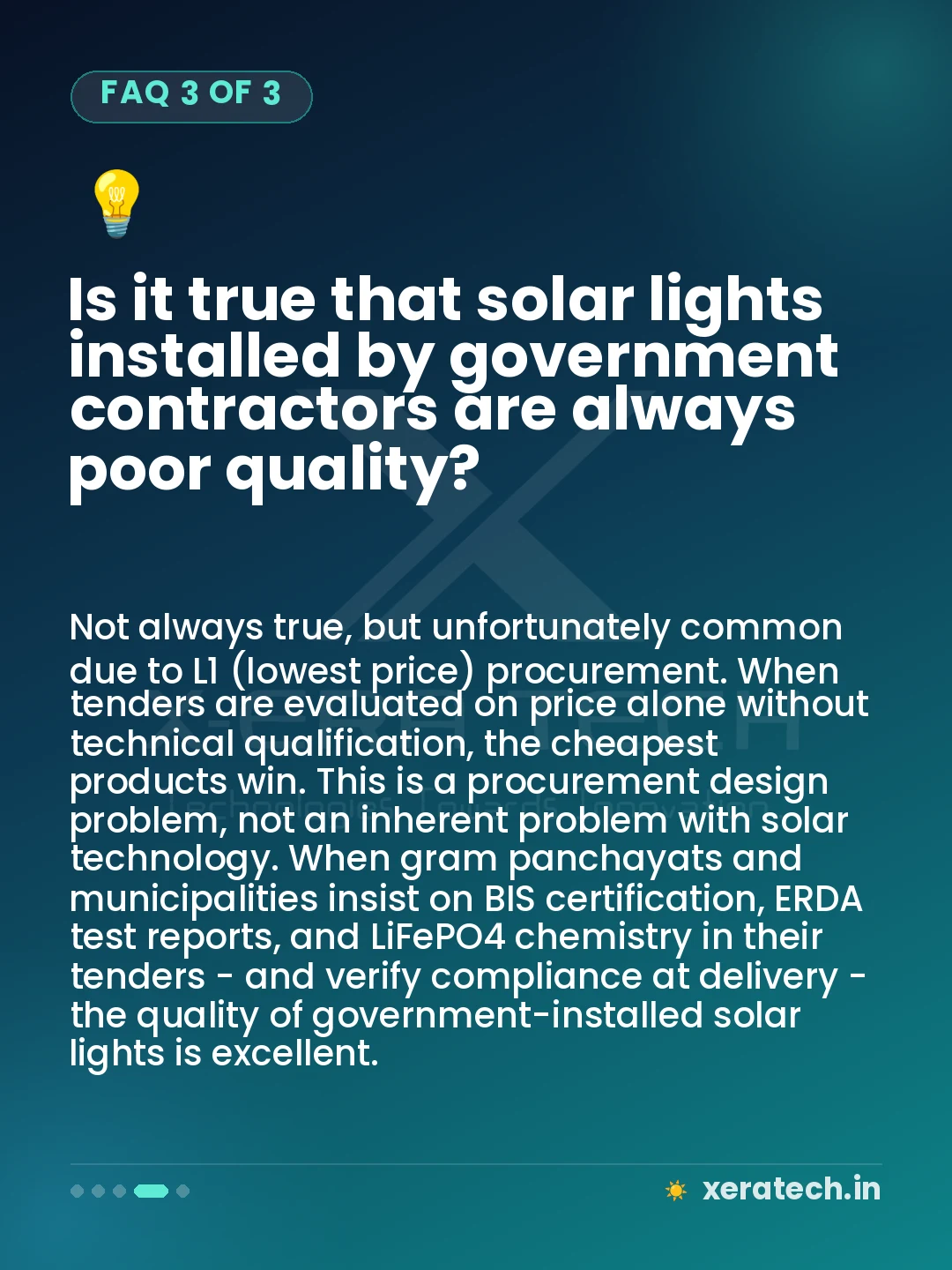
Myth 7 - 'Solar lights are too expensive': Partly true for upfront cost, FALSE for total cost. Over 10 years, solar is typically cheaper than grid lighting for new rural roads when infrastructure costs are included. Myth 8 - 'Only the government can get subsidy for solar lights': FALSE. Housing societies, trusts, and registered organisations can access MNRE and state schemes. CSR-funded projects can also benefit from scheme pricing. Myth 9 - 'All solar lights are the same - just buy the cheapest': FALSE and dangerous. The quality spectrum is wider for solar lights than almost any other product - from 18-month failures to 15-year performers. Myth 10 - 'Local repair shops can fix solar street lights': Partially true for simple repairs (cleaning, fuse replacement). FALSE for controller and battery issues - incorrect repair attempts (wrong battery chemistry, PWM controller replacing MPPT) cause permanent damage.