What Makes a Street Light 'Smart'?
A smart street light has these additional features beyond a standard LED: (1) SCADA/CMS (Central Management System) - allows central monitoring and individual control of each light remotely. (2) Individual addressing - each luminaire has a unique ID, allowing fault detection at pole level. (3) Adaptive dimming - automatically dims to 50% after midnight or when traffic sensors detect low activity. (4) Fault alerts - instant SMS/app notification when a light fails. (5) Energy metering - real-time power consumption data per pole. (6) Photocell override - remote dawn/dusk time adjustment without site visits.
Communication Technologies Used
GPRS/4G: most common in India - each pole has a SIM-based controller reporting to a cloud platform. Cost: ₹150–₹200/month per pole for data. ZigBee Mesh: pole-to-pole wireless mesh, no per-pole SIM cost, but requires a gateway every 500m. LORAWAN: long-range, low-power - good for large cities with central gateway. PLC (Power Line Communication): data transmitted over the existing mains cable - no new wiring needed but more susceptible to interference. For most Indian municipalities, GPRS/4G or ZigBee is the practical choice in 2026.
Energy Savings from Smart Dimming
A typical smart dimming schedule: 6pm–11pm: 100% brightness (peak traffic). 11pm–5am: 50% brightness (low traffic). 5am–6am: 100% brightness (morning traffic). Dimming energy saving: ~35% reduction in night energy consumption. For a city with 10,000 street lights averaging 40W: Annual energy with smart dimming = 10,000 × 40W × 10h × 0.70 efficiency × 365 = 10.22 million units. Without smart dimming = 14.6 million units. Annual saving: 4.38 million units × ₹7 = ₹3.07 crore per year.
Smart City Lighting - How Municipalities Can Implement
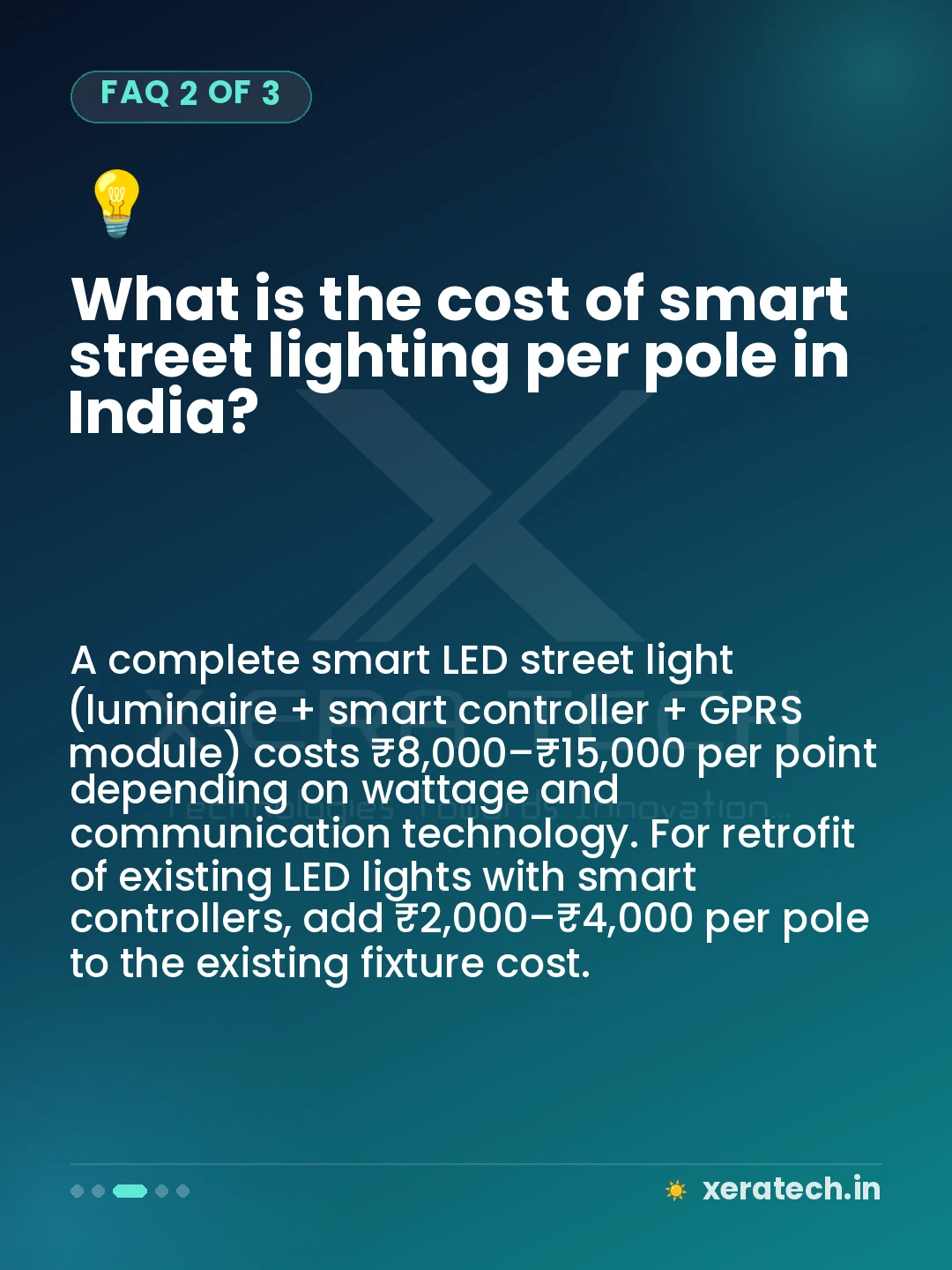
Phase 1: Upgrade all lights to LED (if not already done). Phase 2: Install smart controllers on each pole - retrofit options exist for existing LED fixtures. Phase 3: Set up central command centre with SCADA software. Phase 4: Commission communication network (GPRS or mesh). Phase 5: Train municipal engineers on the CMS dashboard. Phase 6: Set automated dimming schedules and fault alert thresholds. Cost of smart retrofit: ₹1,500–₹3,000 per pole for controller + communication module, beyond the LED fixture cost. Payback via energy savings: typically 2–3 years.