Balancing Safety, Aesthetics, and Cost
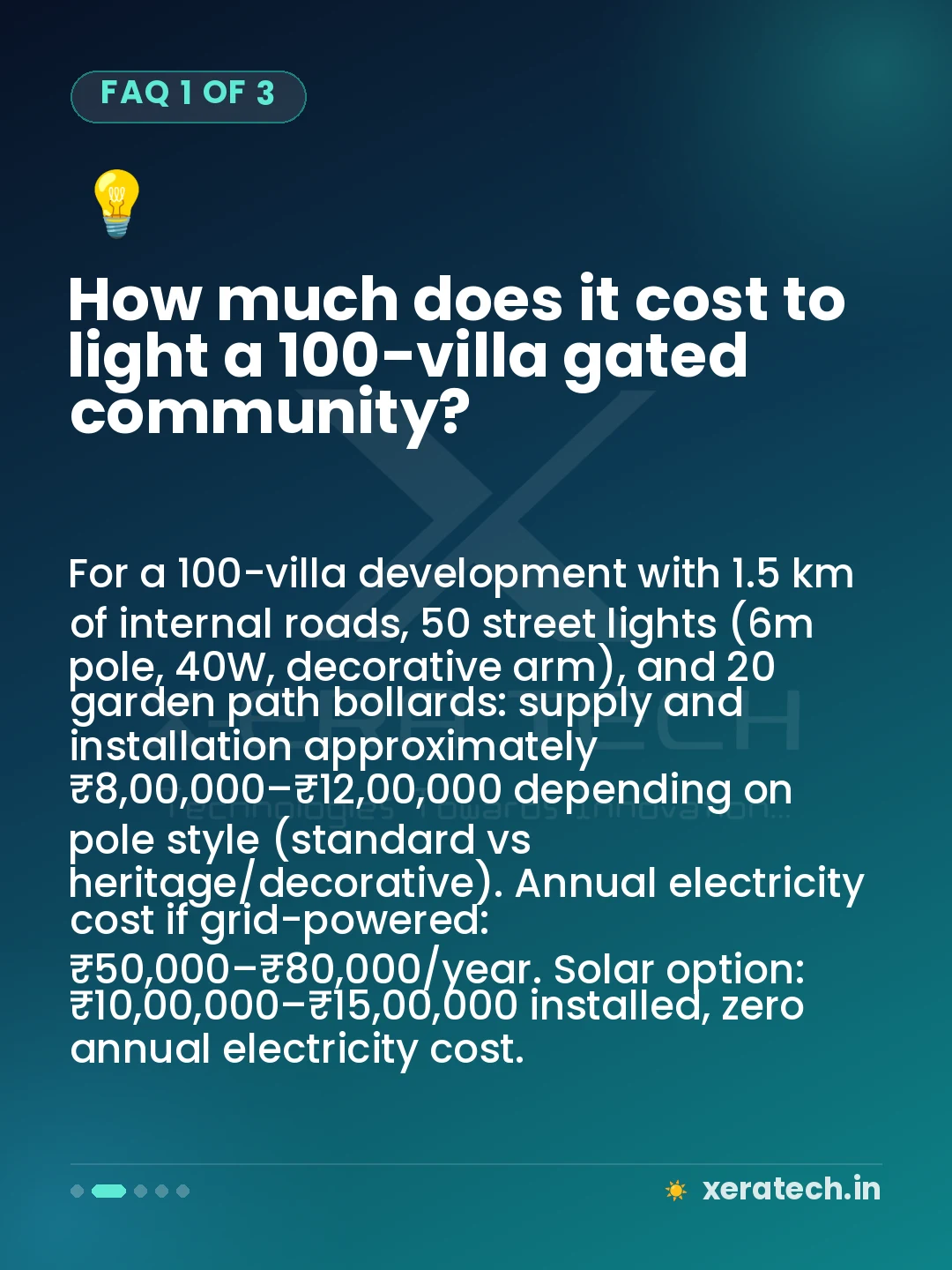
Gated community lighting must achieve three goals simultaneously: Safety: sufficient lux on roads and pathways for residents walking, cycling, and driving after dark. Aesthetics: lighting that enhances the property ambience rather than looking industrial. Cost: manageable electricity or maintenance cost for the residents association. These three goals are often in tension - an industrial 150W flood light achieves safety but fails aesthetically. A purely decorative bollard achieves aesthetics but fails safety. The correct approach: functional LED street lights (30–40W) on aesthetic poles for roads, supplemented by lower-lumen decorative elements (bollards, garden lights) for pathways and green areas.
Pole and Fixture Style Recommendations
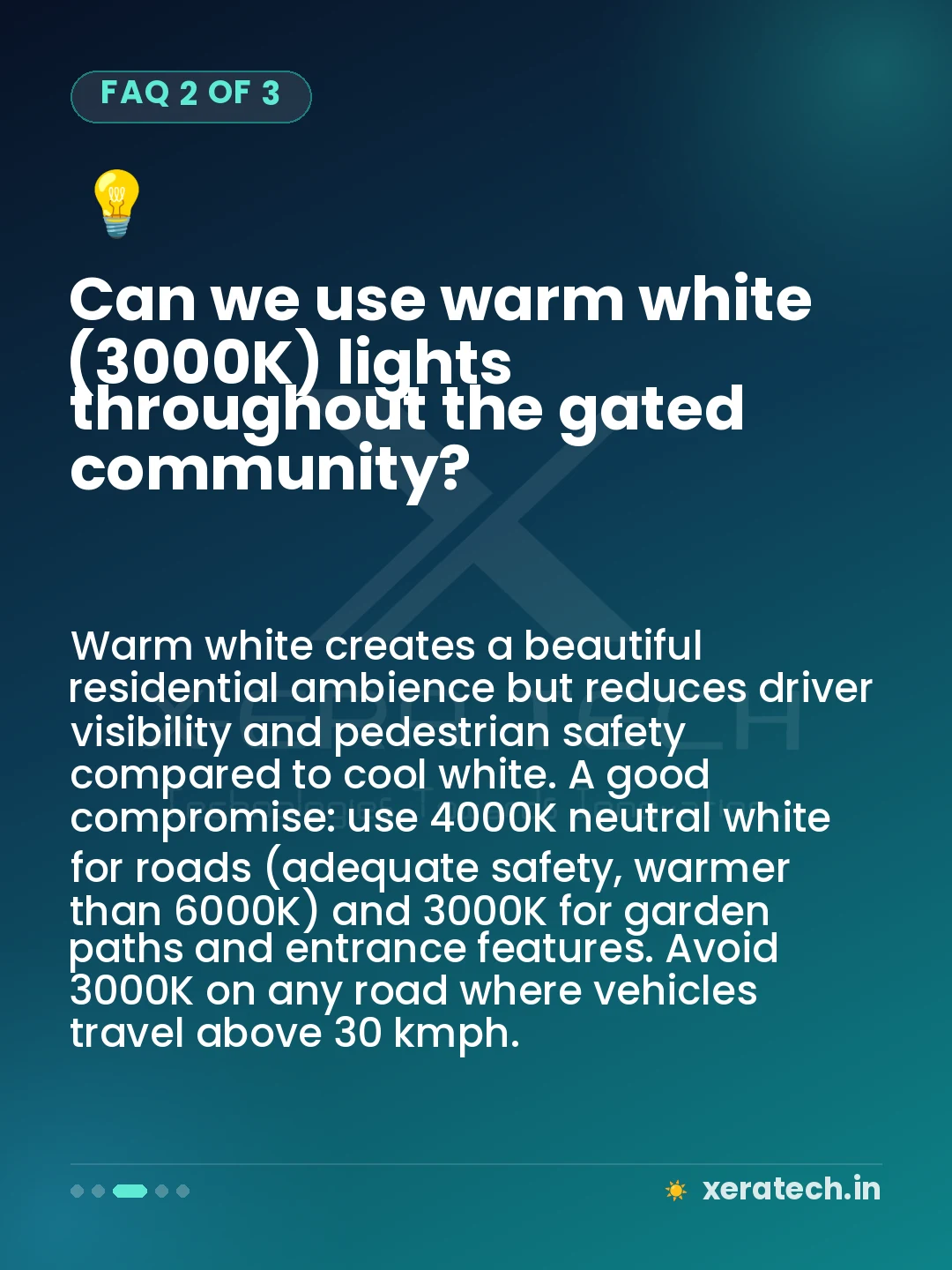
Premium villa/farmhouse estate: swan neck cast iron or powder-coated steel poles with lantern-style globe fittings. Warm white (3000–4000K) for entrance road. Cool white (5000K) for internal roads. Modern township: contemporary geometric single-arm poles, stainless steel or anthracite powder coat. 4000–5000K. Eco/nature-themed development: FRP (rust-free) or hot-dip galvanised MS poles with naturalistic finishes. Warm white (3000K) on garden paths. Budget plotted development: standard GI pole with a decorative single-arm bracket. Focus on lux performance over aesthetics. Mix of 5000K for roads and 3000K for the main entrance creates a welcoming transition.
Solar vs Grid for Gated Communities
Advantages of solar in gated communities: no electricity bill for street lighting (direct reduction in society maintenance charges). Works during power cuts - important for societies in areas with load shedding. No cable trenching through finished landscape/paving. Advantages of grid: consistent 100% brightness all night regardless of season. No battery aging concerns. Suitable for areas with shade from large mature trees. Common hybrid: solar for internal roads and garden paths, grid for main entrance and high-traffic areas where maximum reliability is essential.
Society Approval Process
For new installations in an existing gated community: managing committee resolution is required (typically a simple majority vote). For changes to existing lighting: include in the AGM agenda or call an EGM if the cost exceeds the committee's single-decision limit (check bye-laws). For RERA-registered communities: any change from the declared common amenity specification requires general body approval and RERA amendment if significant. Budget: include in the annual maintenance budget or create a specific reserve for the lighting upgrade. Multiple quotations from BIS-certified suppliers are recommended for any order above ₹1 lakh.