
Lux and CRI Requirements for Textile
IS 3646 Part 2 and international textile lighting standards specify: Weaving and knitting machines: 500–750 lux, CRI ≥ 80. Fabric inspection and colour matching: 1,000–2,000 lux, CRI ≥ 90 (or CRI ≥ 95 for colour-critical fashion fabrics). Cutting and sewing: 500–750 lux, CRI ≥ 80. Embroidery and finishing: 750–1,000 lux, CRI ≥ 85. Yarn storage and general warehouse: 200–300 lux, CRI ≥ 70. Packing and dispatch: 300–500 lux, CRI ≥ 70. The CRI requirement is higher in textiles than almost any other industry - a fabric that appears perfectly matched under CRI 70 light may show a clear mismatch in daylight (CRI 100). Customer returns due to colour mismatch are directly linked to inadequate CRI in inspection lighting.
Flicker-Free Requirement
Textile machines (looms, knitting machines) operate at high speeds - some components move at 500–3,000 RPM. If the LED light flickers at a frequency that coincides with the machine speed, the machine can appear stationary (stroboscopic effect) - making it impossible to detect machine faults and causing serious injury risk. Requirement: LED lights in textile factories must have flicker index below 0.1 and percent flicker below 5% at 100Hz (Modulation Index). This requires a quality LED driver with low-ripple output and Power Factor Correction (PFC). Ask for the flicker test report when specifying factory lighting.
Light Source Spectrum for Colour Accuracy
Colour rendering accuracy depends on the light source spectrum. For colour-critical textile work: 5700–6500K colour temperature most closely approximates daylight. CRI ≥ 90 ensures red, blue, and yellow textile dyes render accurately. R9 (saturated red rendering) ≥ 50 is important for fashion and saree fabrics - red is the most commonly mis-rendered colour under poor-CRI lights. For standard garment manufacturing with less colour-critical work: CRI ≥ 80 at 5000–5700K is adequate and more cost-effective.
Energy Savings in Textile Factories
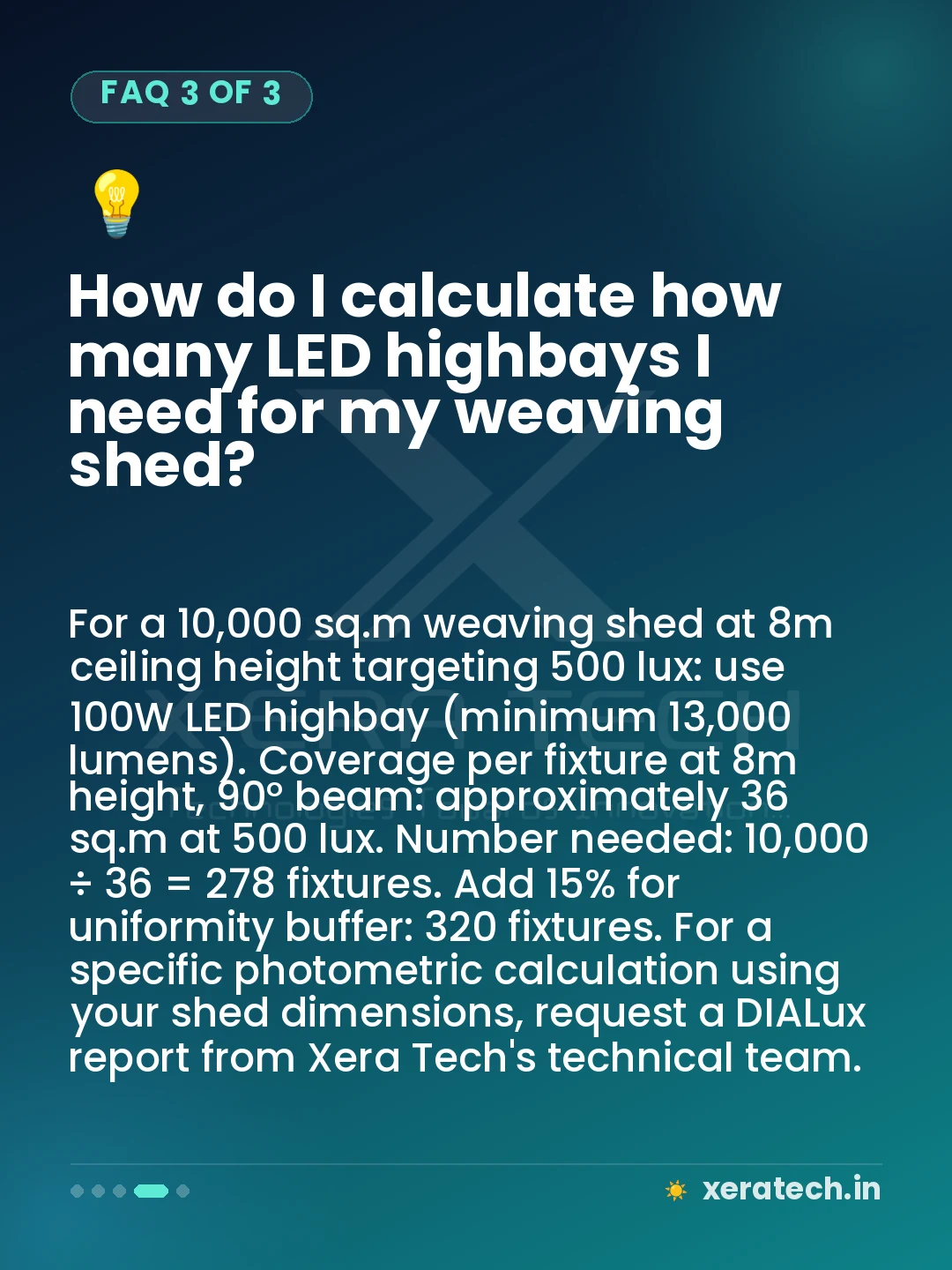
Indian textile mills are among the highest industrial electricity consumers. A 10,000 sq.m weaving shed with 200 × 400W metal halide fixtures running 2 shifts (16h/day): current consumption = 200 × 400W × 16h × 300 days = 384,000 kWh/year = ₹26.88 lakh/year at ₹7/unit. After LED upgrade (200 × 150W LED highbay, CRI 80): 200 × 150W × 16h × 300 = 144,000 kWh/year = ₹10.08 lakh/year. Annual saving: ₹16.8 lakh. Investment: 200 × ₹7,000 = ₹14 lakh. Payback: under 10 months. For the colour inspection area: use 100W CRI 95 LED panels for 1,000 lux - a small fraction of total luminaires but critical for quality.