The Scale of the Opportunity
India has approximately 6 lakh (600,000) villages, with an estimated 25–40 million street light points needed for full coverage of village roads. Current deployment: approximately 8–10 million solar and LED street lights installed as of 2026. Remaining gap: 15–30 million points. At 40W average per point: 30 million × 40W × 10h × 365 = 4.38 billion kWh/year of avoided grid electricity demand. At India's emission factor (0.716 kg/kWh): 3.13 million tonnes of CO₂ per year avoided if the full gap were filled with solar - equivalent to removing 675,000 petrol cars from the roads permanently.
India's NDC and Solar Street Lights
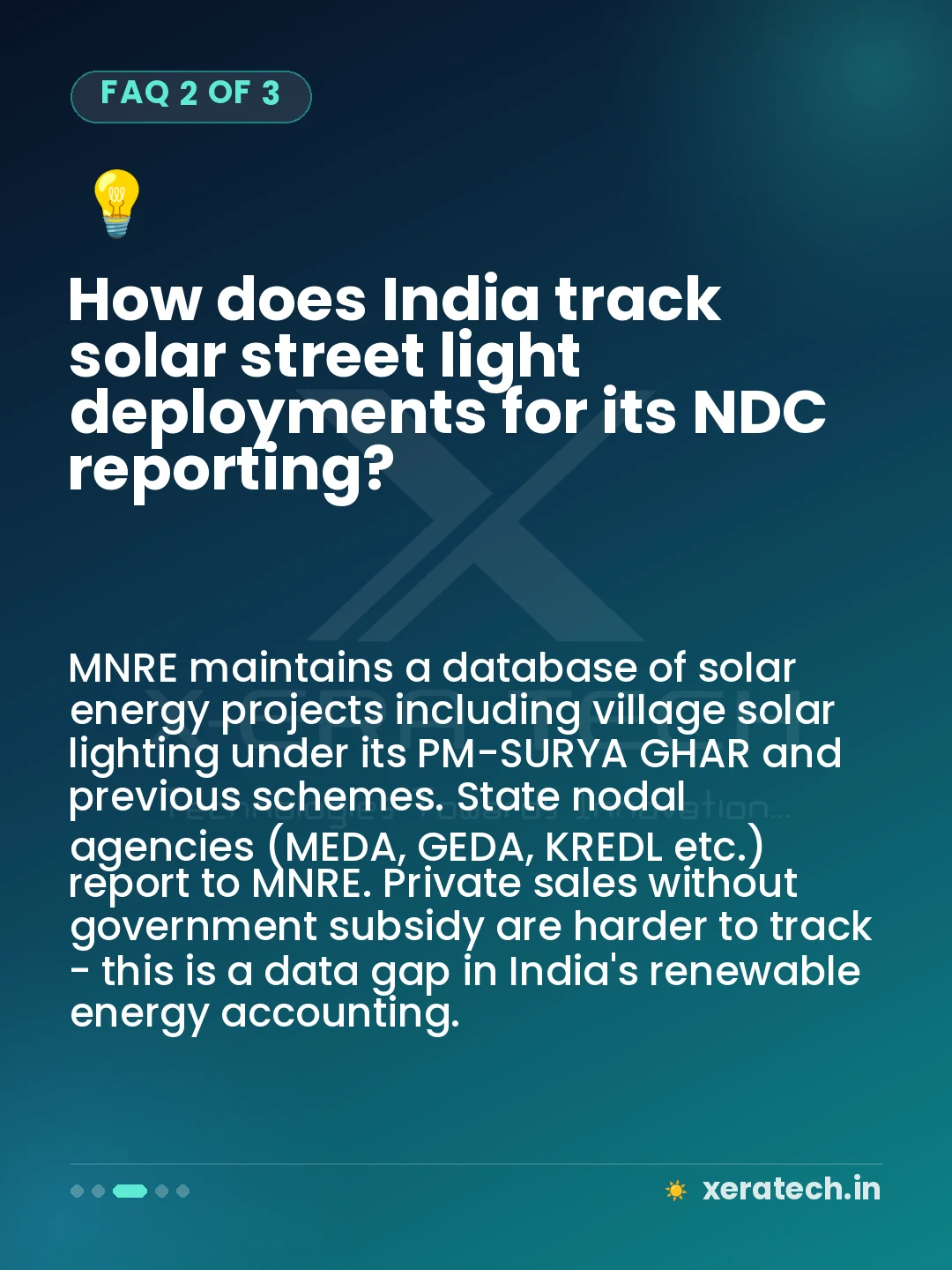
India's Nationally Determined Contributions (NDC) under the Paris Agreement include: 50% of cumulative electric power capacity from non-fossil fuel sources by 2030. Reduction of emissions intensity of GDP by 45% from 2005 levels by 2030. Net zero by 2070. Rural solar street lights contribute directly to all three: non-fossil capacity (solar panels), emissions intensity reduction (replacing grid electricity), and the long-term 2070 pathway. The Ministry of New and Renewable Energy (MNRE) tracks solar street light deployments as part of India's NDC progress reporting.
Carbon Credits and Solar Street Lights
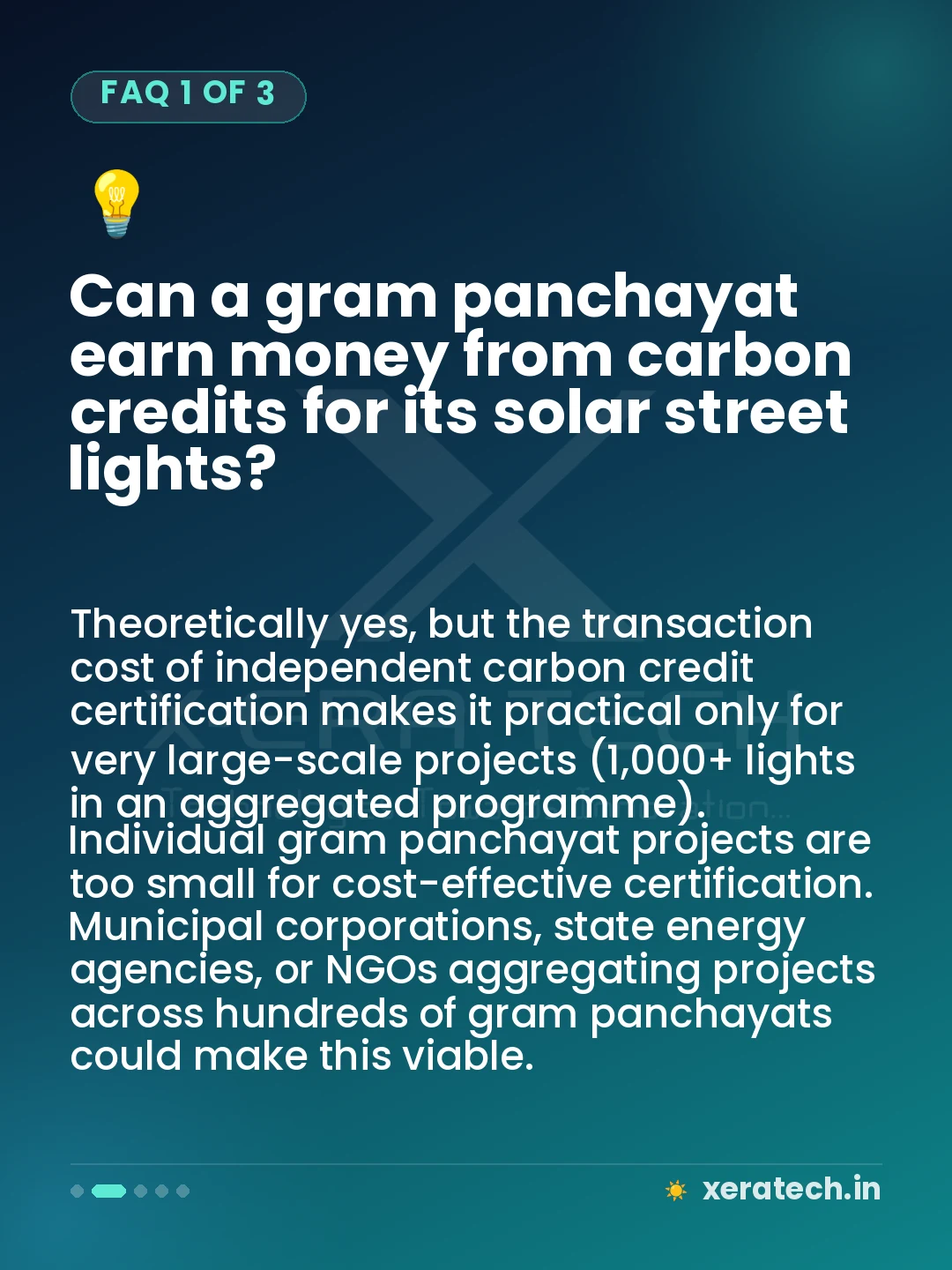
Large-scale solar street light projects can generate voluntary carbon credits under the Gold Standard or Verra (VCS) framework. Calculation: measured electricity savings × CEA emission factor = tonnes of CO₂ equivalent avoided. For projects of 1,000+ lights in a single geographic area, the aggregated carbon volume may justify the third-party verification cost (₹5–15 lakh for project registration and first verification). Carbon credit price: voluntary market credits trade at USD 5–40 per tonne (₹400–₹3,300 per tonne). For 10,000 lights saving 4,380 tonnes/year: at ₹1,000/tonne = ₹43.8 lakh additional revenue per year. This could make large gram panchayat cluster projects financially self-sustaining through carbon revenue.
What Manufacturers Like Xera Tech Contribute
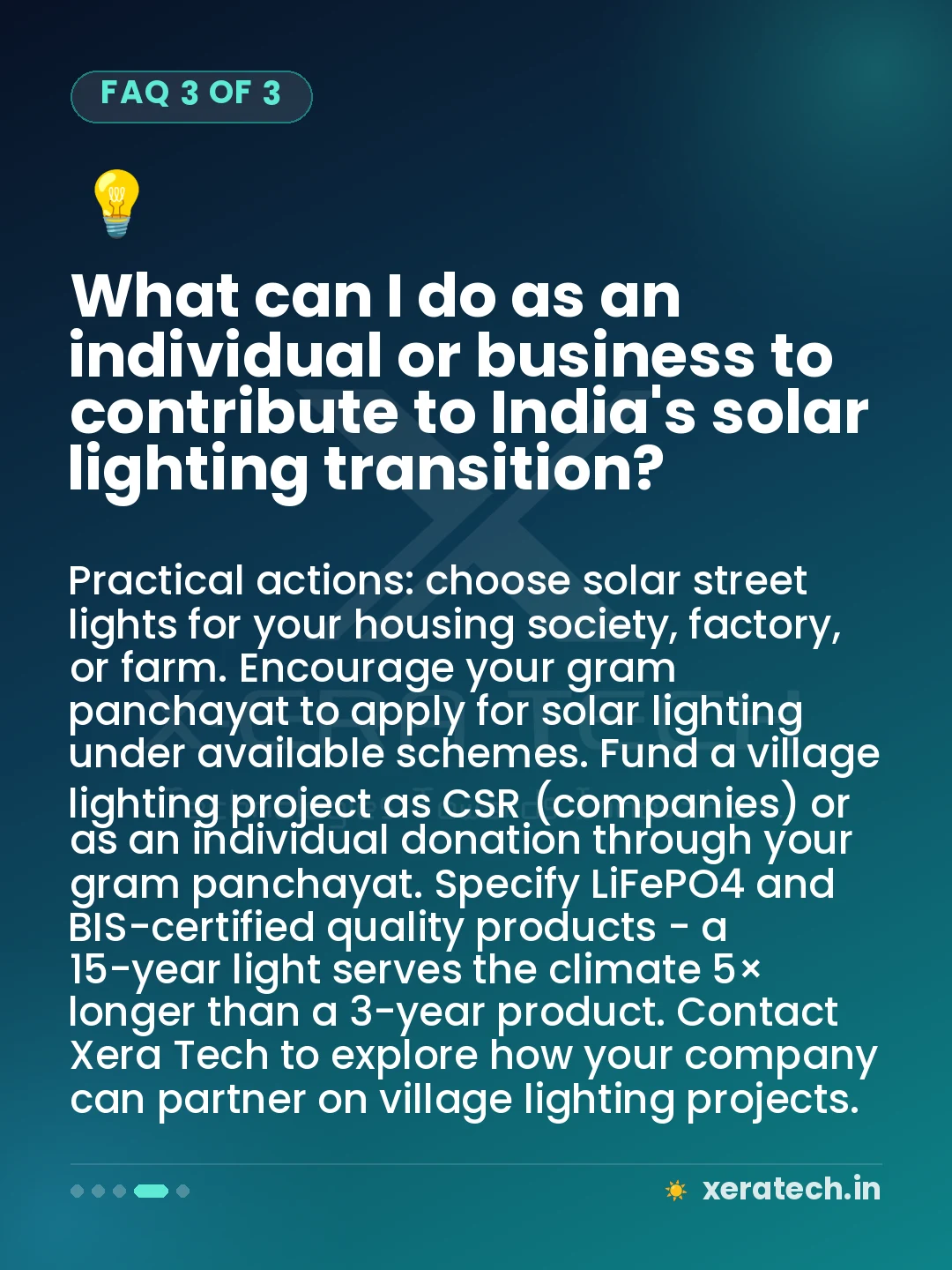
Every quality solar street light manufactured and deployed is a concrete, long-term carbon reduction asset. Unlike renewable energy projects that need transmission infrastructure, each solar street light is a direct, local carbon reducer - generating at the point of use, eliminating both the electricity cost and the transmission loss (which adds another 15–20% to grid electricity's effective carbon footprint). Xera Tech's mission aligns directly with India's climate goals: manufacturing quality solar lights that last 15+ years, supporting deployment across Maharashtra and beyond, and ensuring that India's rural lighting transition delivers lasting rather than short-lived impact.