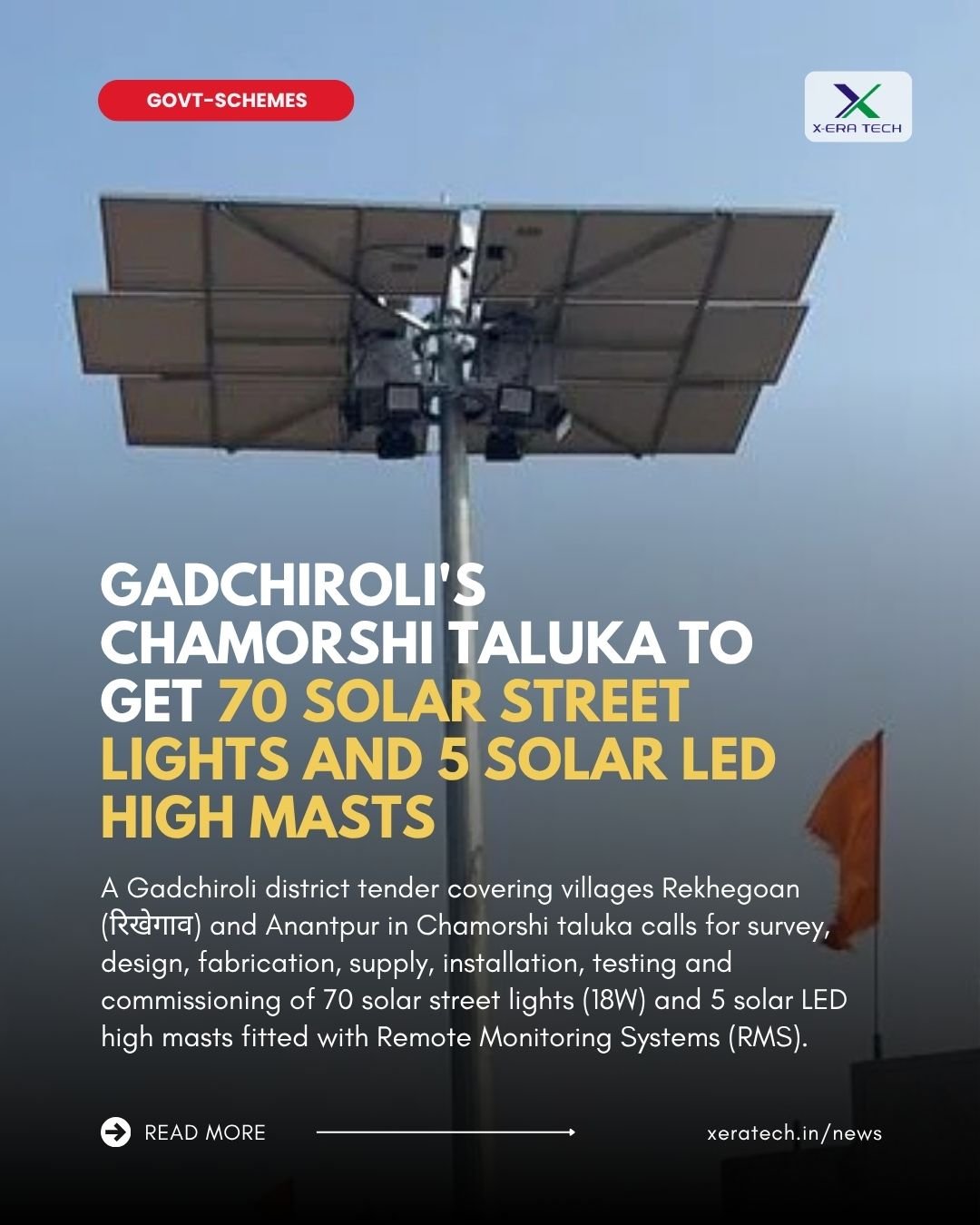
A tender covering the villages of Rekhegoan (रिखेगाव) and Anantpur in Chamorshi taluka, Gadchiroli district, calls for the survey, design, fabrication, supply, installation, testing and commissioning of 70 solar street lights (18W) along with 5 solar LED high masts fitted with Remote Monitoring Systems (RMS).
Why off-grid lighting makes sense here
Gadchiroli is one of Maharashtra's most densely forested and tribal-majority districts, and several of its village clusters still see inconsistent grid electricity, especially through the monsoon months when overhead lines are prone to outages from falling branches and waterlogging. Solar street lights and high masts sidestep this problem entirely by running on a self-contained panel-and-battery system rather than depending on the local feeder line staying up.
What RMS adds
The high mast units specified in this tender include RMS — Remote Monitoring Systems — which let the maintaining authority track each unit's battery health, panel output, and on/off status from a central dashboard rather than relying on a site visit to discover a fault. For a district with the road and terrain challenges Gadchiroli has, that remote visibility meaningfully cuts the time between a light going dark and a repair crew being dispatched.
Scale and scope
At 70 street lights plus 5 high masts, this is a village-cluster-level rollout rather than a single-site installation — enough to cover internal lanes as well as a few larger junction or market areas within Rekhegoan and Anantpur with wider-throw high mast coverage.
Certification bar
As with most MNRE-linked rural solar lighting works in Maharashtra, bidders are expected to supply BIS-certified LED fixtures and MNRE-approved solar panels, with warranty terms covering the battery and controller separately from the fixture itself.